by Nepal Yoga Home | Aug 31, 2026 | Mantra, Meditation, Yoga
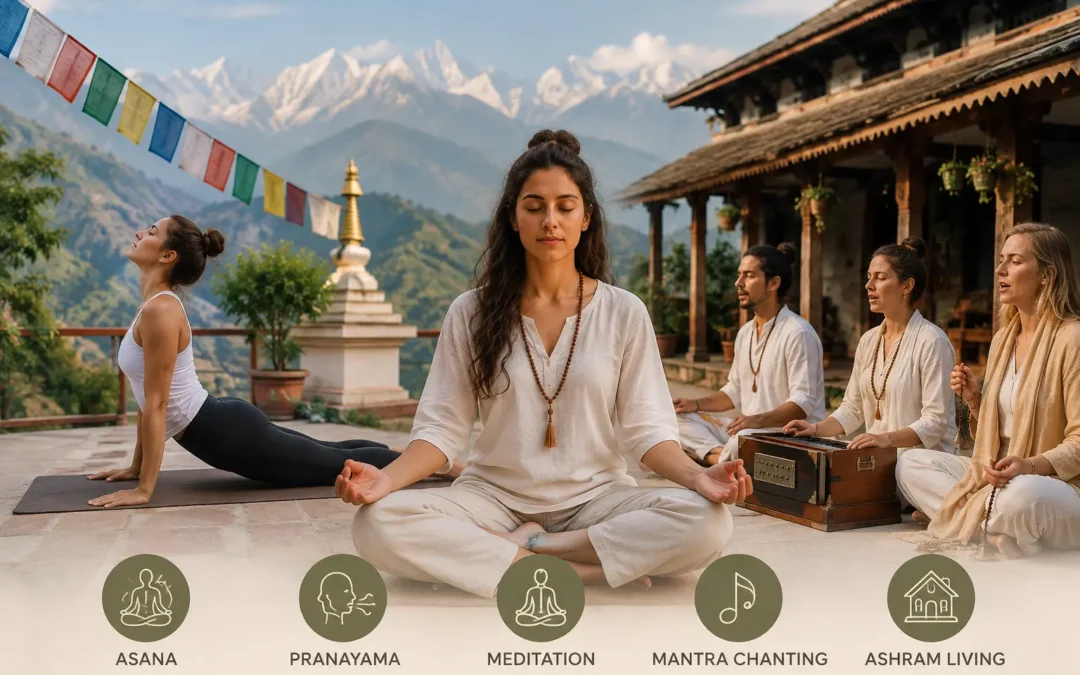
Say “yoga” to most people and a picture pops up straight away: a mat, an hour, some stretching, maybe a bit of sweat by the end. A yoga ashram in Nepal barely resembles that picture.
It takes up the whole day. Breath, posture, sitting still and chanting out loud, none of it gets treated as a separate class here. It’s all one thing, stitched together from sunrise onward.
The setting does a lot of the work too. That’s why Nepal Hoga Home is located on the hillside of the Nagarjun forest above the Kathmandu Valley, a forest that’s said to take its name from an enlightened monk who once meditated there.
This comprehensive blog is written for someone who’s never sat through a real meditation session, never chanted anything out loud, and feels a little unsure about the whole idea.
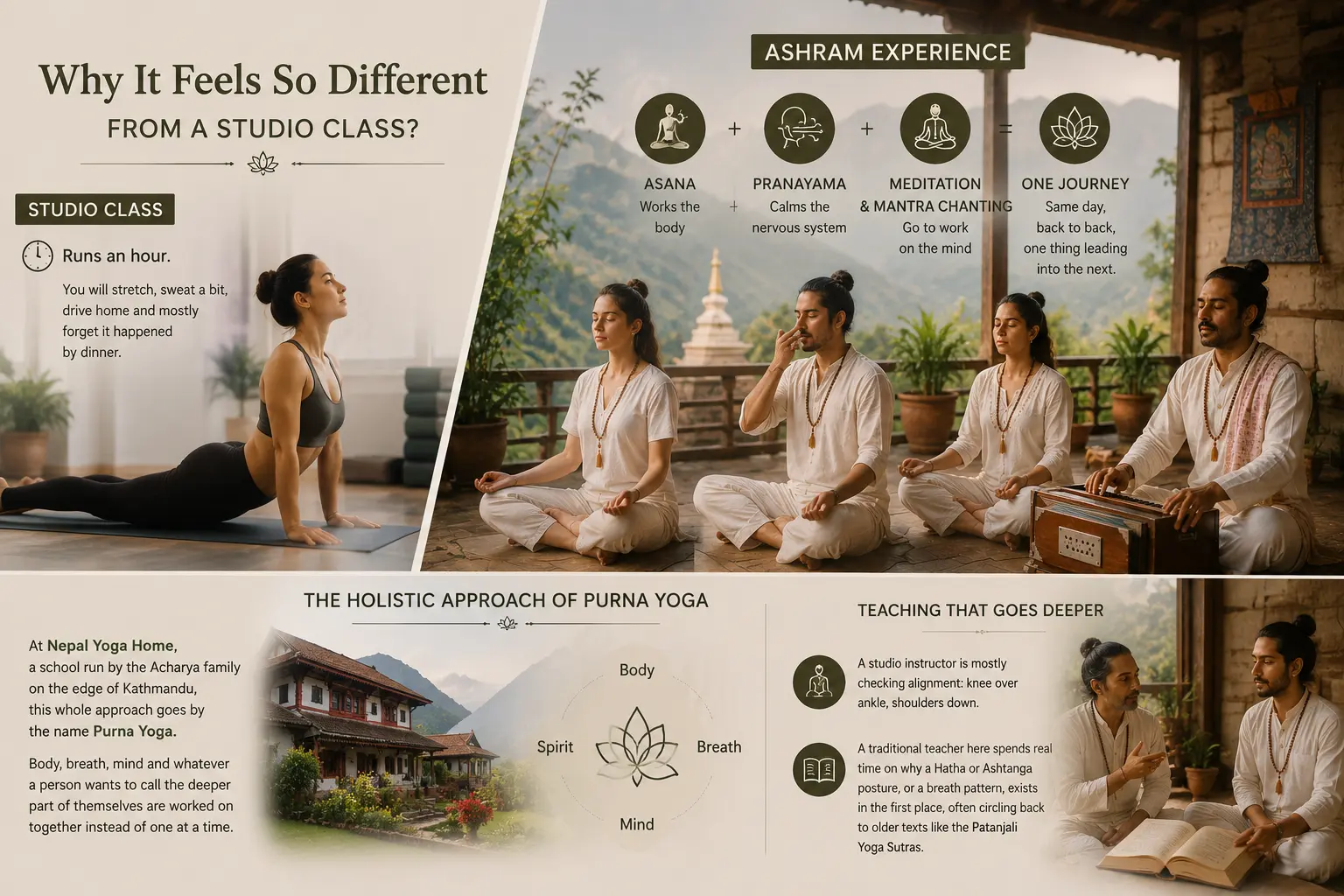
Why It Feels So Different From a Studio Class?
A studio class runs an hour. You will stretch, sweat a bit, drive home and mostly forget it happened by dinner.
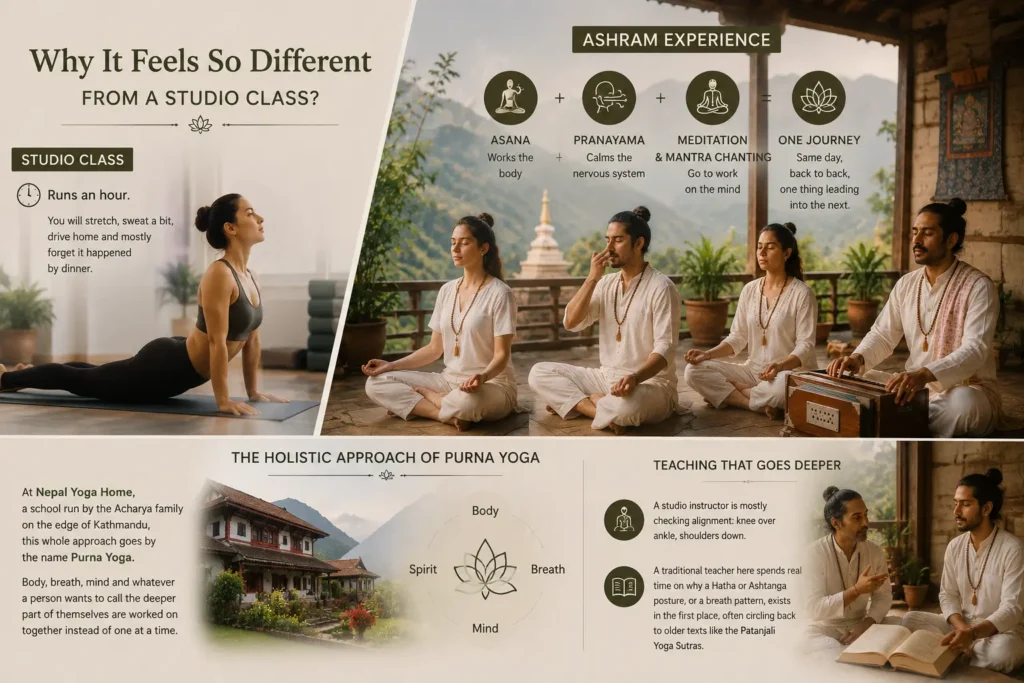
An ashram doesn’t run that way. Asana works the body, pranayama calms the nervous system down, meditation and mantra chanting go to work on the mind, and none of it is spread across separate sessions over separate weeks. Same day, back to back, one thing leading into the next.
At Nepal Yoga Home, a school run by the Acharya family on the edge of Kathmandu, this whole approach goes by the name Purna Yoga. Body, breath, mind and whatever a person wants to call the deeper part of themselves are worked on together instead of one at a time.
Even the teaching feels different. A studio instructor is mostly checking alignment: knee over ankle, shoulders down. A traditional teacher here spends real time on why a Hatha or Ashtanga posture, or a breath pattern, exists in the first place, often circling back to older texts like the Patanjali Yoga Sutras.
What Does Your Daily Rhythm Look Like?
Every ashram runs it a little differently, but the shape repeats itself almost everywhere.
| Time |
What’s Happening |
| Early morning |
Pranayama, then gentle asana as the sun comes up |
| Mid-morning |
Shared vegetarian breakfast, then philosophy or study |
| Afternoon |
Guided or silent meditation, often in the open garden set aside for individual practice |
| Evening |
Mantra chanting and a closing prayer, sometimes with singing on the rooftop afterward |
Sundays are usually off, free for a wander into Kathmandu or just sitting on the terrace with the valley spread out below.
What Happens During Meditation at a Yoga Ashram in Nepal?
A session usually opens with a few minutes of settling the breath, then moves into either guided focus or plain silence, depending on the day.
New arrivals sit for 20 to 40 minutes, and nobody’s expected to have a flawless, quiet mind on the first try. Most don’t, and that’s fine.
Longer stays, a 21-day yoga and meditation retreat for instance, build the sitting time up slowly across the days instead of dropping newcomers straight into an hour of silence.
The Sound Part: Mantra Chanting
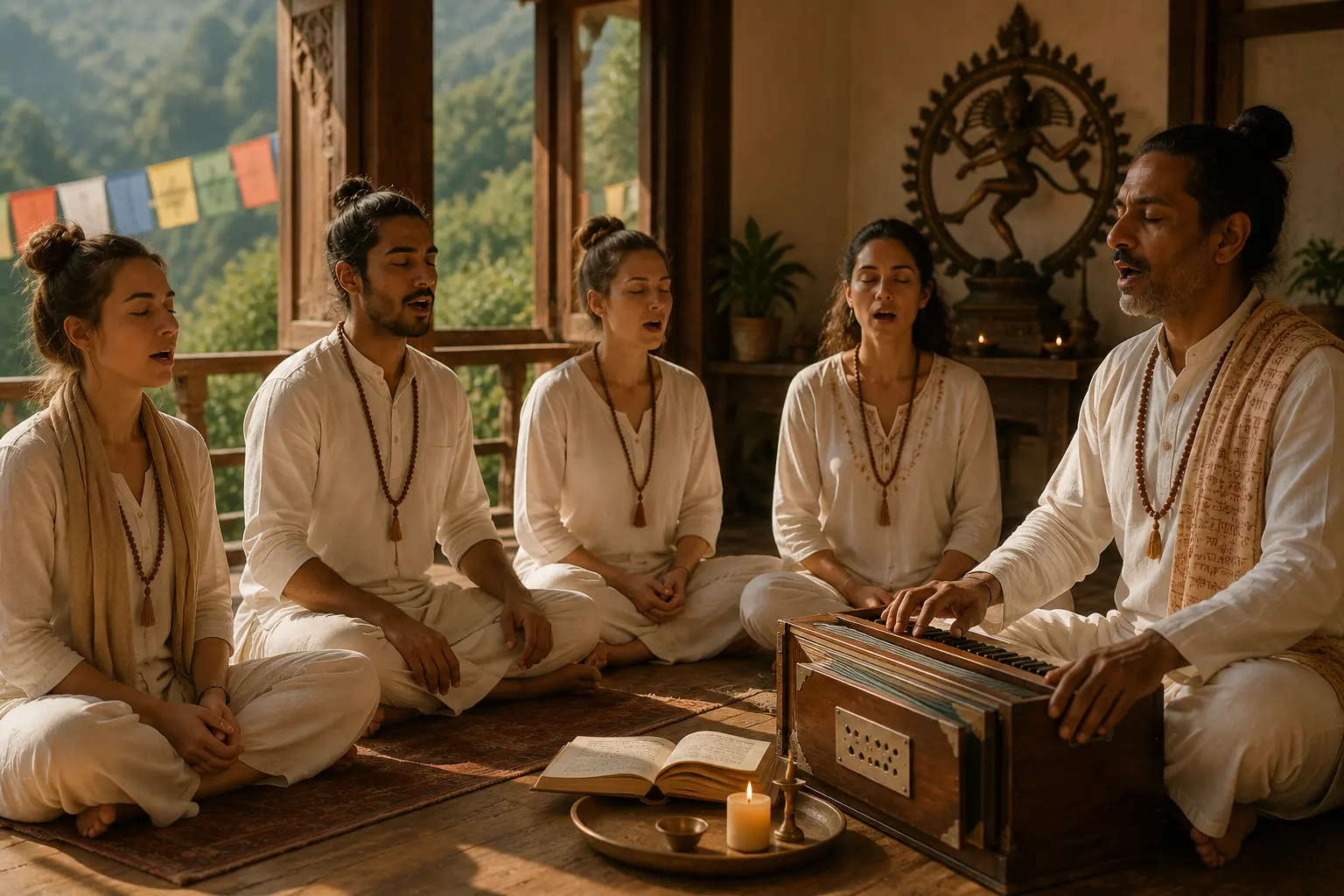
This tends to be the part that makes first-timers nervous before they even land. It looks strange right up until someone actually opens their mouth and tries it, and then, it just stops feeling that way.
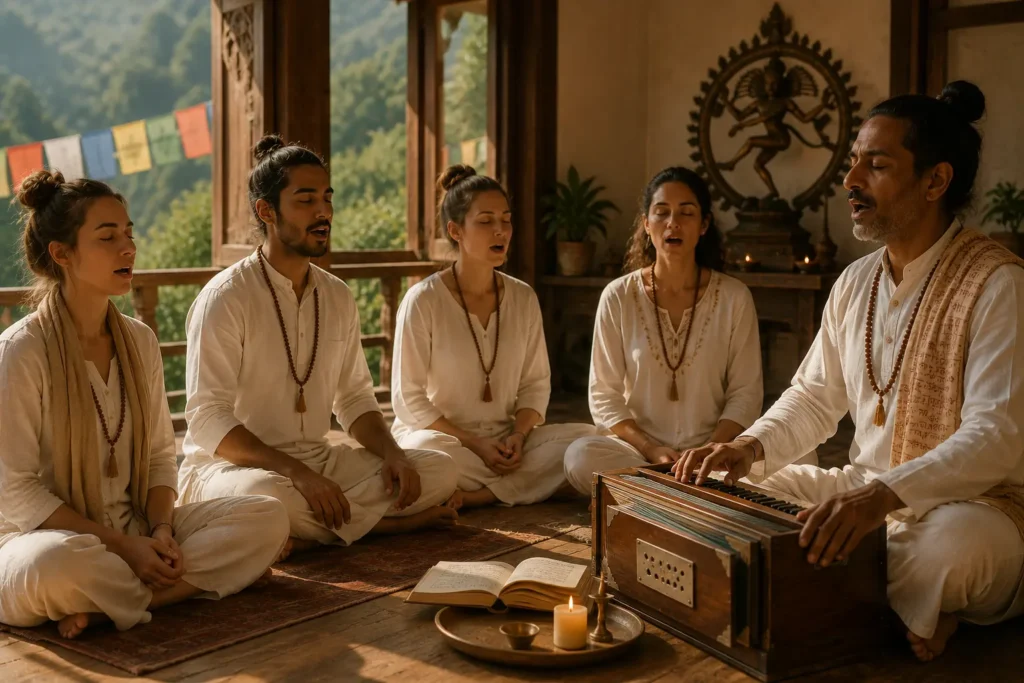
A mantra is a sound or phrase repeated with attention, nothing more complicated than that at its core. The word comes from Sanskrit, “man” for mind and “tra” for freeing, so a mantra is basically a tool for pulling the mind out of the loop it usually runs on all day.
A few that come up most often at a yoga ashram in Nepal:
- Om, the most basic sound there is
- Gayatri Mantra, chanted for clarity and wisdom
- Shanti Mantra, usually recited to close a session, asking for peace
There’s more behind this than tradition alone, as it turns out. A pilot fMRI study on PubMed/NCBI found that chanting Om out loud produced measurable deactivation in brain regions tied to stress and anxiety, an effect the researchers compared to vagus nerve stimulation therapy.
Who This Kind of Retreat Actually Suits?
People hear the word “ashram” and assume it’s only for lifelong yogis or the extremely spiritual. It really isn’t, not even close.
A few types it tends to suit well:
- Complete beginners with zero background in yoga or meditation
- Anyone genuinely burnt out and wanting real distance from a phone
- Travellers who’d rather have some structure than another loose sightseeing itinerary
- People more curious about the philosophy behind yoga than the postures themselves
- Anyone coming off a rough patch who wants a slower pace for a week or two
Anyone with a recent surgery, a serious heart condition, or an early pregnancy should mention it before booking, so the schedule can be adjusted.
There’s also an Ayurvedic doctor and massage on request, which some guests lean on to ease into the physical side of things if postures feel unfamiliar at first.
Nepal Yoga Home’s teacher training programmes and its founder, Dr. Prakash Acharya, can help work out what actually fits before anyone locks in dates.
Considering a Traditional Yoga Ashram in Nepal Retreat?
Reading about asana, meditation and mantra chanting only gets someone so far, honestly. The real shift happens the first morning it actually starts, sitting in a hall at sunrise, chanting next to a dozen strangers.
Nepal Yoga Home has been running programmes like this on the edge of the Nagarjun forest for years and holds Yoga Alliance registration for its teacher training standards.
Have a look at the retreat options, or head straight to booking if the dates are already decided.
Frequently Asked Questions
Is a Yoga Ashram Retreat Safe for Beginners?
Yes. Teachers adjust postures, breathing and meditation length based on where each person is actually starting from, so nobody’s stuck trying to keep pace with an advanced practitioner across the room. Built around meeting people where they are, not the other way round.
Anyone with a recent surgery, a serious heart condition or an early pregnancy should mention it before booking so the plan can be adjusted.
How Long Should a First Stay Be?
One to two weeks usually works best for a first visit, enough time to actually settle in rather than just get used to it and then leave. A shorter three or four day stay works as a taste test, while a 21-day retreat or a full month suits someone after a deeper reset, or planning to roll straight into teacher training afterward.
Is the Food Strictly Vegetarian?
Meals at most Nepal ashrams are simple and vegetarian. Dal, rice, seasonal vegetables and tea on tap through the day, all meant to keep energy steady through a full day of practice. Less about restriction, more about what actually works for the routine.
Can This Be Combined With Yoga Teacher Training?
Yes, plenty of people use a short ashram stay as a warm-up before a longer 200-hour teacher training course. Getting used to the rhythm, the meditation, and the chanting beforehand tends to soften the shock once the more intensive training actually begins.
by Nepal Yoga Home | Aug 30, 2026 | Yoga
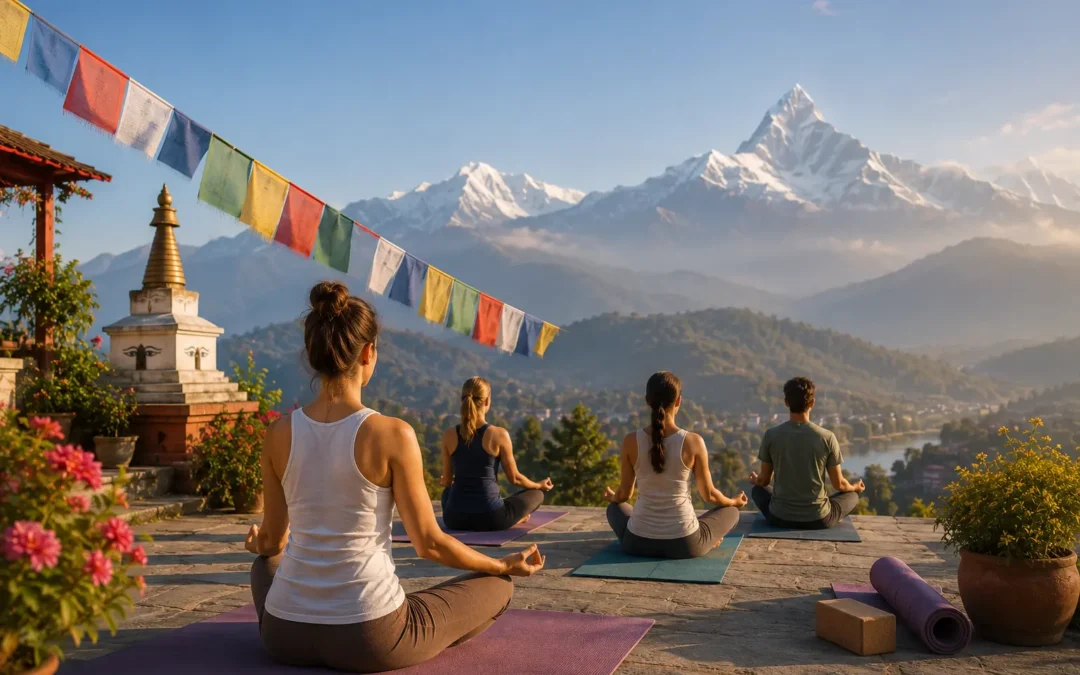
When’s the best time to visit Nepal for yoga? Honestly, it depends on what you’re after, because this country somehow has five different seasons into one year, and each one is different.
We’ve been running Nepal Yoga Home out of the same corner of the Kathmandu Valley for a good time now. Even we still get surprised by how much a single month can change the whole feel of the place.
Some months you get mountain views and trails. Other months it just pours, classes move indoors and prices quietly drop, which is honestly why a lot of students end up joining our 200 Hour Yoga Teacher Training.
By the end you should have a decent idea of which month actually fits how you want to spend your time.
Nepal’s Five Seasons Explained: Best Time to Visit Nepal for Yoga
Forget the four seasons you grew up with. Nepal runs on five, and that fifth one changes more than you’d think.
- Spring (March to May): Warm, flowers everywhere where trails are wide open.
- Summer (early June): Short, hot and kind of a warning sign for what’s coming.
- Monsoon (June to August): Rain most afternoons and hills go green.
- Autumn (September to November): The clearest skies you’ll get all year, and easily the busiest.
- Winter (December to February): Cold, dry and quiet.
Spring (March–May): Best for Outdoor Practice and Trekking
Ask ten students what they imagined before booking, and most of them describe spring without even realizing it. Daytime temperature in Kathmandu sit somewhere around 15 to 25 degrees Celsius.
The hills turn red and pink once the rhododendrons open up in March and it’s genuinely one of the prettiest things you’ll see here. Quite a few students tack on a trek too, like our Everest Base Camp Yoga Trekking program, since the trails are basically at their best. Book for two months out if you can.
Monsoon (June–August): Budget-Friendly Indoor Immersion
Monsoon scares off a lot of travelers but some of the sharpest, most locked-in students we’ve ever had came through in July.
Here’s the thing about monsoon rain, it usually falls hard and fast, mostly at night, so mornings actually come out cool and fresh.
Trails turn to mud pretty quickly, so most people during this lean into asana, breathwork and philosophy instead, which is basically the whole point of our 500 Hours Advanced Yoga Teacher Training.
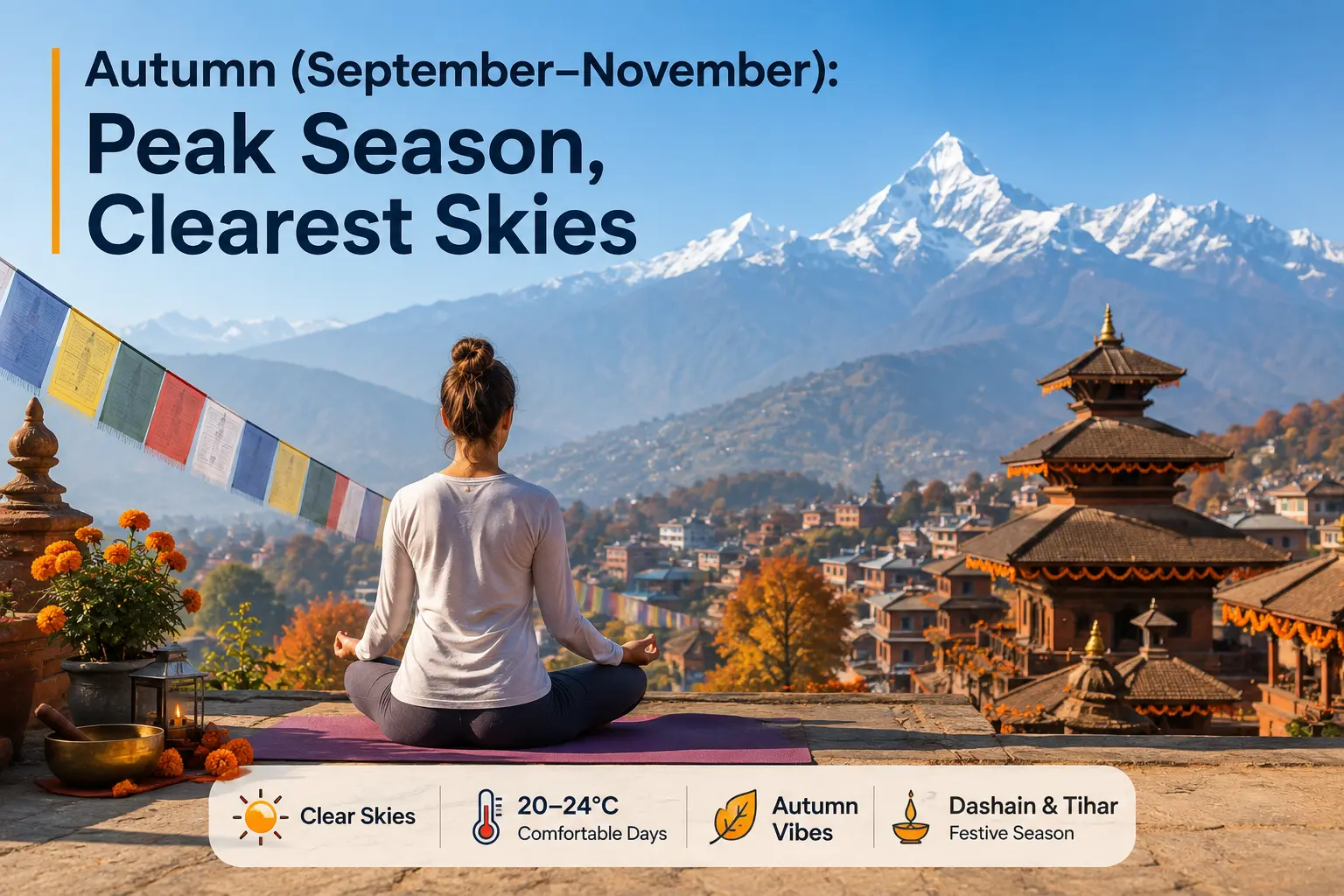
Autumn (September–November): Peak Season, Clearest Skies
Any local will tell you the same thing without hesitating that autumn is the best time to visit Nepal for yoga if clear skies are what you care about most.
The clouds burn off by mid-September and you’re left with crisp air, blue skies, and highs sitting comfortably around 20 to 24 degrees Celsius.
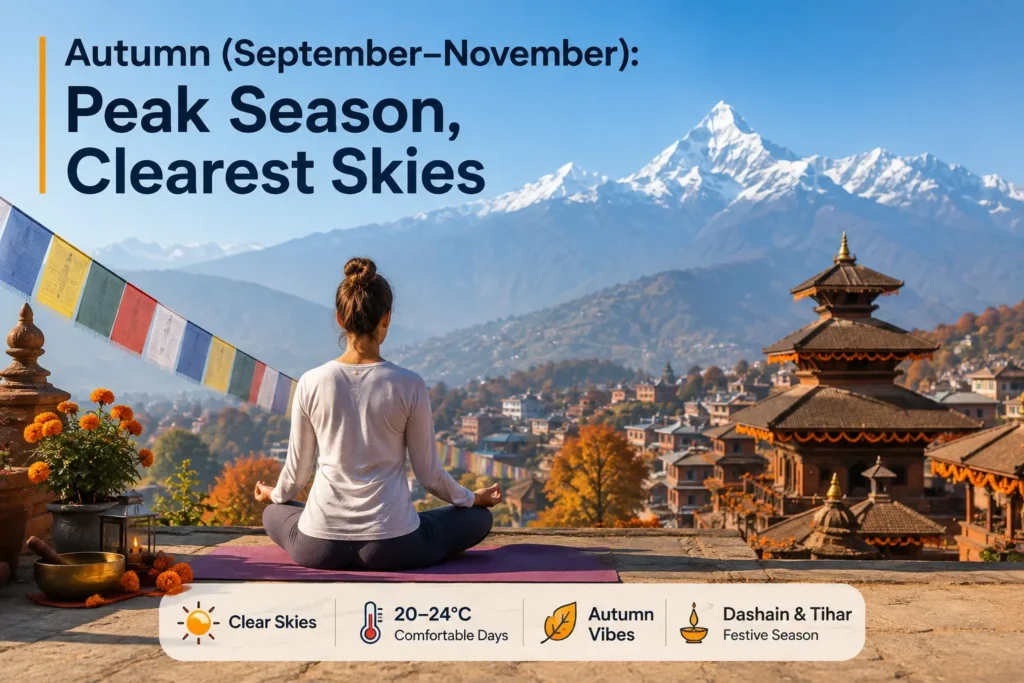
Dashain and Tihar land right in this season and it’s a whole thing. We’ve had students tell us the festival lights outside their window ended up being the highlight of their entire trip, not the yoga.
Good weather comes with a catch, though. Autumn is our busiest and most expensive stretch by a wide margin, so if a spot in our 1 Month Yoga Retreat in Kathmandu is on your mind for October, don’t sit on it too long.
Winter (December–February): Quiet, Cold and Deeply Meditative
Winter gets overlooked by a lot of first-timers, which always surprises us a bit, because it’s exactly what our returning students keep coming back for. Highs sit around 10 to 18 degrees Celsius and nights get cold enough that a shawl just won’t be enough for you anymore.
Skies stay clear for weeks at a stretch, and by this point the autumn crowds have long gone home. It’s a suitable match for our year-round 200 Hour Yoga Teacher Training, especially if you’re the type who actually wants fewer people around.
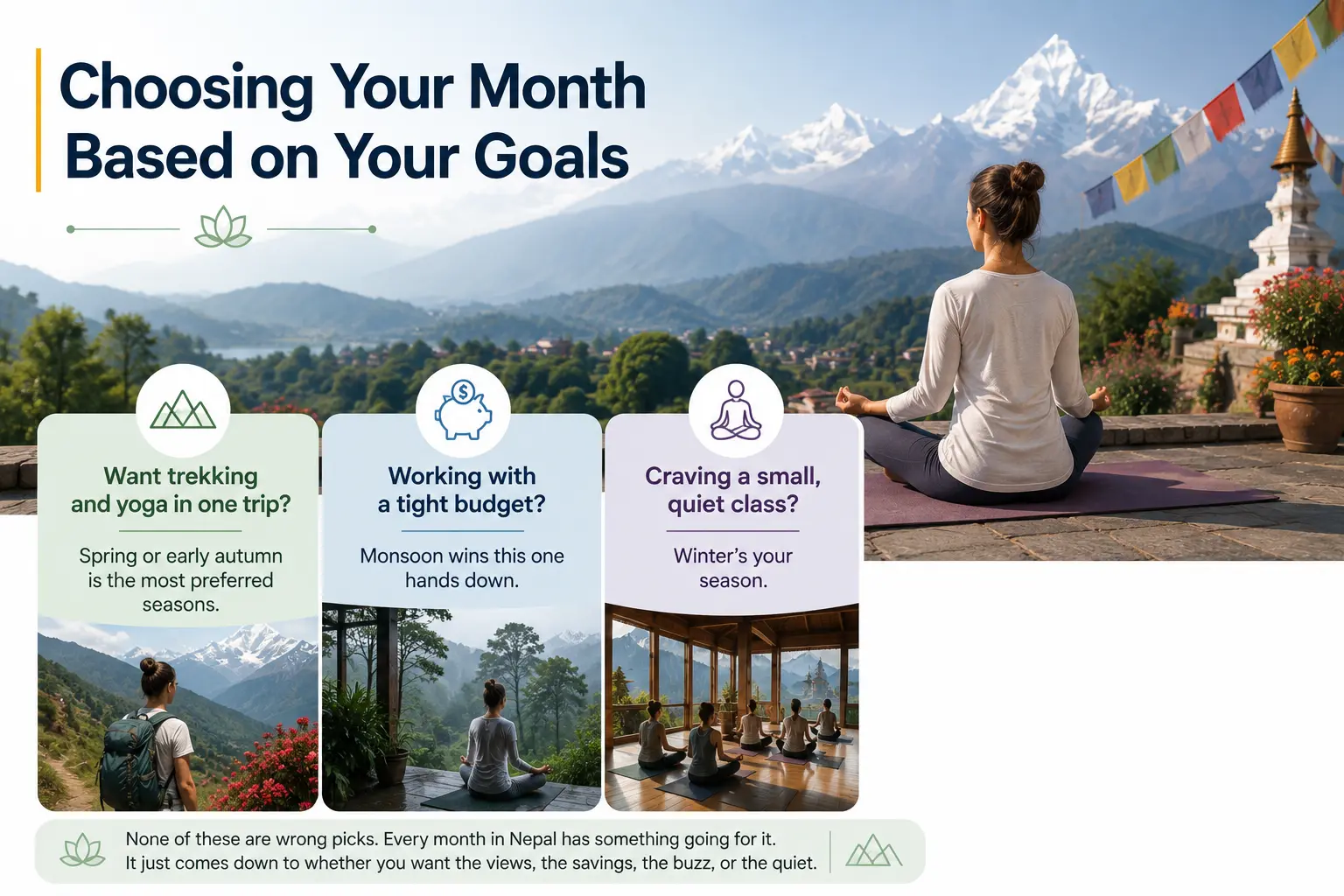
Choosing Your Month Based on Your Goals
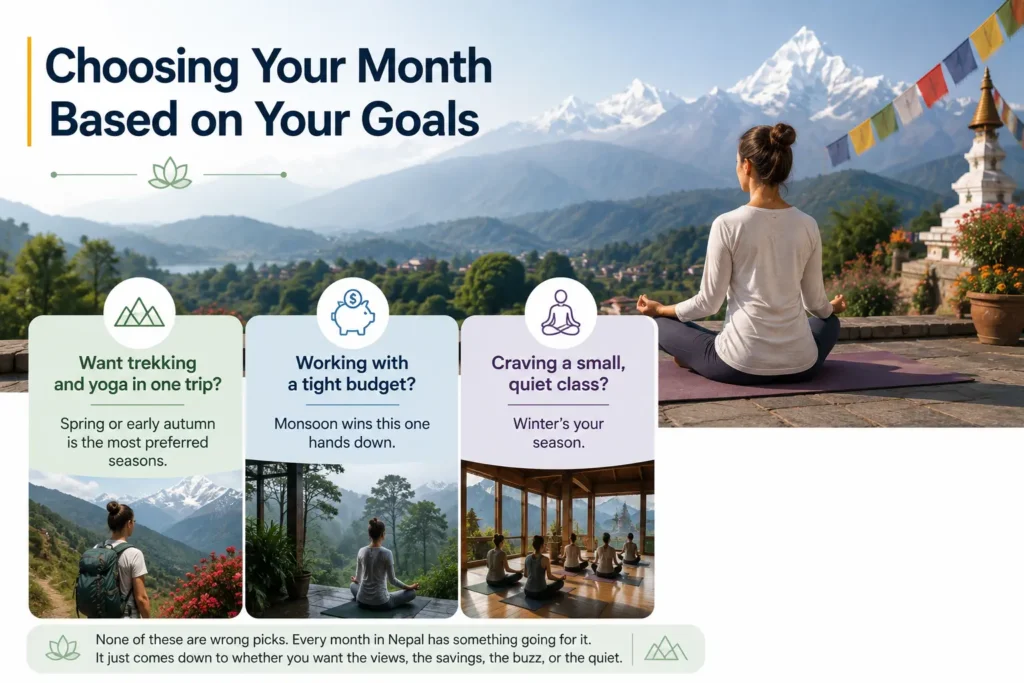
Figuring out the best time to visit Nepal for yoga gets a lot simpler once you’re actually honest with yourself about what you want. So sit with these three questions for a second before locking in any dates.
- Want trekking and yoga in one trip? Spring or early autumn is the most preferred seasons.
- Working with a tight budget? Monsoon wins this one hands down.
- Craving a small, quiet class? Winter’s your season.
None of these are wrong picks, to be clear. Every single month here has something going for it, it really just comes down to whether you want the views, the savings, the buzz or the quiet.
Why Nepal Yoga Home Runs Programs Year-Round?
A lot of schools slow way down once monsoon hits, or they cram everything into one short busy window and call it a day. We’ve never worked that way! We open our doors to new students on the first of every single month, rain or shine, no exceptions.
Our teachers show up the same regardless of what the sky’s doing that morning. A steady practice, in our experience, matters a whole lot more than whether the weather outside happens to be picture-perfect.
Come for our 500 Hours Advanced Yoga Teacher Training in the middle of a rainy July, or grab a shorter retreat in October instead. Every student trains directly with our experienced Nepali teachers, no matter which month they land in.
Conclusion
There’s no single best time to visit Nepal for yoga that works for every traveler out there, and that’s kind of the point.
Spring and autumn bring the views and the energy, monsoon and winter bring the quiet and the lower prices. Nepal Yoga Home just stays open through all of it, ready whenever you decide to show up.
Frequently Asked Questions
What is the coldest month to avoid for YTT in Nepal?
January is the coldest month we see across Kathmandu and the valley around it. It still works just fine if you’re leaning toward indoor study instead of outdoor trekking anyway. Warm layers plus our heated rooms keep the cold from ever turning into a real problem.
Can I still practice yoga in Nepal during monsoon?
Yes. Monsoon never really interferes with indoor asana, breathwork or philosophy classes. A good number of students actually tell us the quieter campus during these months helps them focus even more than usual.
Is Kathmandu or Pokhara better in winter?
Both hold up fine for winter training, if you’re wondering. Pokhara sits a bit lower in elevation, so its winters end up feeling slightly milder than Kathmandu’s do. Either city still gives you cold, clear days that work great for focused study.
by Nepal Yoga Home | Aug 29, 2026 | Yoga, yoga training and yoga courses
There’s a reason so many people search around before committing to a yoga teacher training course in Nepal: the fee itself doesn’t tell you much.
Two programs priced within a hundred dollars of each other can be worlds apart once you factor in what’s actually included. That’s why this blog covers everything from classes, the room you’ll sleep in, food, certificate to the handful of costs that tend to catch people off guard.
Nepal Yoga Home has run these courses for over 15 years and trained more than 10,000 students, so this comes from patterns we’ve noticed.
What Does a Yoga Teacher Training Course in Nepal Actually Cover?
A yoga teacher training in Nepal has to line up with Yoga Alliance requirements, so the teaching content is fairly consistent from one reputable school to the next.
Here’s what that usually means for your daily routine:
- Asana practice: Spent on alignment, adjustments and understanding how postures connect.
- Pranayama, mudra, and bandha: It is taught to you alongside the physical practice from the early days rather than crammed in at the end.
- Meditation: Here the focus is on building your own sitting practice before anyone expects you to teach it.
- Philosophy and anatomy: Going through the Yoga Sutras, subtle body concepts and the practical side of how the body moves.
- Teaching practicum: The point where you actually get in front of the group and run a class.
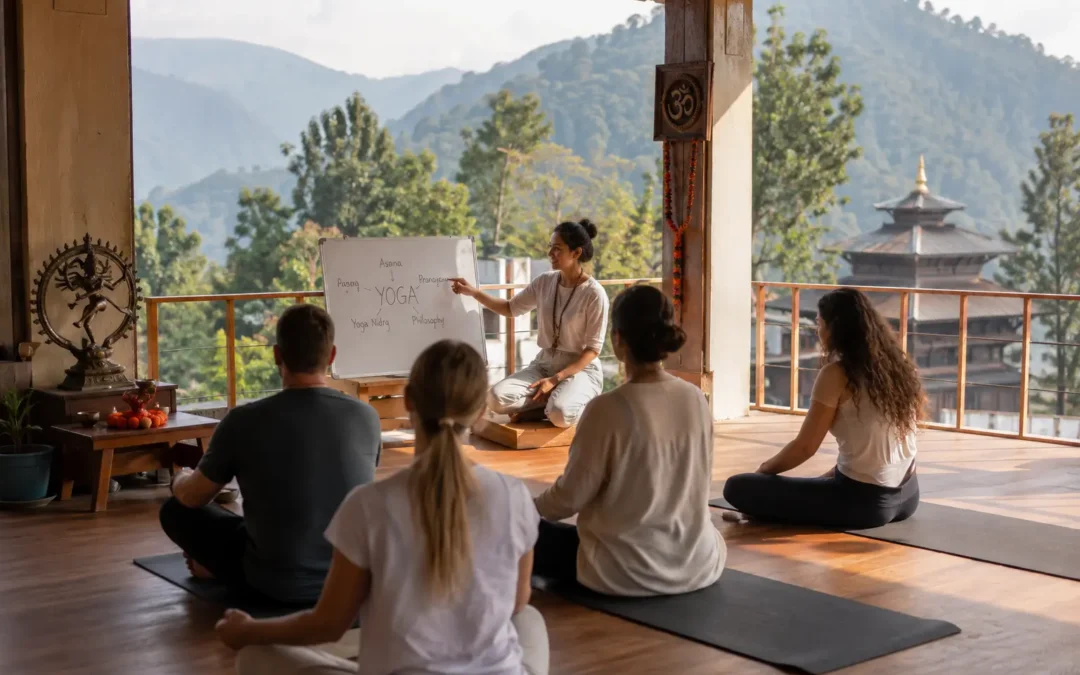
Expect two practice sessions daily with lecture blocks worked in between. For the exact hour-by-hour structure, the 200 hours yoga teacher training page has it mapped out.
Accommodation Options During Your YTTC in Nepal
Your room is almost always folded into the course price, and Nepal follows the same pattern most destinations do.
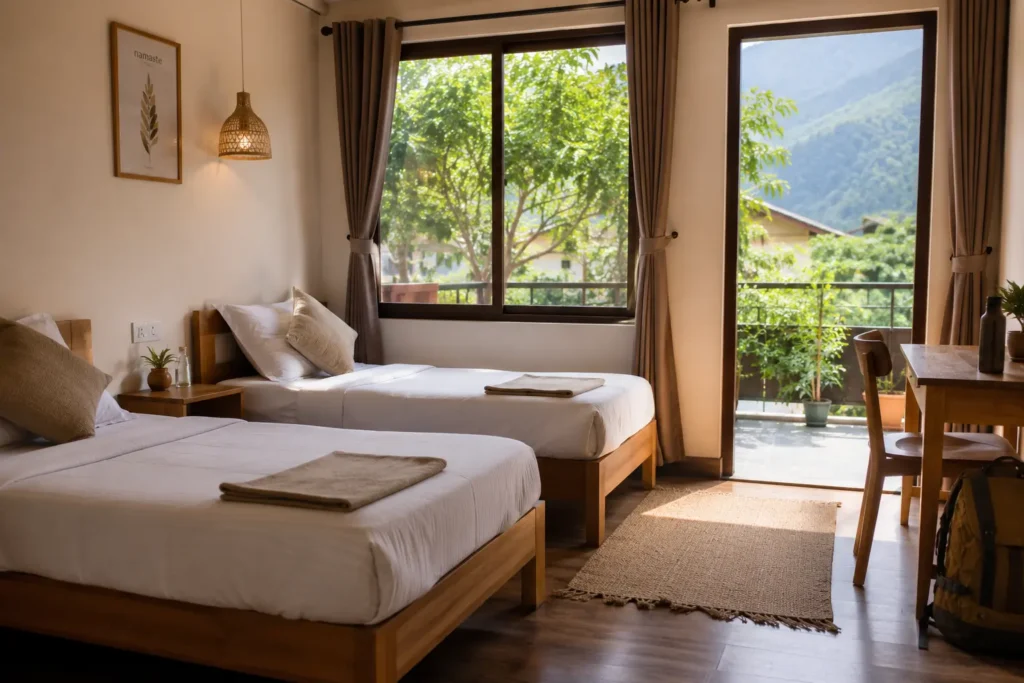
That leaves you deciding between:
- Shared rooms: The more common setup, generally with one other student, and the more affordable option.
- Private rooms: Most schools will let you add for a fee if you’d rather have your own space after a full day of practice.
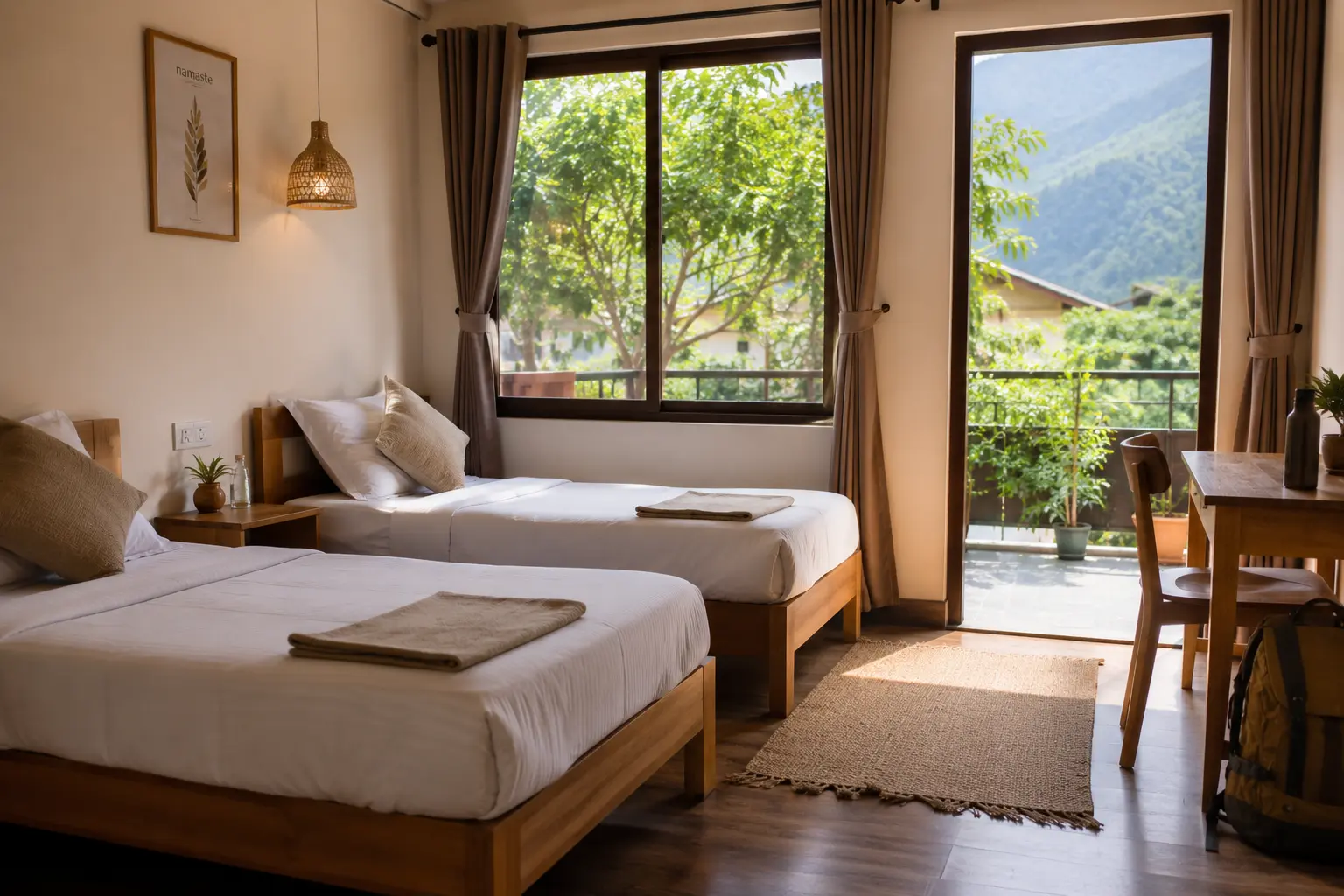
Standard rooms come with a bed, some storage, hot water and Wi-Fi, enough to be comfortable without anything extravagant.
Several schools, including this one, are positioned a little outside the main city area, which means a quieter, greener setting than you’d find closer to downtown Kathmandu.
That doesn’t sound like a big deal until you’re several days into an intense schedule and actually value the quiet. The Services & Facilities page has more on room specifics if you’re comparing options.
Meals and Food During Yoga Teacher Training in Nepal
Food is one of the more dependable inclusions in a yoga teacher training course in Nepal, though the eating style itself often takes people by surprise the first time.
Most schools follow a sattvic, lacto-vegetarian diet, keeping meals lighter than what students are used to at home.
A regular day of meals generally includes:
- Breakfast, lunch and dinner, all prepared fresh
- A tea break in the afternoon, most days
- Room for dietary needs like gluten or dairy sensitivities, provided you mention them ahead of time
Three meals and tea come standard, without an extra line item. Anyone with more specific requirements should reach out to the school before booking.
Study Materials, Certification and Extras
Finishing the program earns you a certificate that lets you register with Yoga Alliance as an RYT 200, the qualification most international studios look for before bringing on a new teacher.
Along with the certificate, schools provide:
- A manual covering the philosophy, anatomy and sequencing taught during the course
- A mat and a small set of props to use throughout your stay
- Time with instructors outside of class if something needs more explanation
A handful of schools do charge separately for mats or printed manuals, so confirm rather than assume it’s all bundled together.
What is Usually Not Included in the Course Fee?
Even a well-packaged course has its limits.
These are the costs students almost always cover on their own:
- Flights into and out of Kathmandu
- Visa fees, arranged either beforehand or once you land
- Travel insurance, which most schools will ask you to sort out yourself
- Extra nights if your arrival or departure doesn’t match the official course dates
- Optional excursions, such as sightseeing or day hikes on free time
Knowing this in advance keeps the total cost from feeling misleading once you’re already there. When you’re weighing a few schools against each other, ask each one for the exclusions in writing, not just what’s advertised.
200 Hour vs 500 Hour YTTC: What Changes in Inclusions
Room, food and study materials don’t really change no matter which course length you go with.
What shifts is how much you cover and how long the stay is:
The total price goes up with a longer course, naturally, but the daily rate tends to land in a similar bracket once you calculate it out.
Sample Daily Schedule During a Nepal YTTC
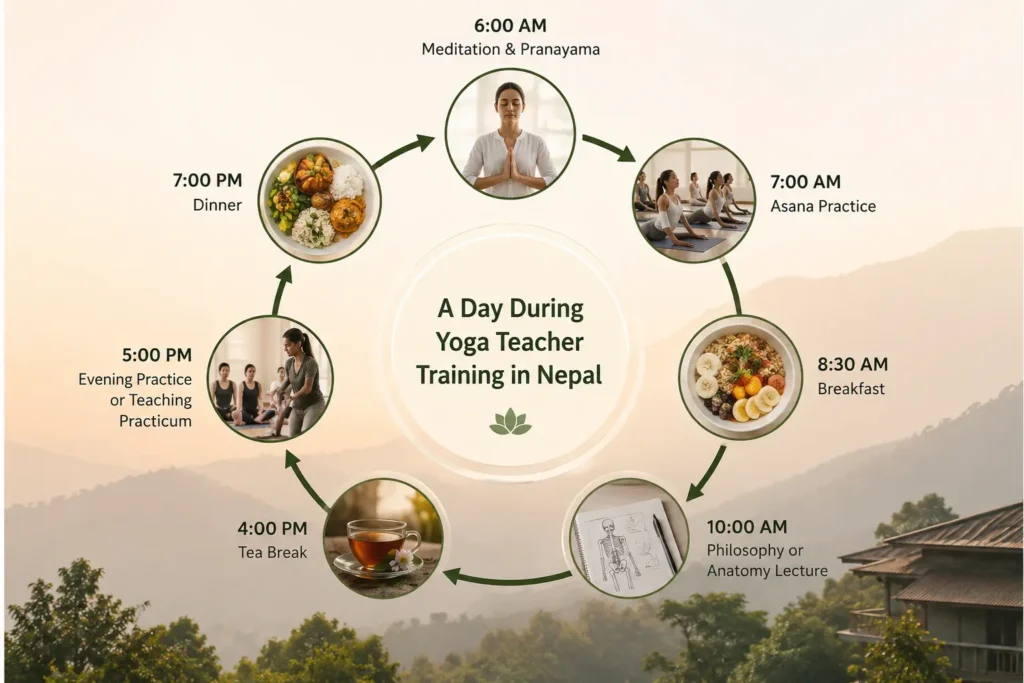
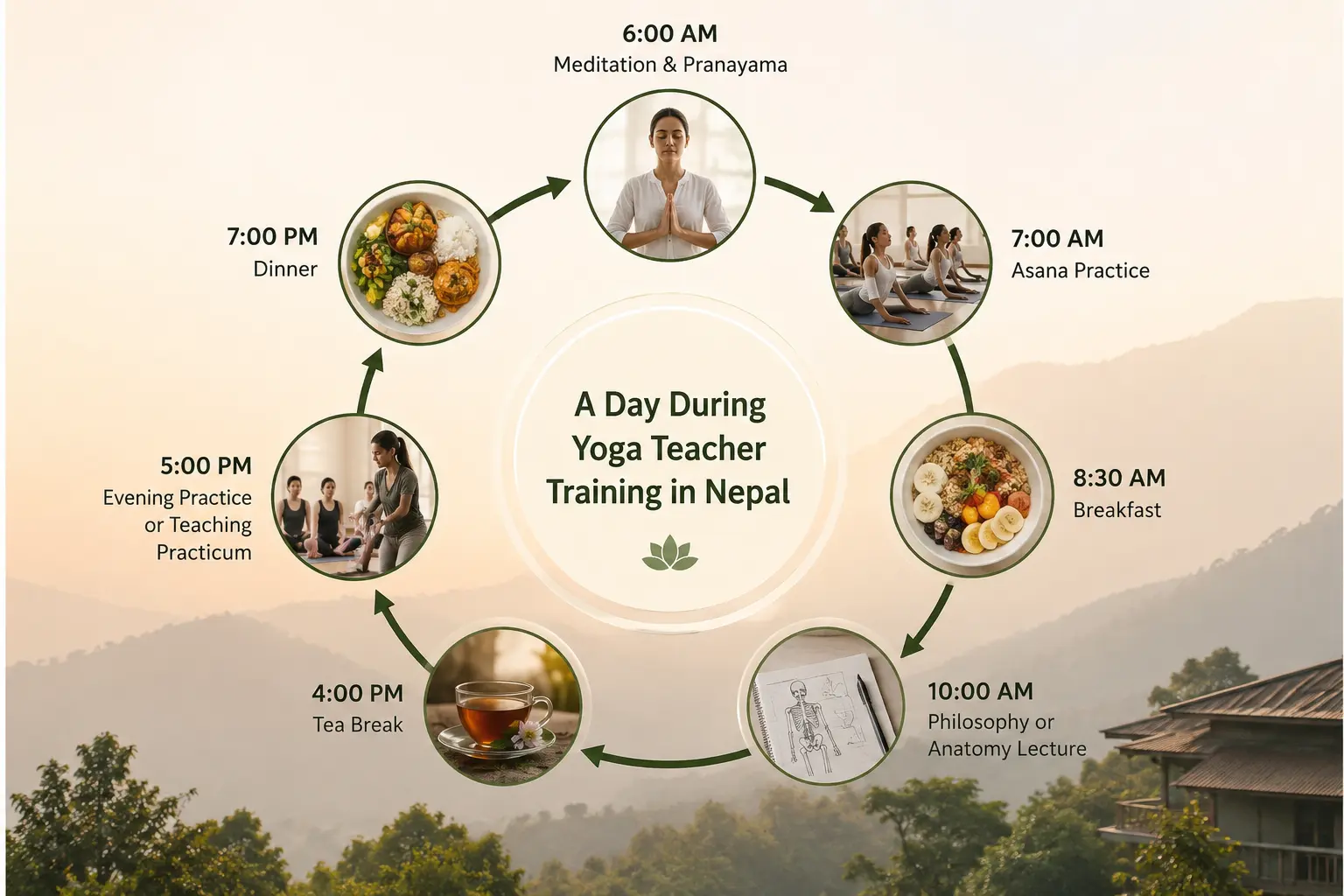
A day during a yoga teacher training in Nepal usually plays out something like this:
- 6:00 AM: Meditation and pranayama
- 7:00 AM: Asana practice
- 8:30 AM: Breakfast
- 10:00 AM: Philosophy or anatomy lecture
- 4:00 PM: Tea break
- 5:00 PM: Evening practice or teaching practicum
- 7:00 PM: Dinner
For a better sense of what those mornings actually feel like, not just what’s written on a timetable, the first-week experience blog covers it in detail.
How to Choose a School Based on Inclusions?
The lowest price you find isn’t automatically the best value once you factor in what’s actually included. A few steps worth taking before you book anywhere:
- Ask for a written list of inclusions and exclusions instead of trusting a landing page summary.
- Compare the daily cost, not the total, across schools running for a similar length of time.
- Ask about class size. Smaller batches usually mean more direct feedback from teachers.
- Check reviews from recent graduates, rather than relying only on quotes a school has selected for its own marketing.
The testimonials page has honest accounts from former students, and the teachers page shows who would actually be leading your training.
Conclusion
Understanding what a yoga teacher training course in Nepal actually includes makes choosing a school far less complicated.
Classes, your room, meals and certification are almost always part of the fee. Flights, visas, insurance and any extra nights typically aren’t included, so those need to be planned for separately.
Want to see the full details for yourself? The 200 hours yoga teacher training page lays it all out, or head to the booking page if you’re ready to reserve a spot. Anything not covered here is likely answered on the FAQ page.
Frequently Asked Questions
Is accommodation included in the course fee?
Yes, this is standard across most schools. A shared room comes as the default, with a private upgrade usually available for an added cost.
Can I upgrade to a private room?
In most cases, yes. Contact the school ahead of your dates to check availability and confirm the price difference.
Is the certificate recognised internationally?
Yes, as long as the school holds Yoga Alliance certification. Graduates can register as an RYT 200 and teach at studios worldwide that accept it.
Can I arrive early or stay after the course ends?
Most schools will accommodate this for an extra nightly charge. It’s best to arrange this early, particularly during busier booking seasons.
by Nepal Yoga Home | Aug 28, 2026 | Ayurveda, Yoga
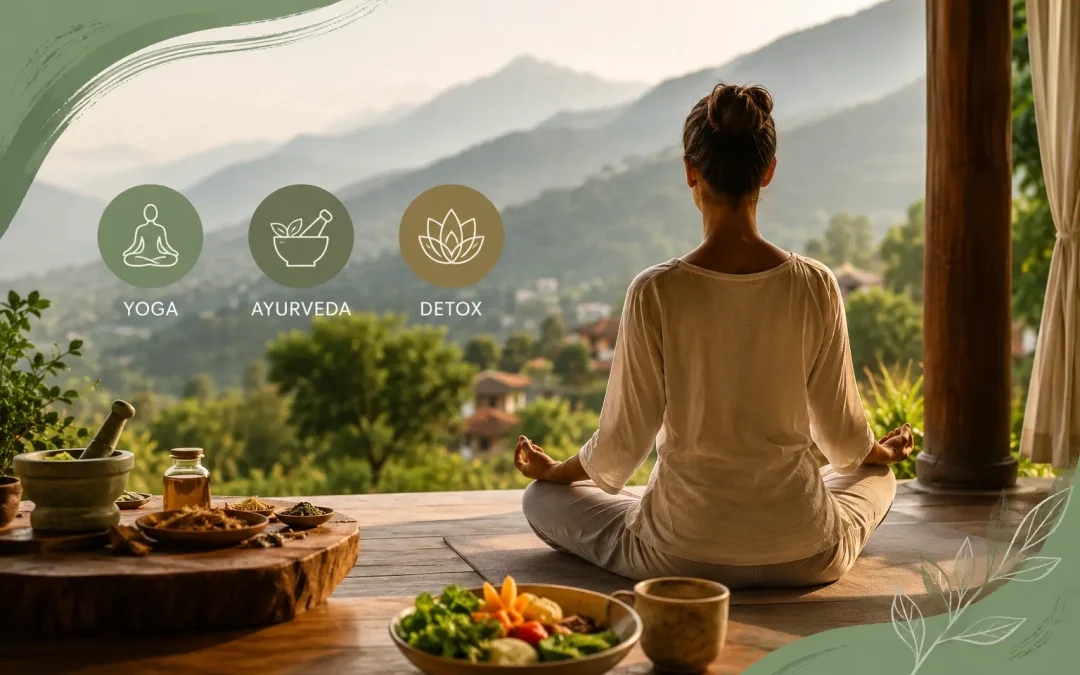
Most people arrive at an Ayurveda and yoga detox retreat in Nepal expecting a spa holiday. By the time you leave, you’ll have gone through something closer to a full reset than a few relaxing days.
That’s the real difference between a wellness weekend and a proper detox program. One relaxes you for a while. The other changes how your body handles food, stress and sleep long after you’ve flown home.
At Nepal Yoga Home, we’ve been guiding guests through exactly this kind of transformation for over 15 years, from our forested retreat centre just five kilometres outside Kathmandu, near Nagarjuna Hill.
If you’re weighing up a two-week stay against a full month, here’s exactly what to expect, day by day, therapy by therapy, so you can choose the right one for you.
What is an Ayurveda and Yoga Detox?
Ayurveda treats your body as a balance of three doshas, including Vata, Pitta and Kapha. When that balance tips, Ayurveda calls the buildup “ama,” or toxins.
These toxins aren’t just about diet. They build up from poor digestion, disrupted sleep, stress, pollution and simply living faster than your body can process.
An Ayurveda and yoga detox retreat in Nepal is built to clear that buildup using two tools together. Our Ayurvedic therapies work on the physical layer, while your yoga and pranayama sessions work on your nervous system and mind.
That pairing is what separates a genuine Ayurveda and yoga detox retreat in Nepal from a generic massage package. You won’t just get rubbed with oil and sent on your way rather, you’ll follow a plan our doctor designs specifically for your constitution.
The Opening Consultation and Dosha Assessment
Every one of our programmes starts here, not with a massage table. On your first morning with us, our Ayurvedic doctor will sit with you for a proper consultation.
They’ll check your pulse, ask about your digestion, sleep patterns, stress levels and any ongoing health concerns.f From this, they’ll determine your Prakriti and your current imbalance.
That single conversation shapes everything you do with us afterwards:
- Which therapies you’ll receive, and in what order
- The oils and herbs suited to your dosha
- Your daily diet plan
- How your yoga sessions will be paced
No two guests on our Ayurveda and yoga detox retreat in Nepal follow an identical schedule, because no two bodies arrive in the same state.
Two-Week Program: Week-by-Week Breakdown
Fourteen days is our most popular length for first-timers. It’s long enough for you to see real change, short enough to fit around a holiday or a career break.
| Phase |
Days |
Focus |
| Preparation (Purvakarma) |
1–3 |
Doctor consultation, gentle oil massage (Abhyanga), light diet to prepare your digestion |
| Core Therapy |
4–10 |
Daily Ayurvedic treatments, steam therapy, targeted yoga, dietary restriction |
| Rejuvenation (Rasayana) |
11–14 |
Lighter therapies, restorative yoga, gradual reintroduction of regular food |
The first few days are deceptively gentle. Your body needs to be prepared before deeper therapies can do any real work.
By the middle week, you’ll likely notice clearer digestion and better sleep. It’s also the week most guests find hardest, because the diet is at its strictest and old habits tend to protest.
The final days ease you back out gently, so you leave feeling lighter and calmer, with a diet and routine you can actually keep up at home. If two weeks fits your schedule best, our Two Weeks Ayurveda and Yoga Detox Course page has exact dates and pricing.
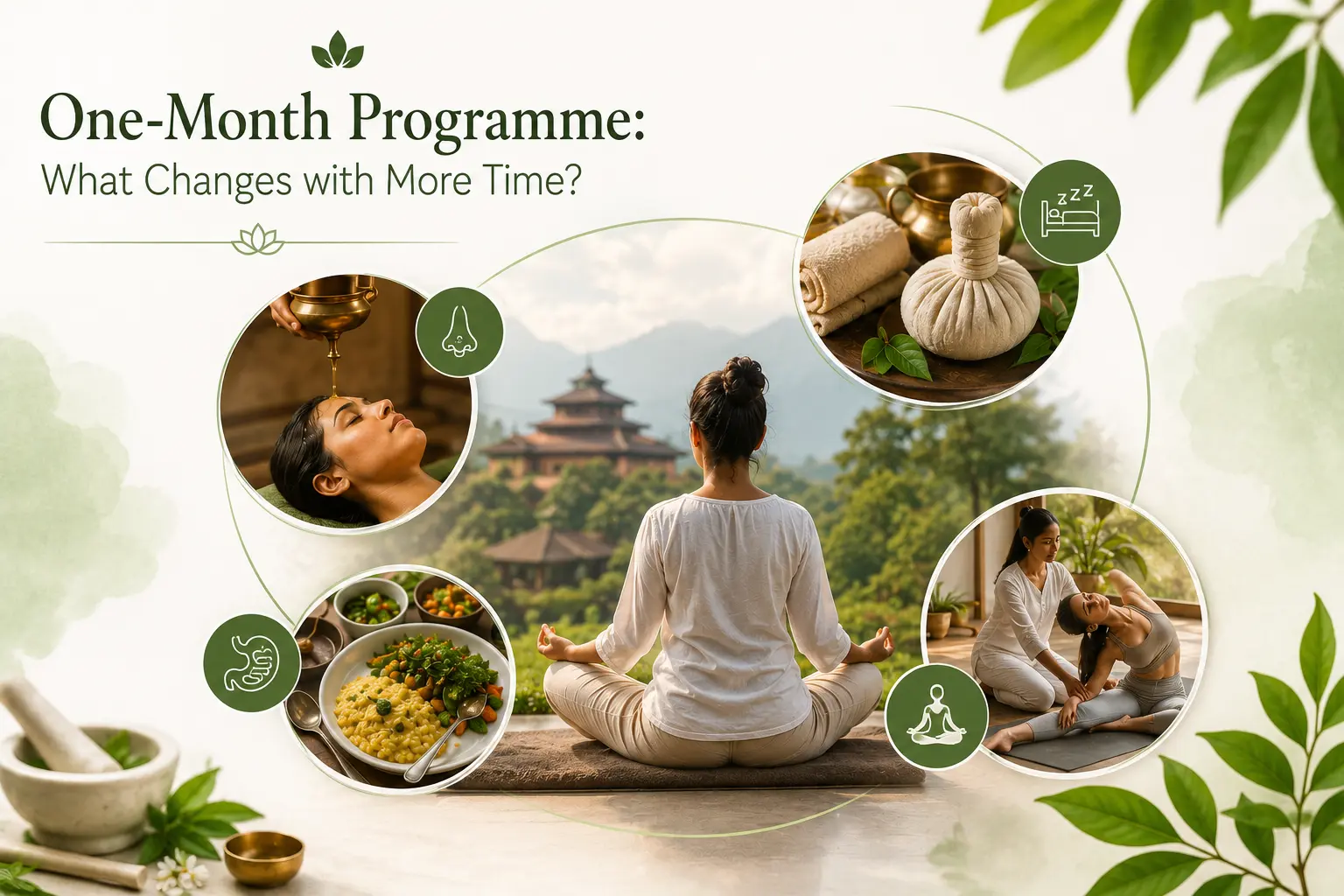
One-Month Program: What Changes with More Time?
A month with us doesn’t just double your number of therapy sessions. It changes the depth of what we can offer you.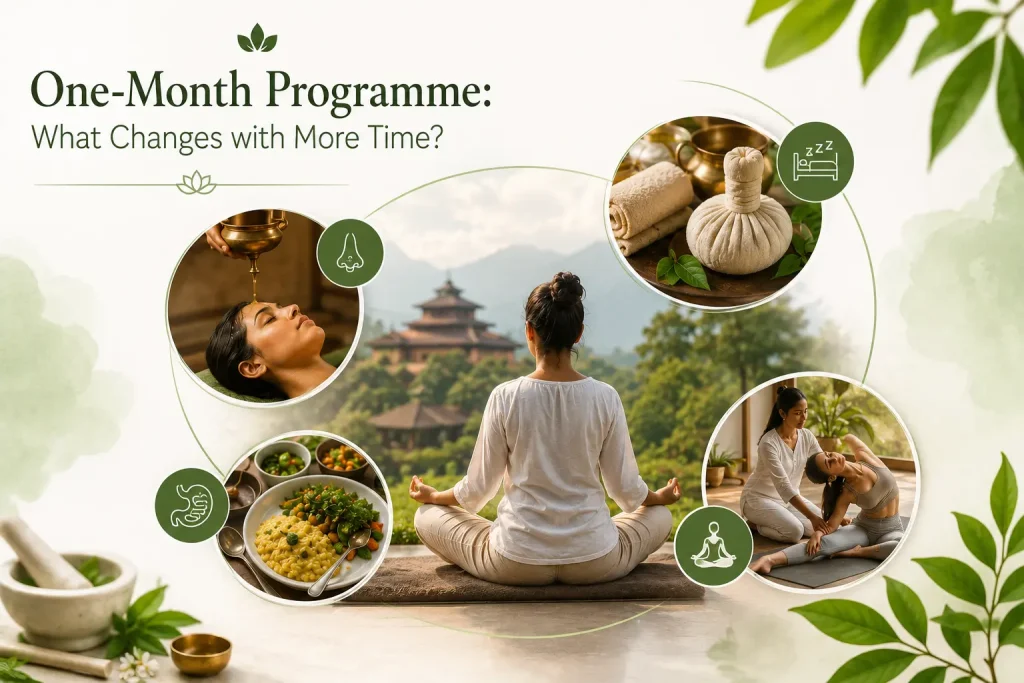
Where our two-week Ayurveda and yoga detox retreat in Nepal focuses on surface-level cleansing and dosha balancing, our one-month programme has room for full Panchakarma stages, the five classical purification therapies, applied in proper sequence rather than a shortened version.
A few things your longer stay allows for:
- Deeper Panchakarma stages, including therapies like Basti (medicated enemas) and Nasya (nasal therapy), which need a longer preparation window
- A true rest week built into your schedule, since a month of continuous intensive therapy would exhaust most bodies
- Slow, supervised food reintroduction, so your digestive fire (Agni) rebuilds properly instead of being shocked back into normal eating
- More yoga teaching time, meaning you leave with an actual home practice, not just a week of stretching
If you’ve dealt with chronic digestive issues, long-term stress or diets that never quite stuck, you’ll likely see more lasting results from the full month with us. Our One Month Ayurveda & Yoga Detox Retreat page breaks down the extended schedule in detail.
Daily Ayurvedic Therapies You Can Expect
The exact therapies you receive rotate based on your consultation, but a handful appear across nearly every Ayurveda panchakarma and yoga retreat in Nepal we run.
| Therapy |
What It Involves |
Purpose |
| Abhyanga |
Full-body warm oil massage, done by two therapists in sync |
Loosens toxins, calms your nervous system |
| Shirodhara |
A slow, steady stream of warm oil poured across your forehead |
Deep relaxation, helps with insomnia and anxiety |
| Swedana |
Herbal steam therapy following massage |
Opens channels so toxins can be flushed out |
| Marma Therapy |
Pressure applied to specific energy points on your body |
Releases blocked energy, reduces pain |
| Basti |
Medicated enema using herbal oils or decoctions |
Deep colon cleansing, mainly in our longer programmes |
None of these are spa treats, they build on each other across your days with us. That’s why committing to a full Ayurveda and yoga detox retreat in Nepal tends to give you far better results than mixing and matching short one-off treatments.
How Yoga Classes Are Adapted to Support Your Detox?
Your yoga classes here aren’t a fitness session in between treatments. We design them around whatever your body just went through on the treatment table.
- After Abhyanga or steam therapy: Gentle, restorative sequences, since your body is already working hard internally.
- On your lighter therapy days: More active asana practice, building strength and flexibility.
- Every evening: Pranayama and short meditation, to settle your nervous system before sleep.
- Toward the end of your programme: Slightly more dynamic classes, as your energy and stamina return.
Our Yoga Alliance-certified instructors check in on which therapy you had that morning before deciding how hard to push a class. It’s one of the small details that makes our Ayurveda and yoga detox retreat in Nepal feel genuinely tailored rather than templated.
Food During the Detox: What You’ll Actually Eat?
This is usually where guests worry the most, and it’s the part that surprises them the most too. You are not fasting with us.
Your meals are built around Kitchari, a simple dish of split mung beans and rice cooked soft with digestive spices like cumin, ginger and turmeric. It’s easy on your digestion and genuinely filling, not a punishment dish.
Alongside Kitchari, you can expect:
- Warm herbal teas throughout the day, chosen for your dosha
- Steamed vegetables, seasonal and locally sourced from around our retreat
- No caffeine, alcohol, processed sugar or heavy dairy during your core therapy days
- A gradual return to normal meals in your final days
Our sattvic, home-style vegetarian food is one of the things past guests mention most often in their reviews, and you’ll likely feel lighter within your first week rather than hungrier.
Who This Programme Is and Isn’t Right For?
We’d rather give you an honest answer here than a sales pitch, because Ayurveda works best when you approach it with the right expectations.
A good fit if you’re:
- Dealing with digestive issues, chronic fatigue or high stress
- A complete beginner to both yoga and Ayurveda
- Looking for a structured reset rather than a passive holiday
Worth a conversation with us first if you’re:
- Pregnant
- Living with a serious heart condition or recovering from recent surgery
- On medication that affects your digestion or blood pressure
If you’re unsure where you fit, that’s exactly what your opening consultation with our doctor is for. We’ll adjust your plan, or if it’s genuinely necessary, hold off on certain therapies rather than force a single schedule on you.
If you want something shorter as a first taste, take a look at our 10 Days Ayurveda Retreat or Four Nights Ayurveda Detox Retreat before committing to a longer stay.
According to the World Health Organization’s overview of traditional medicine, interest in evidence-informed traditional practices like Ayurveda keeps growing worldwide as people look for approaches that complement, rather than replace, modern healthcare.
Conclusion
Choosing between a two-week and a one-month Ayurveda and yoga detox retreat in Nepal really comes down to how deep you want to go, and how much time you can give yourself.
Two weeks will reset your digestion, sleep and stress levels while a full month rebuilds those foundations from the ground up, with proper Panchakarma stages and a slower, supervised return to everyday eating.
Either way, you won’t be left guessing what happens next. Your programme is shaped around you from the very first consultation, and adjusted daily as your body responds to therapy, food and yoga.
Whether two weeks or a full month suits your schedule better, the most useful next step is talking it through with our team directly. You can read what past guests experienced on our testimonials page, or head straight to our booking page to check upcoming dates.
Frequently Asked Questions
Do I need a medical reason to join an Ayurveda detox?
No. Most of our guests come simply wanting a structured reset for energy, sleep or stress, though if you have a serious existing condition, let us know while booking so our doctor can plan around it.
What’s the difference between your 2-week and 1-month programme?
It’s not just extra days tacked on. Your one-month programme allows for deeper Panchakarma stages, a built-in rest period, and a slower return to regular eating.
Will I be hungry on the detox diet?
Our Kitchari-based meals are designed to be filling, not restrictive in the way a fast would be. Most guests tell us they feel lighter, not starved.
Can I still do full yoga classes during the detox?
Your classes are adapted around your therapy schedule rather than cancelled altogether. Expect gentler sessions on heavy treatment days and more active practice when your body has the energy for it.
Is this suitable for complete beginners to yoga?
Yes. The Ayurvedic side of our programme doesn’t require any prior yoga experience, and our instructors build your practice up gradually alongside your therapy.
by Nepal Yoga Home | Aug 25, 2026 | Yoga
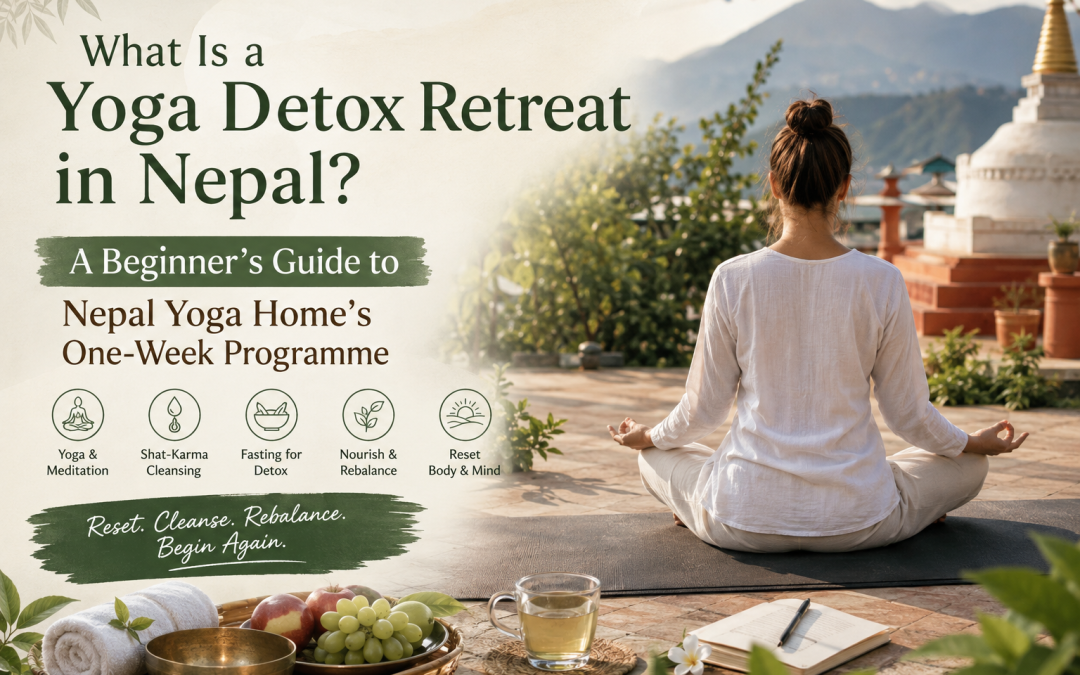
Book a yoga detox retreat in Nepal and you’ll get a confirmation email with a start date. Nobody tells you what actually happens between check-in and check-out.
This guide fills that gap, using Nepal Yoga Home’s real eight-day schedule in Kathmandu. After reading this blog, there will be no guesswork. You’ll get comprehensive information about what happens each day and why it’s arranged that way.
What Happens During a Yoga Detox Retreat in Nepal?
Three things run in parallel across the week:
- Shat-Karma cleansing techniques
- A fasting schedule that shifts daily
- Yoga and meditation sessions built into most mornings and evenings
The programme leans on six traditional cleansing methods alongside asana, pranayama and guided meditation. Every piece is placed on a specific day for a reason in your one-week yoga detox retreat in Nepal.
Most guests arrive carrying more strain than they’d admit to such as late nights, rushed meals and screens until midnight. None of it feels like a crisis in the moment, it just exists quietly until your digestion, sleep or skin starts showing it.
Only a week won’t undo years of these habits. However, it interrupts it with the help of someone actually supervising instead of you guessing your way through a fast solo.
Signs Your Body Might Want a Break
A few things tend to come up repeatedly in first-day consultations:
- Tiredness that a full night’s sleep doesn’t fix
- Frequent headaches
- Bloating digestion
- Skin that flares without an obvious trigger
- Trouble concentrating through the day
You might consider them as small things, but it adds up over years. This week exists to interrupt that buildup before it turns into a bigger problem.
Fasting itself has been studied fairly extensively outside the yoga world too. Cleveland Clinic’s overview of intermittent fasting is worth a read if you want a broader research picture.
Who Should Go and Who Should Wait?
Beginners fill most of the one-week yoga detox retreat, more than you’d guess. Plenty of guests have never fasted a single day before landing in Kathmandu.
Your first day starts with a private talk with your detox mentor, who prepares a personalised plan for the week around your history.
Here are few conditions that can rule out your retreat plan or at least call for a doctor’s approval first:
- Hernia or peptic ulcer
- Recent heart surgery
- Pregnancy
- Advanced thyroid or kidney conditions
Your age and fitness barely matter beyond that list.
Day by Day: What Your Week Looks Like
Day 1: You’ll sit down privately with your detox mentor. They’ll cover your medical history, diet and daily habits. Two sessions of pranayama and meditation is included in your day.
Day 2: You’ll learn jala neti and Kunjal Kriya. Asana and relaxation classes fill the rest of the schedule. Your meals stay light on purpose as tomorrow is heavier.
Day 3: Shankha Prakshalana happens today, a saltwater intestinal cleanse under close supervision. You’ll rest for 45 minutes afterward. Then comes khichari, rice and lentils, gentle enough for a freshly cleansed gut.
Day 4: Mono fasting starts. You’ll get three small bowls of steamed cabbage across the day. Caffeine-free tea is available whenever you want it.
Day 5: Cabbage gets swapped for apples, again in three servings. An extra cleansing step and evening pranayama round out the day.
Day 6: Water only, roughly two to three liters. The day stays quiet, low on activity.
Day 7: Soups, fruit and vegetables come back into your food. Yoga eases off in intensity as your body readjusts.
Day 8: One last morning practice wraps things up. Normal vegetarian food returns and most people head home by early afternoon.
The Cleansing Techniques
A few terms come up repeatedly and it helps to know them ahead of time:
- Jala Neti: Nasal cleansing with a small pot and saline water, simple once you’ve tried it once
- Kunjal Kriya: Clears the upper digestive tract
- Shankha Prakshalana: The day-three centerpiece, a fuller gastrointestinal cleanse
You won’t need prior experience with any of them. Your instructors will inform you about each one before it starts.
If you like checking credentials before trying something hands-on, Yoga Alliance’s school directory explains what accreditation actually means for a retreat centre.
How Does Your Food Change Through the Week?
The eating pattern isn’t a hard drop into fasting on day one. It moves in stages:
- Light meals in the first two days
- Mono fasting on day four
- Fruit-based fasting on day five
- Water only on day six
- A gradual return to normal food on days seven and eight
Skipping ahead in that order tends to backfire on people.
The slow pace is what makes the week workable if you’ve never fasted before and Nepal Yoga Home runs a longer version of the same approach through its one-month Ayurveda and yoga detox course, for anyone wanting more time.
What People Say They Feel?
Day four or five tends to be the roughest for most guests. By the final two or three days, people usually report feeling lighter and noticeably more focused than when they arrived.
Commonly reported effects include:
- Better digestion
- Sharper concentration
- Deeper sleep
- Calmer, clearer skin
- Easier breathing and less sinus congestion
- A general mood lift by the end
Nothing shows up on day one and that’s expected. Building the week in stages is what makes these shifts hold once guests get home.
If You’re Ready to Book
Current pricing and room options are there on Nepal Yoga Home’s yoga detox retreat page. Standard and deluxe rooms come in shared and private setups. If a week feels short, the yogic detoxification programme covers similar ground at a different pace. Our guests who’ve done it tend to call the week a genuine reset rather than a holiday.
Frequently Asked Questions
Is a yoga detox retreat in Nepal safe for beginners?
For most healthy adults, yes. Nepal Yoga Home welcomes every level, though pregnancy, hernias, ulcers and recent heart surgery need a doctor’s input first.
Will I be hungry the entire week?
No. Fasting builds gradually, fruit and lighter days come well before water fasting and normal food returns by day seven.
What exactly is Shankha Prakshalana?
A traditional saltwater intestinal cleanse done on day three, always under supervision. It’s not something you’d attempt alone at home.
How much does the one-week retreat cost?
It depends on room type. Standard and deluxe options exist in shared or private arrangements, with current rates listed on the main service page.
Can I combine this with a longer programme?
Plenty of guests do, adding the detox week before or after a longer retreat. Reach out to Nepal Yoga Home directly to arrange the combined dates.
Do I need yoga experience before I go?
None at all. Instructors meet you wherever you’re starting, even if this is your first week on a mat.
by Nepal Yoga Home | Aug 24, 2026 | Yoga
Nepal is where yoga started and you can feel that history in the way it’s taught here. Centers are located in quiet forests near Kathmandu or right on the lake in Pokhara, and most days move slowly, built around simple meals and long practice sessions.
Not every retreat suits every person, though. Some are built for silence and stillness, others for trekking and long hikes, so picking the wrong one can leave you frustrated halfway through.
This guide covers nine things worth checking before you book a yoga retreat in Nepal. Go through them one at a time and you’ll have a much better idea of what actually fits you.
Why Nepal Works So Well for a Yoga Retreat?
Yoga’s roots trace back to this part of the world, so the teaching style feels grounded instead of trendy or overly polished. Add the mountain views and forest settings, and practicing outdoors becomes a normal part of your day rather than something special you plan for.
Most retreats sit in one of two areas. The Kathmandu Valley is known for its temples and quiet hillsides, while Pokhara is known for its lake and the Annapurna range in the background. You can browse the full range on our Yoga Retreat in Nepal page.
1. Know Your Goal First
A retreat and a Yoga Teacher Training are two different things, and mixing them up is a common mistake. A retreat is about practice and rest. A training ends with a certificate you can actually use to teach.
| If you want |
Look for a retreat that offers |
| Rest and a reset |
Shorter, relaxed programs |
| A daily discipline |
Longer, structured schedules |
| Detox and cleansing |
Ayurveda-based courses |
| A certificate |
A Yoga Teacher Training, not a retreat |
2. Pick Kathmandu or Pokhara
Kathmandu Valley retreats usually sit on forest hillsides, close to temples and not far from the airport, which makes arrival day a lot easier. Pokhara feels different. You get lake views with mountains in the distance and more tourist infrastructure close by if you want it.
If you’d rather stay active, trekking retreats pair yoga with actual hiking. Our Everest yoga trekking and Annapurna yoga trek programs both combine daily practice with real trail time in the mountains.
3. Choose the Right Length
Most people do better starting short before jumping into a longer yoga retreat in Nepal. You’ll know a lot more about what you actually want after even a few days.
4. Match the Style to Your Body
Not every yoga style suits every body, and this is where a lot of people end up picking the wrong retreat. Hatha moves slowly and works well for beginners. Ashtanga and Vinyasa move faster and ask more of you physically, and you can read more about those on our Vinyasa yoga and 10-day Ashtanga retreat pages.
Dealing with an injury or old pain? Our Therapeutic Yoga program is built for that. Older travelers often do better with the gentler pace of our Seniors Yoga course, and anyone chasing real quiet should look at our Monastery Yoga Retreat.
5. Check Who’s Teaching
Look for Yoga Alliance certification rather than just a long bio full of years of experience. Class size matters too. Smaller groups mean the teacher can actually correct your form instead of just calling out poses from the front.
Reading real feedback helps more than most people expect. Check our Testimonials page, and you can also get to know the instructors ahead of time through our Teachers page.
6. Look at Food and Rooms Too
Vegetarian meals are pretty standard at most centers in Nepal, but it’s still worth asking if they can handle specific allergies or restrictions. Room setup matters more than people think as well. Shared and private rooms come at different prices and change how the whole stay feels.
Small things like hot water, wifi rules, and laundry access get overlooked until you’re actually there and need them. You can see our full setup on the Services & Facilities page.
7. Time It With the Season for Yoga Retreat
| Season |
Months |
What to Expect |
| Spring |
March to May |
Clear skies, warm days |
| Autumn |
Sept to Nov |
Best overall weather |
| Monsoon |
June to Aug |
Rain, more classes moved indoors |
| Winter |
Dec to Feb |
Cold nights, quieter centers |
Spring and autumn are the easiest months to plan a trip around, since the weather stays fairly predictable and outdoor practice rarely gets cancelled.
8. Compare What’s Included in the Price of Yoga Retreat
Most packages include accommodation, meals, and daily classes as the baseline. Extras like spa treatments, visa fees, and travel insurance usually cost more and don’t always get mentioned upfront, so ask before you pay a deposit.
Detox focused programs such as our 1 Week Yoga Detox Retreat or Ayurveda Detox Course tend to cost a bit more because of the added therapies. Stress relief programs like the 2 Week Stress Management Retreat often bundle counseling sessions into the price too.
9. Sort Out the Practical Stuff
Nepal offers visa on arrival for most nationalities, but check the current rules before booking flights since these things do change. Getting travel insurance that actually covers your retreat dates matters more than people realize, and it’s one of the first things people skip.
If you have an injury, are pregnant, or have had a hard time with meditation in the past, mention it to the organizers before you arrive rather than after. It also helps to get the deposit and cancellation policy in writing so nothing gets confusing later.
Before locking in your dates, check our FAQ page for common questions, then head over to Booking to reserve your spot. If you’d rather ease into things slowly, our Holiday Yoga Meditation Retreat is a decent middle ground.
Final Thoughts
Choosing the right yoga retreat in Nepal really comes down to matching your goal, your schedule, and your budget to the right program. Skip that step and even a beautiful setting won’t fix a retreat that’s wrong for you.
Work through the nine points above one at a time. By the end, you’ll know exactly what kind of retreat you need and where to book it.
FAQ
What’s the difference between a yoga retreat and a Yoga Teacher Training?
A retreat is for rest, practice, and personal time with no certificate at the end. A Yoga Teacher Training follows a set curriculum and leads to a Yoga Alliance-recognized certificate.
How long should my first yoga retreat be?
Start small, like 3 days or a week. You’ll get a real feel for the pace and style before signing up for anything longer.
Kathmandu or Pokhara, which is better?
Kathmandu gives you forest quiet and temples close by. Pokhara gives you lake views and mountains in the background. Both work well, it just depends what you’re after.
Do I need yoga experience to join?
No, most yoga retreat welcome complete beginners along with advanced practitioners. Just tell the organizers your level ahead of time so they can plan accordingly.
What’s usually included in the price?
Accommodation, meals, and daily classes come standard in most packages. Spa treatments, visa costs, and travel insurance are usually separate charges.
Is a retreat safe for older adults or people with injuries?
Yes, as long as you mention it before you arrive so the schedule can be adjusted. Our Seniors Yoga and Therapeutic Yoga programs are built specifically for that.
What’s the best time of year to go?
Spring and autumn give you the clearest skies and most comfortable weather. Monsoon and winter are quieter seasons but come with rain or cold, depending on where you go.