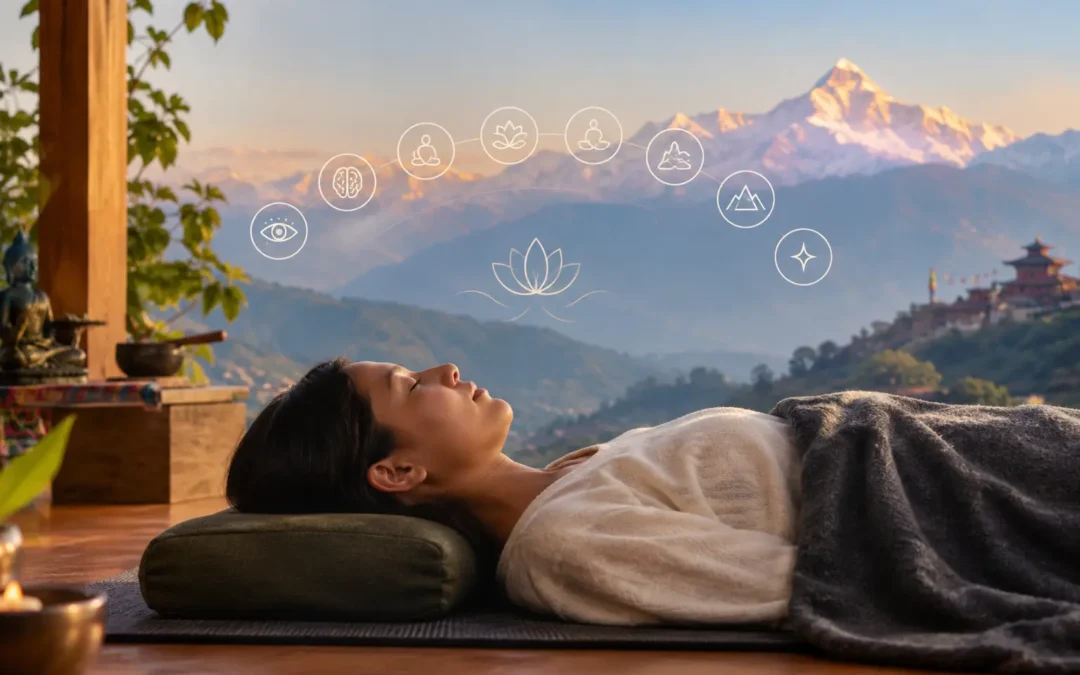
Yoga nidra for deep sleep is the kind of thing you find at 2 a.m., scrolling through your phone because sleep just isn’t happening. It’s a strange in-between place, not quite awake, not quite asleep either.
It doesn’t knock you out the way a pill would. It just clears the noise that was keeping you up.
That’s a small difference, but it matters. A lot of people try everything else first, melatonin, white noise apps, cutting off screens at 8 pm and only find yoga nidra afterward, usually wishing they’d found it sooner.
So here’s a detailed information on what yoga nidra for deep sleep is, why it works on the body, and the eight stages that make up an actual session. We’ll also get into how it’s taught at a real yoga school in Nepal, where none of this has been shortened for an app.
What is Yoga Nidra for Deep Sleep?
The name translates to “yogic sleep” in Sanskrit. You’re not actually asleep. You’re lying still with your eyes closed, fully conscious, while someone talks you through a fixed sequence of steps.
The Sleep Foundation notes that it requires almost no physical movement at all, which is probably why it works for people who find sitting meditation restless or just plain boring.
At Nepal Yoga Home, it isn’t treated as a five-minute cooldown included at the end of an asana class. It gets taught as its own thing, something students carry with them well after the course wraps up.
Why Does Your Body Actually Respond to It?
There’s real physiology behind this, not just good vibes.
A few things tend to happen during a session:
- The nervous system shifts out of fight-or-flight
- Cortisol drops fairly quickly
- Breathing and heart rate slow down without you trying
- Brainwaves ease from busy beta patterns into slower alpha and theta ranges
One 2021 study in the Journal of Alternative and Complementary Medicine looked at people with insomnia after a single yoga nidra session and found a real drop in negative mood. Most participants said they’d want to do it again.
The 8 Stages of Yoga Nidra for Deep Sleep
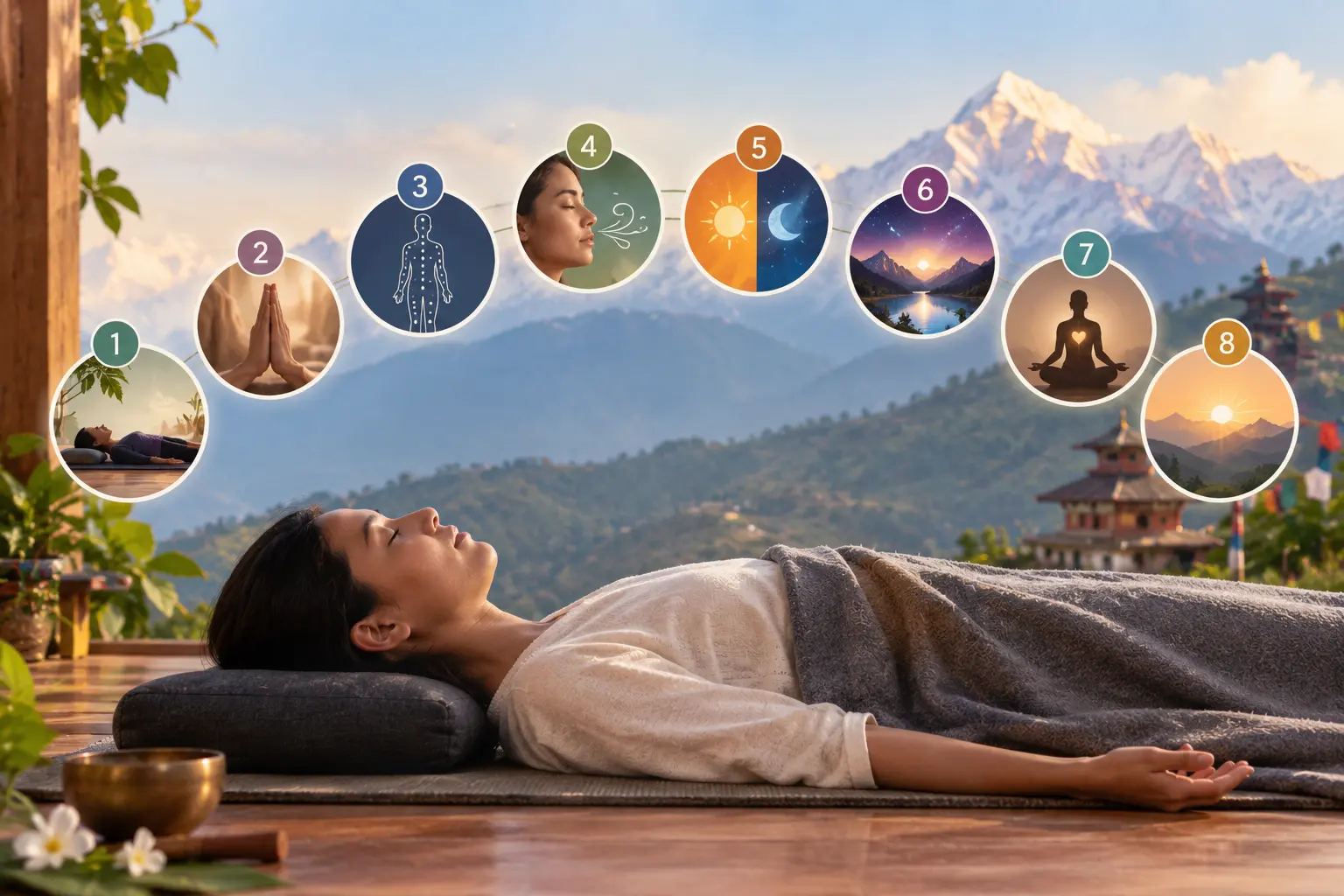
Nothing about a proper session is random.
Each stage sets up the next one, including:
- Preparation: Lie down in Shavasana, corpse pose, and just settle.
- Sankalpa: Set a short personal intention, silently, to yourself.
- Rotation of Consciousness: The teacher moves your attention through the body, part by part.
- Breath Awareness: Notice how you’re breathing. Don’t try to change it.
- Sensation and Opposites: Feel contrasts, heavy versus light, warm versus cool.
- Visualization: Mental imagery keeps the thinking mind occupied and out of the way.
- Repeating the Sankalpa: Same intention, now sitting much deeper in a relaxed state.
- Externalization: You’re eased back to full waking awareness.
Trying to learn all eight from scattered YouTube videos gets confusing fast. The Yoga Nidra Training in Nepal program covers each one properly, with guided practice built into every day.
Yoga Nidra, Meditation and Regular Sleep Aren’t the Same Thing
People mix these up constantly. Sitting meditation asks you to stay upright and alert while holding your focus on something.
Yoga nidra flips that, you’re lying down, being led, which honestly takes way less effort to keep up with. Moreover, regular sleep just switches your awareness off completely.
Yoga nidra sits in its own lane because a thread of awareness stays on the whole time, even while the body drifts into something close to deep sleep. That’s the part most people find odd the first time. It’s also usually the part they end up liking best.
Who Does Yoga Nidra for Deep Sleep Actually Helps?
It’s not just for insomniacs, even though that’s the group that finds it first.
If you’re going through any of these, it can be helpful for you:
- Anyone with chronic or broken sleep
- People carrying anxiety that won’t quiet down at night
- Shift workers stuck on an unusual sleep schedule
- Athletes trying to recover faster between hard training blocks
- People working through past trauma, sometimes paired with trauma management training
How It’s Taught in Nepal?
Nepal treats this differently than the West tends to. It’s not marketed as a sleep hack here, it’s one piece of a much older approach to yogic relaxation, taught next to pranayama and yoga philosophy, not instead of them.
At Nepal Yoga Home, the location does some of the work on its own. Classes run near the forested slopes of Nagarjuna Hill, just outside Kathmandu, well away from traffic noise.
Much of the teaching style traces back to Yoga Guru Dr. Prakash Acharya, whose own background is in classical Himalayan yoga rather than a trimmed-down modern version of it.
Nobody just plays a recording here and calls it done. Students learn the logic behind the order of the stages, and eventually how to shift things around once they’re the ones teaching.
What a Yoga Nidra Teacher Training in Nepal Looks Like Day to Day?
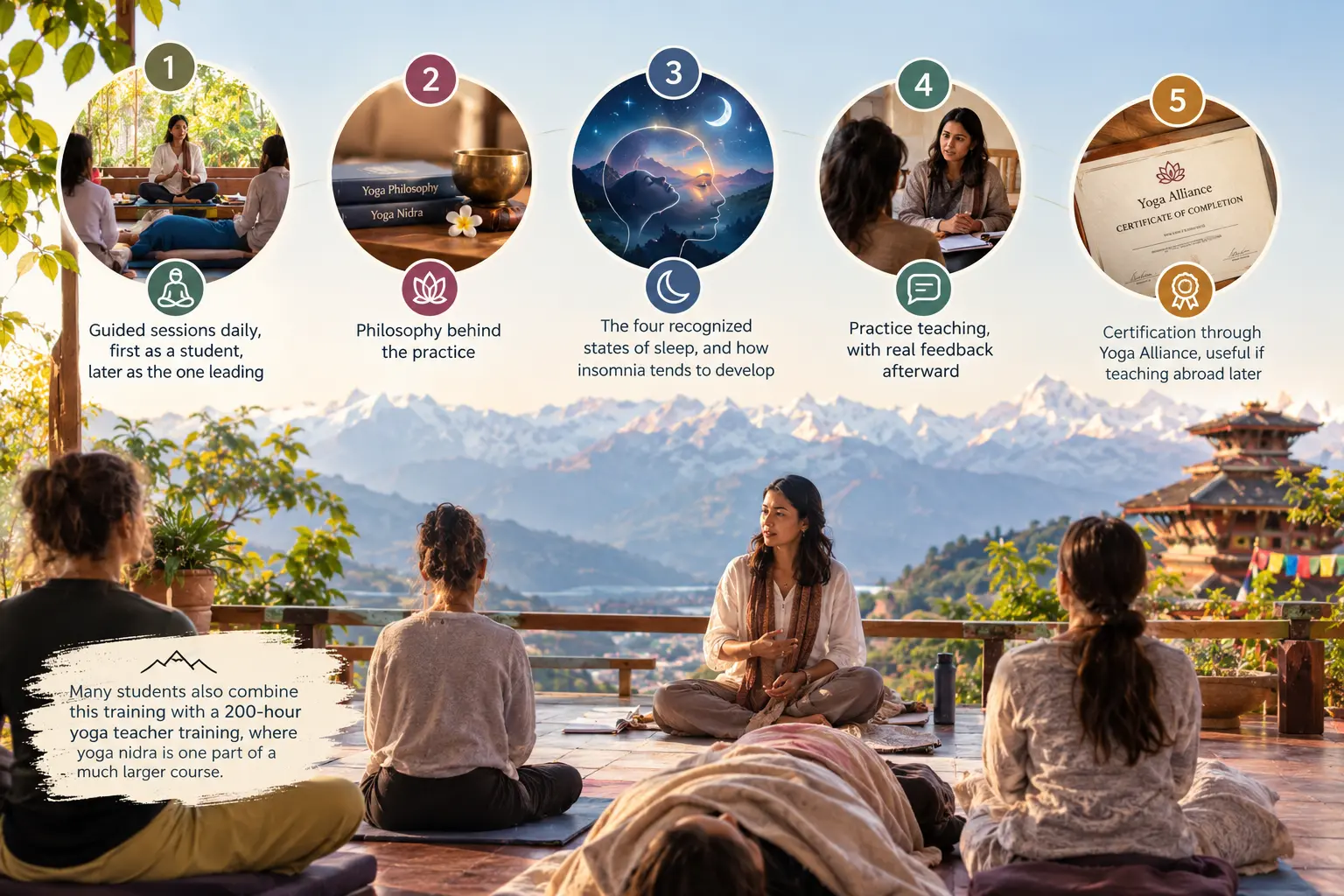
If training is more your goal than just practicing at home, here’s what’s typically involved:
- Guided sessions daily, first as a student, later as the one leading
- Philosophy behind the practice
- The four recognized states of sleep, and how insomnia tends to develop
- Practice teaching, with real feedback afterward
- Certification through Yoga Alliance, useful if teaching abroad later
A good number of students combine this with the 200-hour yoga teacher training, where yoga nidra for deep sleep is one piece of a much larger course.
A Short Version You Can Try Tonight
Just try this short version before your bedtime tonight:
- Lie on your back, arms loose at your sides, palms up.
- Close your eyes. Take three slow breaths.
- Silently set an intention, something like “I’m calm and I’ll sleep well tonight.”
- Move your attention from your toes up to your head, slowly.
- Let your breathing settle back to normal on its own.
- Stop trying. Just let sleep take over whenever it’s ready.
If that helps even a little, doing it every day at a yoga retreat in Nepal gives it room to actually work, rather than squeezing it in between everything else in your day.
Why Learn It at Nepal Yoga Home
A recorded app session can only take you so far. There’s a difference between that and a teacher who’s spent years refining exactly how they pace their voice and guide a room.
Nepal Yoga Home has run yoga programs in Kathmandu for more than fifteen years now, and yoga nidra shows up throughout several of them, including the 500-hour advanced yoga teacher training for anyone wanting to go further than a single module.
Frequently Asked Questions
What are the 8 stages of yoga nidra?
Preparation, sankalpa, body scan, breath awareness, sensation and opposites, visualization, a second sankalpa and externalization. They run in that order for a reason, so skipping around doesn’t really work the way it might in other meditation styles.
Can yoga nidra for deep sleep actually fix insomnia?
Not overnight. But stick with it for a few weeks and a lot of people notice they fall asleep quicker and wake up less through the night.
How long does a session need to be?
Anywhere from 20 to 45 minutes for a full one, though even 10 minutes works fine when you’re starting out. Doing a short version regularly beats a long one every once in a while.
Do I need yoga experience first?
No. There’s no posture work involved, so complete beginners can start on their very first try without feeling behind.
Is training in Nepal recognized outside the country?
Yes. Nepal Yoga Home is registered with Yoga Alliance, so the certification travels with you. Plenty of former students have gone home and started teaching their own classes using exactly what they picked up here.