by Nepal Yoga Home | Sep 18, 2026 | Yoga
Someone rings a small bell outside the meditation hall a little before 6 am. It’s still dark, cold and nobody in the group looks especially thrilled about it, though nobody’s complaining out loud either.
That’s roughly what mornings look like at a yoga ashram in Nepal, minus the filtered sunlight and neat rows of mats you’d see on a studio’s Instagram page.
Here in this blog, we have covered what an ashram actually is, what a real day feels like and who can be better off skipping it.
What Does the Word “Ashram” Actually Mean?
Ashram is Sanskrit, it means a shelter for spiritual work, which is a fair bit different from how the word gets used now. Back when the term first meant something, a student lived close to their teacher, followed a fixed routine, and treated discipline as the entire reason for being there. Comfort wasn’t really part of the deal.
A lot of what’s marketed as an ashram today skips most of that. The ones actually worth your time in Nepal still hold onto the old version pretty closely, meaning basic food, a set schedule, and not much room for negotiation.
Nepal Yoga Home lays this out fairly directly on its goals page, which honestly says more than most retreat sites bother to.
Yoga Ashram vs Retreat vs Studio: What’s the Real Difference?

These three get used all the time interchangeably, and that’s usually where things go sideways for people booking their first trip.
| Setting |
Structure |
Best For |
| Yoga studio |
Drop-in classes, no fixed schedule |
Locals or short visits wanting a single session |
| Yoga retreat |
A few days to a few weeks, guided but flexible |
Travelers wanting yoga plus some free time |
| Yoga ashram |
Full daily schedule, community living and simple food |
People wanting deep, disciplined practice |
One thing that’s a bit unusual: Nepal Yoga Home runs all three at once. Their services and facilities page breaks down what each option actually includes, so you can show up for one class, book a short retreat, or move in for the full ashram experience. Whichever matches how much structure you’re actually willing to put up with.
Why Nepal Is a Serious Place for Yoga Ashram Living?
India tends to get all the attention when this topic comes up, and sure, that’s the older tradition. But Nepal built its own version alongside it, shaped by Himalayan and Buddhist practice going back a long way, not just borrowed.
Kathmandu Valley still has pockets that haven’t been paved into a parking lot. Nagarjuna Hill is a good example. Forested, close enough to reach in fifteen minutes, but far enough from the traffic that it might as well be a different city.
Also worth checking the teachers page before booking. Who’s leading your sessions changes the whole experience more than the scenery ever will.
Your Day Inside an Ashram
This is the part most brochures conveniently leave out:
- Wake-up somewhere around 5 or 5:30am
- Meditation or breathing practice
- Asana session
- Simple vegetarian breakfast
- A philosophy or theory class
- Rest, or time for personal study
- Another asana or workshop block later in the day
- Evening satsang, chanting, or meditation
- Lights out, usually by 10pm
Not a lot of gaps in there. That’s not an oversight, it’s basically the whole method. One 5am wake-up won’t change much about a person but even of them back-to-back tends to.
There’s more on this on the meditation page, but the short version is the schedule itself does most of the teaching.
What Food Looks Like in a Yoga Ashram?

Meals lean satvik with fresh, vegetarian, light on onion and garlic and not much spice. None of that’s because those ingredients are bad, it’s more that heavy or stimulating food works against the calm the whole routine’s aiming for.
If you’re coming off a typical Western diet, this is usually the hardest adjustment of the entire stay, harder than the physical yoga most days. Give it three or four days before deciding it’s not for you.
The yoga detox retreat is basically built around this shift, and past guests bring up the food change more often than anything else when asked what surprised them.
Who Should Actually Consider a Yoga Ashram in Nepal?
Not everyone should do this, and any website telling you otherwise just wants the booking.
Here are a few people who can consider a yoga ashram in Nepal:
- Beginners who genuinely want structure rather than content for later
- Burned-out professionals after something closer to an actual reset
- Long-term students working toward a yoga teacher training course
- People who can go a week without checking their phone every ten minutes
If what you actually want is downtime and flexibility, a lighter option like the therapeutic yoga retreat is probably a better fit for you.
Final Thoughts
A yoga ashram in Nepal isn’t a lounge chair with a green juice sitting on the armrest. It’s built around discipline, plain food and a decent amount of discomfort in the early days, and that discomfort is honestly doing most of the heavy lifting.
The people who walk away changed usually aren’t the most experienced yogis in the room. They’re the ones who got up at 5am without making a production of it, ate the same simple meal and sat through boredom instead of grabbing their phone out of habit.
If you’ve made it this far and the idea still sounds appealing rather than exhausting, that’s probably a good sign. From here, either the yoga retreat programs at Nepal Yoga Home or the booking page is the next reasonable step.
Frequently Asked Questions
Is a yoga ashram in Nepal only for religious people?
No. Guests come from every kind of background, religious or not, and nobody’s asked to sign onto any belief system to stay there. Most people treat it as personal discipline rather than worship, so plenty never engage with the spiritual side beyond the daily practice itself.
How long should a first stay be?
A few days up to a week is usually enough to get a feel for it without blowing your whole trip on something you’re unsure about. After that, you’ll have a much better sense of whether a longer program or a full teacher training is worth the money, and the FAQ page covers the boring but necessary logistics, visas, transport and payment.
Is ashram life physically hard?
Yes. The wake-up time combined with a packed schedule catches nearly everyone off guard in the first couple of days, and that stretch tends to be the low point of the whole stay. Most people say it eases up noticeably by around day five, once the body stops fighting it.
Can I leave the ashram grounds during my stay?
Depends on the program, but there’s usually a bit of free time or an occasional outing worked into the week somewhere. It’s not a lockdown situation, though it’s also not really built for independent sightseeing, so plan a few extra days before or after if exploring Kathmandu is actually on your list.
by Nepal Yoga Home | Aug 31, 2026 | Mantra, Meditation, Yoga
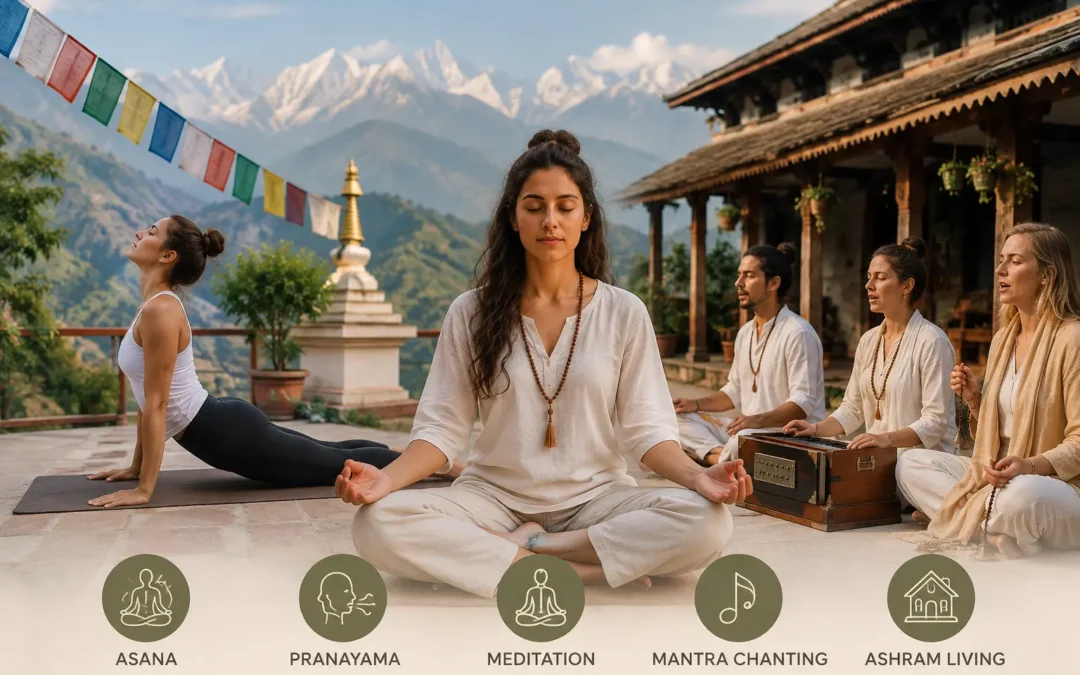
Say “yoga” to most people and a picture pops up straight away: a mat, an hour, some stretching, maybe a bit of sweat by the end. A yoga ashram in Nepal barely resembles that picture.
It takes up the whole day. Breath, posture, sitting still and chanting out loud, none of it gets treated as a separate class here. It’s all one thing, stitched together from sunrise onward.
The setting does a lot of the work too. That’s why Nepal Hoga Home is located on the hillside of the Nagarjun forest above the Kathmandu Valley, a forest that’s said to take its name from an enlightened monk who once meditated there.
This comprehensive blog is written for someone who’s never sat through a real meditation session, never chanted anything out loud, and feels a little unsure about the whole idea.
Why It Feels So Different From a Studio Class?
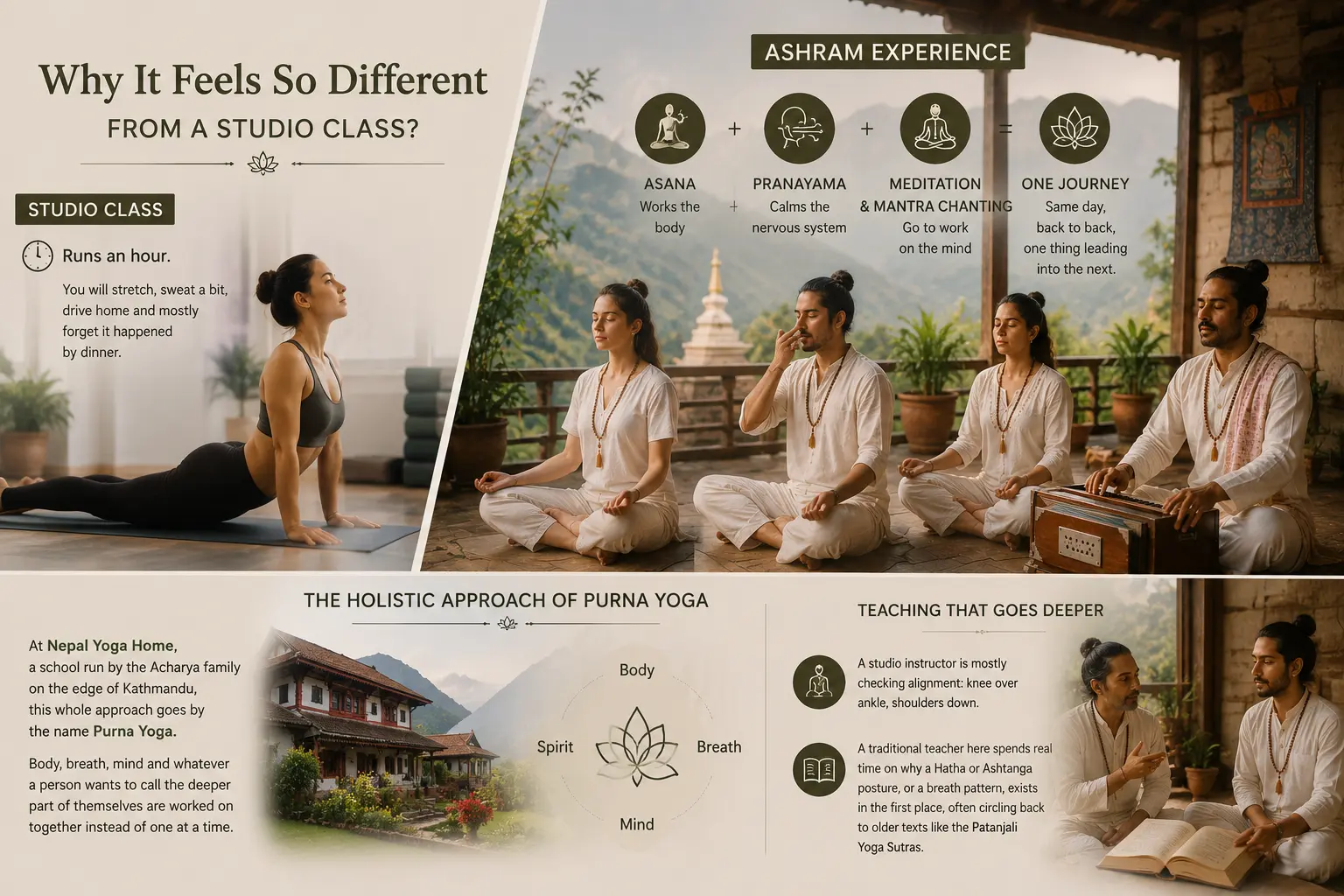
A studio class runs an hour. You will stretch, sweat a bit, drive home and mostly forget it happened by dinner.
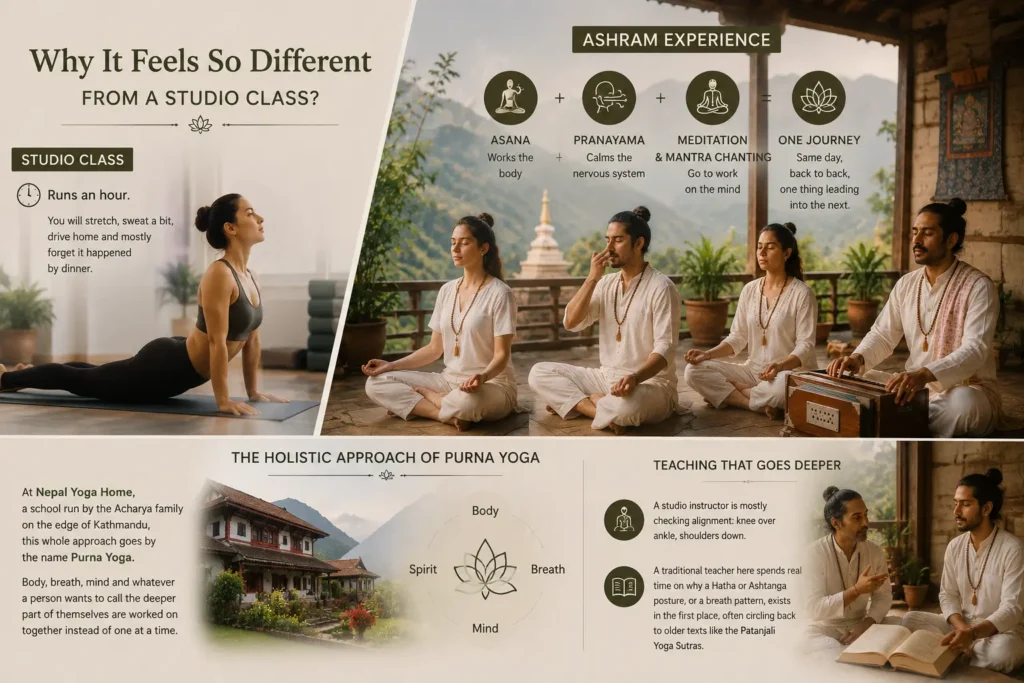
An ashram doesn’t run that way. Asana works the body, pranayama calms the nervous system down, meditation and mantra chanting go to work on the mind, and none of it is spread across separate sessions over separate weeks. Same day, back to back, one thing leading into the next.
At Nepal Yoga Home, a school run by the Acharya family on the edge of Kathmandu, this whole approach goes by the name Purna Yoga. Body, breath, mind and whatever a person wants to call the deeper part of themselves are worked on together instead of one at a time.
Even the teaching feels different. A studio instructor is mostly checking alignment: knee over ankle, shoulders down. A traditional teacher here spends real time on why a Hatha or Ashtanga posture, or a breath pattern, exists in the first place, often circling back to older texts like the Patanjali Yoga Sutras.
What Does Your Daily Rhythm Look Like?
Every ashram runs it a little differently, but the shape repeats itself almost everywhere.
| Time |
What’s Happening |
| Early morning |
Pranayama, then gentle asana as the sun comes up |
| Mid-morning |
Shared vegetarian breakfast, then philosophy or study |
| Afternoon |
Guided or silent meditation, often in the open garden set aside for individual practice |
| Evening |
Mantra chanting and a closing prayer, sometimes with singing on the rooftop afterward |
Sundays are usually off, free for a wander into Kathmandu or just sitting on the terrace with the valley spread out below.
What Happens During Meditation at a Yoga Ashram in Nepal?
A session usually opens with a few minutes of settling the breath, then moves into either guided focus or plain silence, depending on the day.
New arrivals sit for 20 to 40 minutes, and nobody’s expected to have a flawless, quiet mind on the first try. Most don’t, and that’s fine.
Longer stays, a 21-day yoga and meditation retreat for instance, build the sitting time up slowly across the days instead of dropping newcomers straight into an hour of silence.
The Sound Part: Mantra Chanting
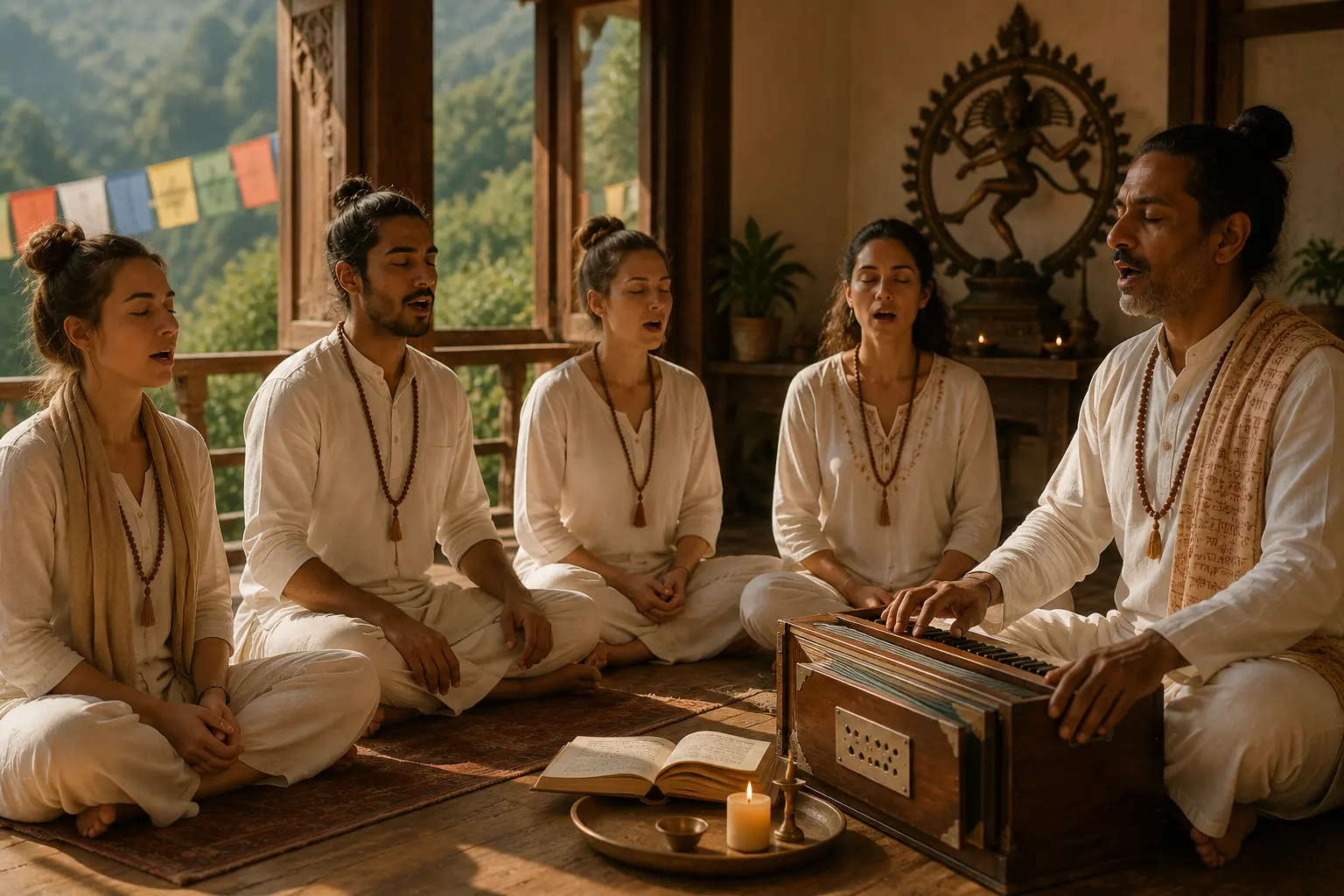
This tends to be the part that makes first-timers nervous before they even land. It looks strange right up until someone actually opens their mouth and tries it, and then, it just stops feeling that way.
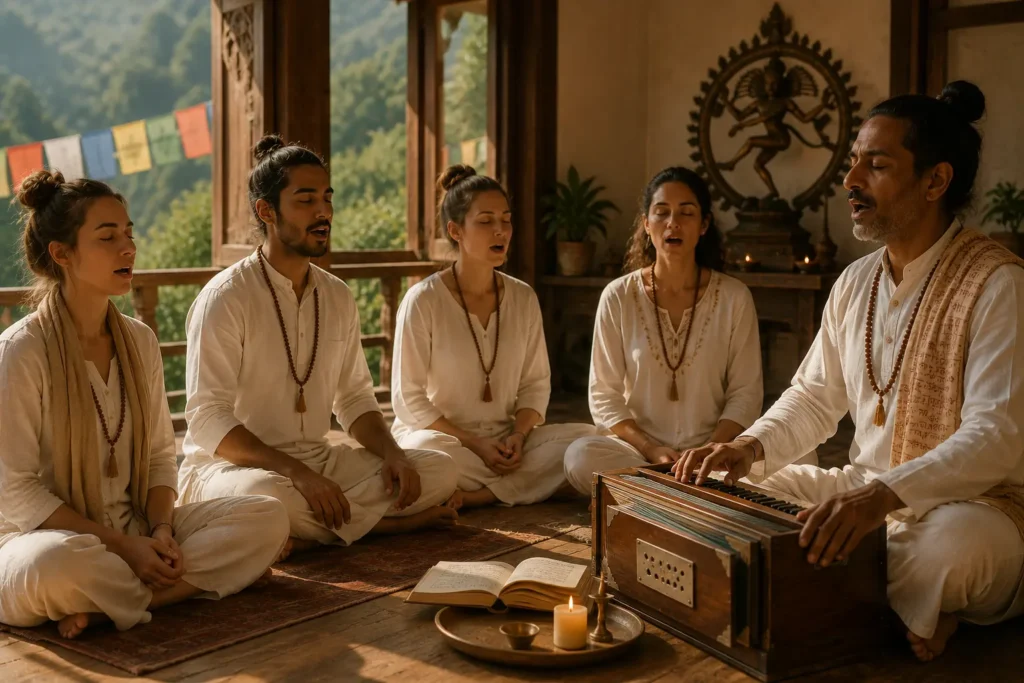
A mantra is a sound or phrase repeated with attention, nothing more complicated than that at its core. The word comes from Sanskrit, “man” for mind and “tra” for freeing, so a mantra is basically a tool for pulling the mind out of the loop it usually runs on all day.
A few that come up most often at a yoga ashram in Nepal:
- Om, the most basic sound there is
- Gayatri Mantra, chanted for clarity and wisdom
- Shanti Mantra, usually recited to close a session, asking for peace
There’s more behind this than tradition alone, as it turns out. A pilot fMRI study on PubMed/NCBI found that chanting Om out loud produced measurable deactivation in brain regions tied to stress and anxiety, an effect the researchers compared to vagus nerve stimulation therapy.
Who This Kind of Retreat Actually Suits?
People hear the word “ashram” and assume it’s only for lifelong yogis or the extremely spiritual. It really isn’t, not even close.
A few types it tends to suit well:
- Complete beginners with zero background in yoga or meditation
- Anyone genuinely burnt out and wanting real distance from a phone
- Travellers who’d rather have some structure than another loose sightseeing itinerary
- People more curious about the philosophy behind yoga than the postures themselves
- Anyone coming off a rough patch who wants a slower pace for a week or two
Anyone with a recent surgery, a serious heart condition, or an early pregnancy should mention it before booking, so the schedule can be adjusted.
There’s also an Ayurvedic doctor and massage on request, which some guests lean on to ease into the physical side of things if postures feel unfamiliar at first.
Nepal Yoga Home’s teacher training programmes and its founder, Dr. Prakash Acharya, can help work out what actually fits before anyone locks in dates.
Considering a Traditional Yoga Ashram in Nepal Retreat?
Reading about asana, meditation and mantra chanting only gets someone so far, honestly. The real shift happens the first morning it actually starts, sitting in a hall at sunrise, chanting next to a dozen strangers.
Nepal Yoga Home has been running programmes like this on the edge of the Nagarjun forest for years and holds Yoga Alliance registration for its teacher training standards.
Have a look at the retreat options, or head straight to booking if the dates are already decided.
Frequently Asked Questions
Is a Yoga Ashram Retreat Safe for Beginners?
Yes. Teachers adjust postures, breathing and meditation length based on where each person is actually starting from, so nobody’s stuck trying to keep pace with an advanced practitioner across the room. Built around meeting people where they are, not the other way round.
Anyone with a recent surgery, a serious heart condition or an early pregnancy should mention it before booking so the plan can be adjusted.
How Long Should a First Stay Be?
One to two weeks usually works best for a first visit, enough time to actually settle in rather than just get used to it and then leave. A shorter three or four day stay works as a taste test, while a 21-day retreat or a full month suits someone after a deeper reset, or planning to roll straight into teacher training afterward.
Is the Food Strictly Vegetarian?
Meals at most Nepal ashrams are simple and vegetarian. Dal, rice, seasonal vegetables and tea on tap through the day, all meant to keep energy steady through a full day of practice. Less about restriction, more about what actually works for the routine.
Can This Be Combined With Yoga Teacher Training?
Yes, plenty of people use a short ashram stay as a warm-up before a longer 200-hour teacher training course. Getting used to the rhythm, the meditation, and the chanting beforehand tends to soften the shock once the more intensive training actually begins.