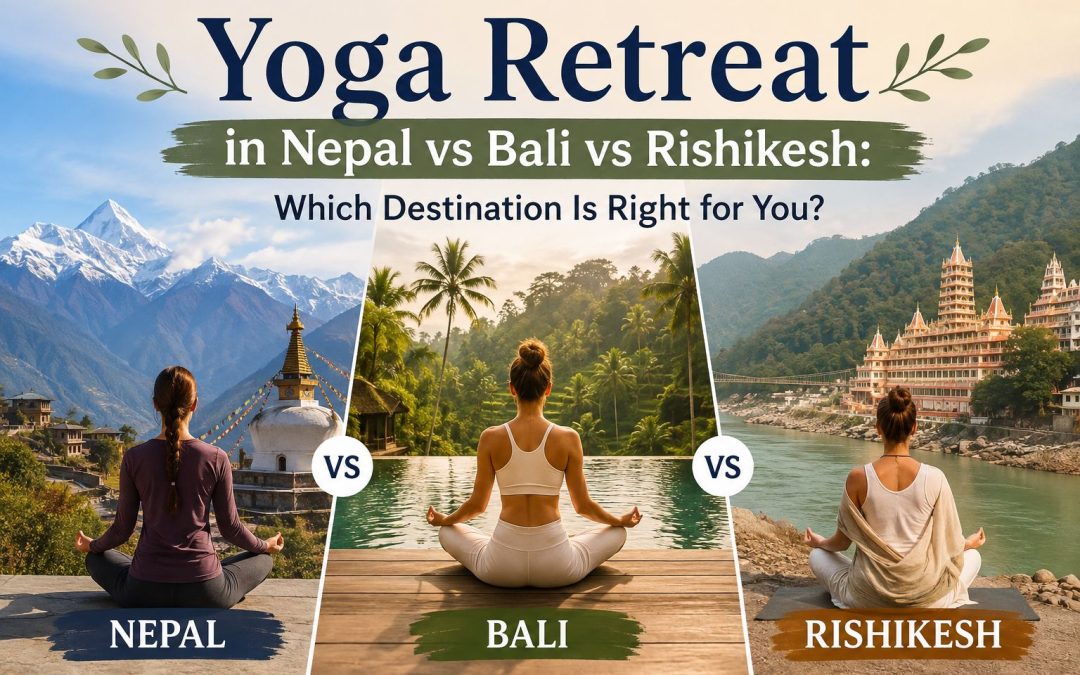
If you’ve spent an evening comparing a yoga retreat in Nepal vs Bali vs Rishikesh, you know how quickly it turns into a mess.
One review tells you Bali is overrated. The next says Rishikesh changed someone’s life. A third swears by a tiny school in Kathmandu you’ve never heard of.
All three destinations are amazing, and thousands of certified teachers have come out of each one, but they are not interchangeable once you look past the photos.
This guide provides detailed information about what each place actually costs, what your mornings will look like and which type of traveler tends to leave each one happiest.
Nepal vs Bali vs Rishikesh at a Glance
Costs and class sizes don’t mean much in isolation. Understand the ground each destination stands on first, then the numbers make a lot more sense.
1. Nepal: Himalayan, Understated and Community-Focused
Yoga schools in Nepal cluster mostly around the Kathmandu Valley or the lakeside town of Pokhara. Practice often happens at altitude, sometimes with a Himalayan peak framed right behind your mat.
The centres running these programmes tend to feel more like someone’s home than a business, and that difference is usually obvious within a day or two of arriving.
2. Bali: Polished, Social and Built for Comfort
Head to Bali and you’ll probably end up in Ubud, the town where Bali’s yoga reputation was really built. Art galleries, juice bars, and studios line up one after another, and the scene has only grown since Eat, Pray, Love put Ubud on the map.
Rice paddy views and five-star shalas are easy to find here. If Ubud feels too crowded, Canggu offers a surfier, trendier version of the same scene.
3. Rishikesh: Raw, Spiritual and Intense
Rishikesh has carried the nickname “Yoga Capital of the World” since the Beatles studied meditation there in 1968. It’s beside the Ganges, and the evening Ganga Aarti ceremony after a day of practice is something most travelers don’t forget.
Quick Comparison Table: Yoga Retreat in Nepal vs Bali vs Rishikesh
Here’s a detailed table that helps you understand yoga retreat in Nepal vs Bali vs Rishikesh:
| What’s being compared | Nepal | Bali | Rishikesh |
| 7-day retreat cost | A week in Nepal usually costs $300 to $700, with meals and lodging fully included. | A comparable week in Bali often runs $500 to $1,500, and meals aren’t always bundled in. | Rishikesh stays cheapest overall, with a full week sometimes available for around $200. |
| 200-hour YTT cost | A complete 200-hour teacher training in Nepal typically costs $800 to $1,500 with everything covered. | The same certification in Bali often runs $2,000 to $4,000, frequently excluding food and lodging. | Some Rishikesh ashrams offer full 200-hour training for close to $1,000, the lowest of the three. |
| Visa process | A visa on arrival costs $30 to $50, and no paperwork is needed beforehand. | Bali grants a free 30-day visa on arrival, though longer stays require extra paperwork later. | India requires an e-visa arranged in advance, usually taking three to five working days. |
| Typical class size | Nepali schools generally keep groups between eight and fifteen students, allowing for closer instructor attention. | Larger Bali studios can run fifteen to thirty students per class during busy season. | Popular Rishikesh ashrams sometimes place twenty to forty students in a single batch. |
| Everyday comfort | Electricity stays reliable across most of the Kathmandu Valley, and hot water is standard at nearly every school. | Bali offers dependable power and widespread air conditioning, plus easy access to Western comforts. | Power cuts happen often in Rishikesh, and air conditioning remains rare across most of the town. |
| Food and lifestyle | Local meals cost $2 to $5 a plate, with both vegetarian and meat options easy to find nearby. | Meal options range from cheap warungs to pricier Western cafes, and alcohol is sold almost everywhere. | The entire town stays alcohol and meat free, keeping the focus squarely on yogic lifestyle. |
| Best suited for | Budget-conscious beginners who also want to trek in the Himalayas usually pick Nepal. | Travelers who want resort-level comfort and a strong digital nomad scene usually pick Bali. | Long-stay purists who value tradition over comfort usually pick Rishikesh. |
What the Numbers Actually Mean?
Nepal ranks in the middle on price, but the value goes further than the number alone suggests. $800 to $1,500 buys a private room and daily meals there, not a shared dorm bed.
Rishikesh looks cheapest on paper but that price comes bundled with unreliable power and a dry town.
Bali costs the most by a wide margin, and scooter rental plus Western cafe prices only stretch that gap wider once you’re actually on the ground.
What a Yoga Retreat Actually Costs You in Each Country?
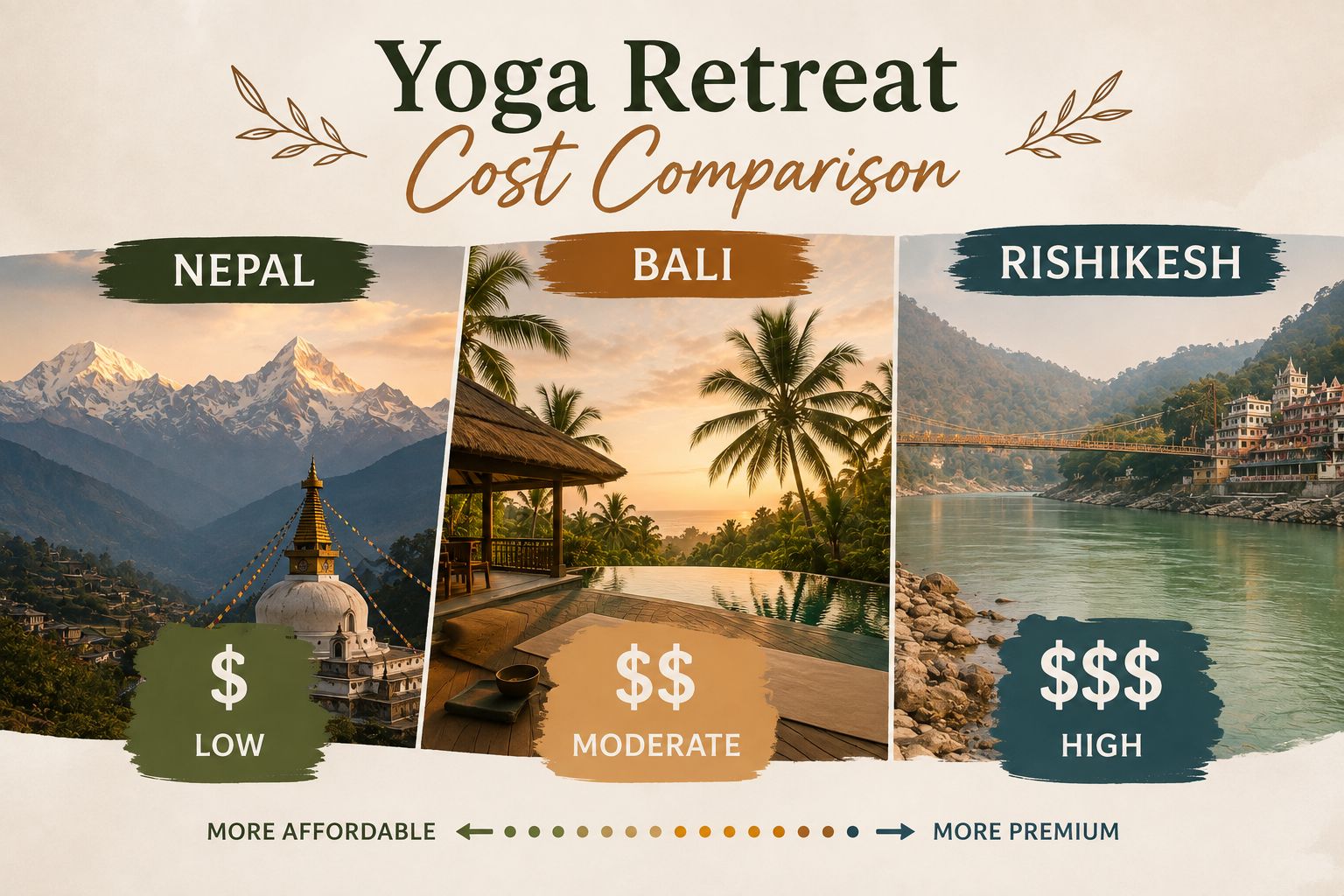
Here’s what a yoga retreat actually costs you per day:
1. Nepal: Where Your Money Is Most Valuable
A week in Nepal costs $300 to $700, and a full 200-hour teacher training lands between $800 and $1,500. Nepal Yoga Home’s 200 Hours Yoga Teacher Training offers accommodation, meals and daily classes already built into the price.
A few things tend to catch first-time visitors off guard when they start budgeting:
- A 30-day visa costs around $50, paid in cash at the airport, with no paperwork required beforehand.
- Food outside the programme runs $2 to $5 a plate, so even a day barely exceeds the budget.
- A full month of local transport, if it’s even needed, rarely climbs above $40.
2. Bali: Comfort Carries a Real Price Tag
A week in Bali costs $500 to $1,500, and a full YTT often runs $2,000 to $4,000, frequently without meals or accommodation included. Ubud studios really are beautiful and that polish is exactly what pushes the price up.
The visa stays free for the first 30 days, which softens things slightly. Scooter rental, Western cafe prices and Ubud’s general cost of living catch up with most budgets fast.
3. Rishikesh: The Cheapest Option
A week in Rishikesh can cost as little as $200 and some ashrams run full 200-hour trainings for around $1,000. Thali meals cost a couple of dollars each, so daily spending stays low throughout the stay.
The catch shows up before the trip even starts. An Indian e-visa has to be arranged in advance and can take several days to process, so last-minute bookings rarely work here.
Scenery and Setting: What You’ll Wake Up To
Mood shifts more here than almost anywhere else on this list.
1. Waking Up in Nepal
Forested hills, prayer flags moving in the wind and on a clear morning in Pokhara, Machhapuchhre reflected across Phewa Lake. Quiet settles in fast, without much effort required to slow down.
Travelers drawn to mountains and forest trails will find that Nepal Yoga Home’s Yoga Retreat programmes lean fully into that Himalayan setting.
2. Waking Up in Bali
Humidity, birdsong and rice terraces stepping down toward the valley floor greet most mornings in Ubud. Shalas here are often open-air, so practice happens with a breeze moving through bamboo walls.
3. Waking Up in Rishikesh
The Ganges announces itself before it’s even visible. Temple bells ring through town well before sunrise, and the Aarti ceremony along the riverbank each evening tends to stay with people long after the trip ends.
Authenticity and Lineage: Who Is Actually Teaching You?
Not all yoga instruction carries equal weight. It’s worth asking who trained your teacher before you book anything.
Nepal and Rishikesh both has genuinely old yogic traditions, where Hatha, Ashtanga and Kundalini styles pass down through instructors trained under their own teachers.
Bali’s scene grew mostly out of the global wellness boom of the last twenty years, which makes it younger and shaped more by market demand than lineage.
How Nepal Yoga Home Approaches Tradition?
Training at Nepal Yoga Home runs under the direct guidance of Yoga Guru Dr. Prakash Acharya, the school’s founder, covering Hatha, Ashtanga, Iyengar, and Kundalini inside one multi-style curriculum. That matters if depth counts for more to you than decor.
Crowds and Commercialization: How Much Space Is There?
-
Rishikesh: Crowded and Still Growing
Laxman Jhula and Tapovan have turned into one long strip of yoga shops, smoothie bars, and competing ashrams over the past decade. Elbow room isn’t really on offer here anymore.
-
Bali: Trendy but Increasingly Busy
Ubud started as a quiet artist town. These days it’s packed with co-working cafes and studios competing for attention online, and Canggu has absorbed a good chunk of the overflow crowd chasing something newer.
-
Nepal: Small by Design
Kathmandu’s schools have mostly stayed out of that race. Family-run centres with eight to fifteen students per class remain the norm rather than the exception.
This is one of the clearer reasons Nepal keeps coming up favorably in the yoga retreat in Nepal vs Bali vs Rishikesh conversation.
Visa and Travel Logistics to Plan Around
A few practical points worth sorting before booking flights:
- Nepal offers a visa on arrival at Tribhuvan International Airport, no advance paperwork, costing $30 for 15 days or $50 for 30 days.
- Bali grants a free visa on arrival for the first 30 days, with extensions available but increasingly bureaucratic.
- Rishikesh, India requires an e-visa before departure, usually taking three to five working days to process.
Anyone booking a trip on short notice will find Nepal and Bali far more forgiving than India.
Which Destination Actually Fits You: Yoga Retreat in Nepal vs Bali vs Rishikesh?
If Price Is Your Deciding Factor
Rishikesh wins here, as long as power cuts and a completely dry town aren’t dealbreakers for you.
If Comfort Is Your Priority
Bali delivers that experience well, and the price reflects it.
If Balance Matters Most
Nepal is usually the answer if you want mountains, small groups, real tradition and a price that leaves room for the rest of your trip. Most first-time visitors land here once they’ve weighed everything else.
Why Consider Nepal Yoga Home Specifically?


If Nepal is starting to look like the right call, here’s why you should choose us:
1. A School With Fifteen Years Behind It
Nepal Yoga Home has run teacher training and retreat programmes out of Kathmandu for more than fifteen years, with over ten thousand students from roughly eighty countries passing through its doors.
Our school is near Nagarjun Hill, away from city noise, and classes stay deliberately small so nobody gets lost in a crowd of thirty strangers.
2. Certified Courses Across Every Level
Every course runs under Yoga Alliance USA certification. That includes the 200 Hours Yoga Teacher Training for those just starting out and the 500 Hours Advanced Yoga Teacher Training for those going further, both taught across Hatha, Ashtanga, Iyengar, and Kundalini styles.
3. Retreats, Extensions and Himalayan Treks
For anyone wanting more than a single course, the 1 Month Yoga Retreat in Kathmandu blends asana, pranayama, meditation, and yogic philosophy into a longer stay.
Pairing practice with mountain trekking, something neither Bali nor Rishikesh really offers, is also possible through the Everest Base Camp Yoga Trek or the Annapurna Yoga Trek.
4. Food and Community
Meals are home-cooked, vegetarian, and made fresh daily as part of the school’s ashram-style routine.
Past students bring up the food and the family atmosphere again and again in their reviews, which are worth reading in full on the testimonials page. It’s usually the detail people remember longest after the trip ends.
Conclusion
There’s no single right answer to the yoga retreat in Nepal vs Bali vs Rishikesh question, since each place genuinely rewards a different kind of traveler. A cheap ashram bed in Rishikesh and a private villa in Ubud are solving completely different problems, and neither is wrong.
If a decision still feels hard after all this, ask what you’d regret skipping more: the mountain views, the comfort, or the lowest possible price tag. That question tends to answer itself faster than any comparison chart, and for a lot of travelers, the honest answer ends up being Nepal.
Frequently Asked Questions
Is Nepal cheaper than Bali for yoga teacher training?
Yes. A 200-hour YTT in Nepal typically costs $800 to $1,500, while the same course in Bali often runs $2,000 to $4,000 and sometimes leaves out meals and lodging entirely.
Is Rishikesh or Nepal better for beginners?
Both work fine for beginners, though the day-to-day experience feels quite different. Nepal tends toward smaller classes and a gentler pace, while Rishikesh has deeper infrastructure built over decades, along with bigger crowds and fewer comforts.
How many days should a yoga retreat in Nepal be?
That comes down to schedule and goals more than anything else. Nepal Yoga Home runs everything from a single overnight package up to a full one-month retreat, covering both short breaks and longer immersions.
Can trekking be combined with a yoga retreat in Nepal?
Yes, and it’s one of Nepal’s clearer advantages over the other two destinations. The Everest Base Camp Yoga Trek and Annapurna Yoga Trek both weave daily practice into multi-day mountain hikes.
Is Nepal Yoga Home Yoga Alliance certified?
Yes, the school is registered under Yoga Alliance USA for both its 200-hour and 500-hour courses. Full certification details are on the FAQ page or through the About Us section.