by Nepal Yoga Home | Sep 8, 2026 | Meditation
Why does almost every yoga retreat in Kathmandu send guests to the Pashupatinath temple at some point? That’s something a lot of people wonder. When you stand on the Bagmati riverbank one time, you stop asking.
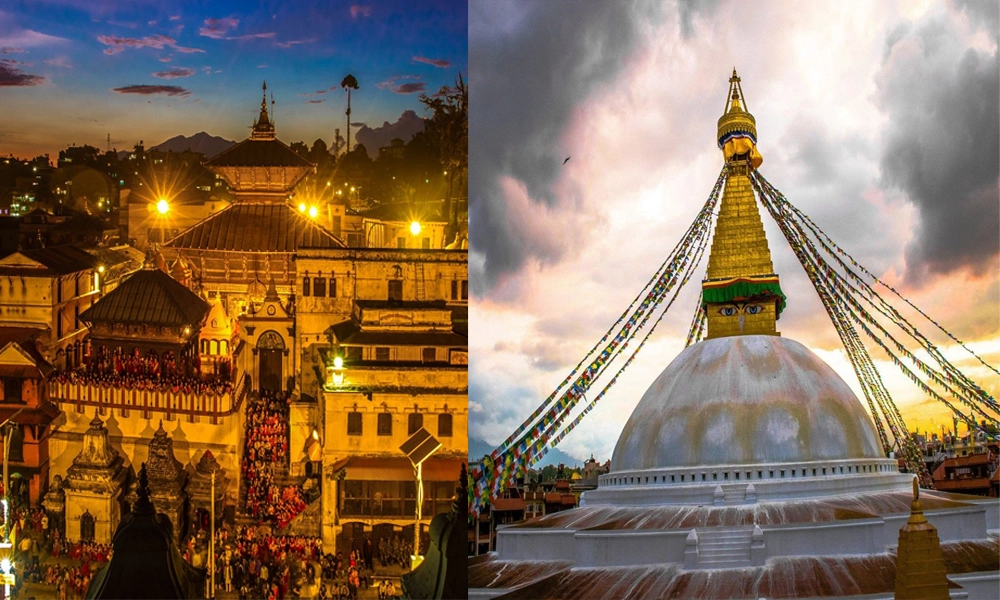
A short drive away from Pashupatination temple you’ll get to see Boudhanath stupa. Between the two you’ve got the emotional center of the whole valley.
This blog shows what each site actually means, how not to be that tourist once you’re there and how we fit both into retreats at Nepal Yoga Home.
Pashupatinath Temple: Nepal’s Most Sacred Hindu Site
Pashupatinath temple is on the Bagmati River on Kathmandu’s eastern edge. It’s dedicated to Shiva in his form as Pashupati, protector of all living beings and it’s been the country’s most important Hindu pilgrimage site for longer than anyone can really pin down.
Parts of the complex go back over a thousand years. What’s actually standing now is only a few centuries old, since fires and earthquakes have both taken their toll more than once, and the whole place has been rebuilt piece by piece over generations.
Down by the water are the cremation ghats. Families carry out funeral rites right out in the open, no curtains, no privacy, nothing hidden from view. It’s a lot to take in the first time. When you’re there, you’ll experience how quiet everyone in the group is, nobody says much for the rest of that walk.
Non-Hindus can’t get into the main shrine. Everything around it though, the courtyards, the forested hill behind, all of that is open to anyone who wants to wander through. If you only do one thing here, make it the evening aarti. Bells, lamplight bouncing off the river and the smell of incense drifting everywhere.
Boudhanath Stupa: A Center of Tibetan Buddhist Practice
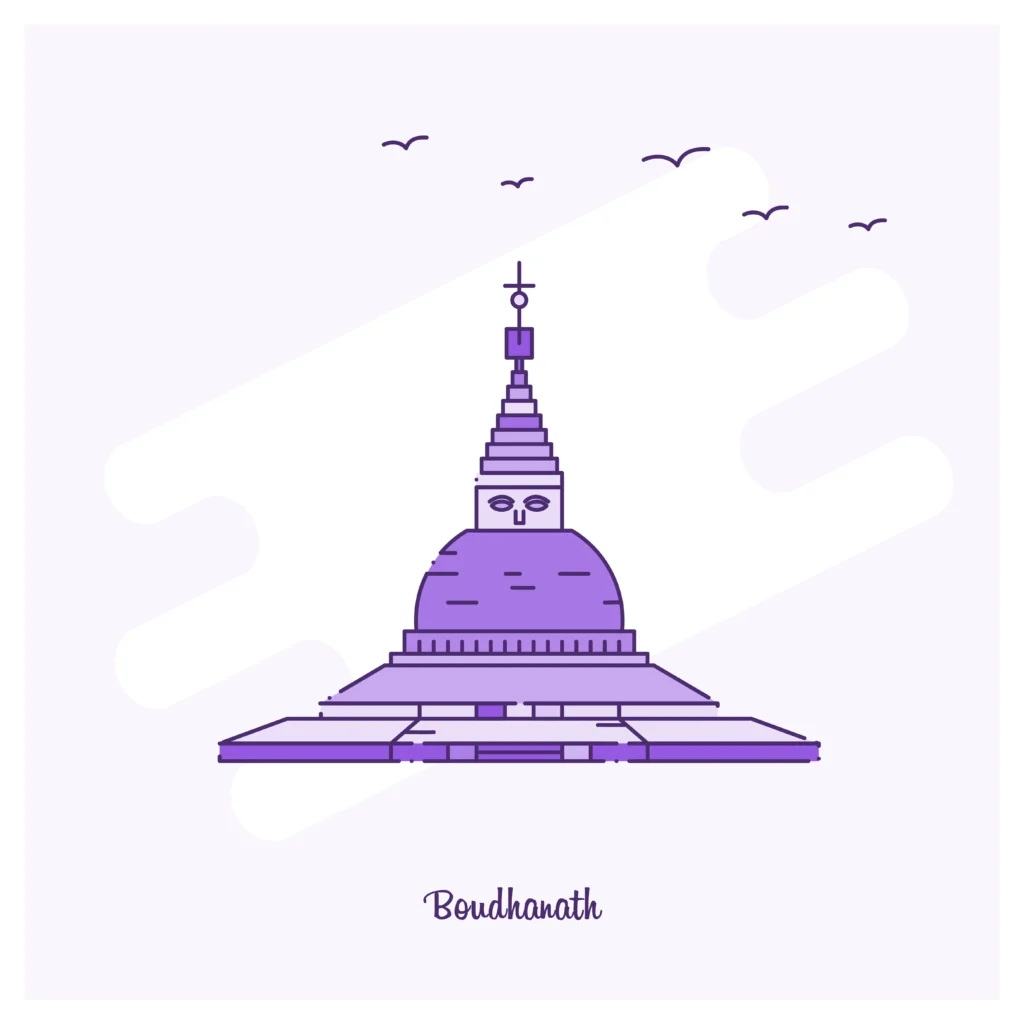
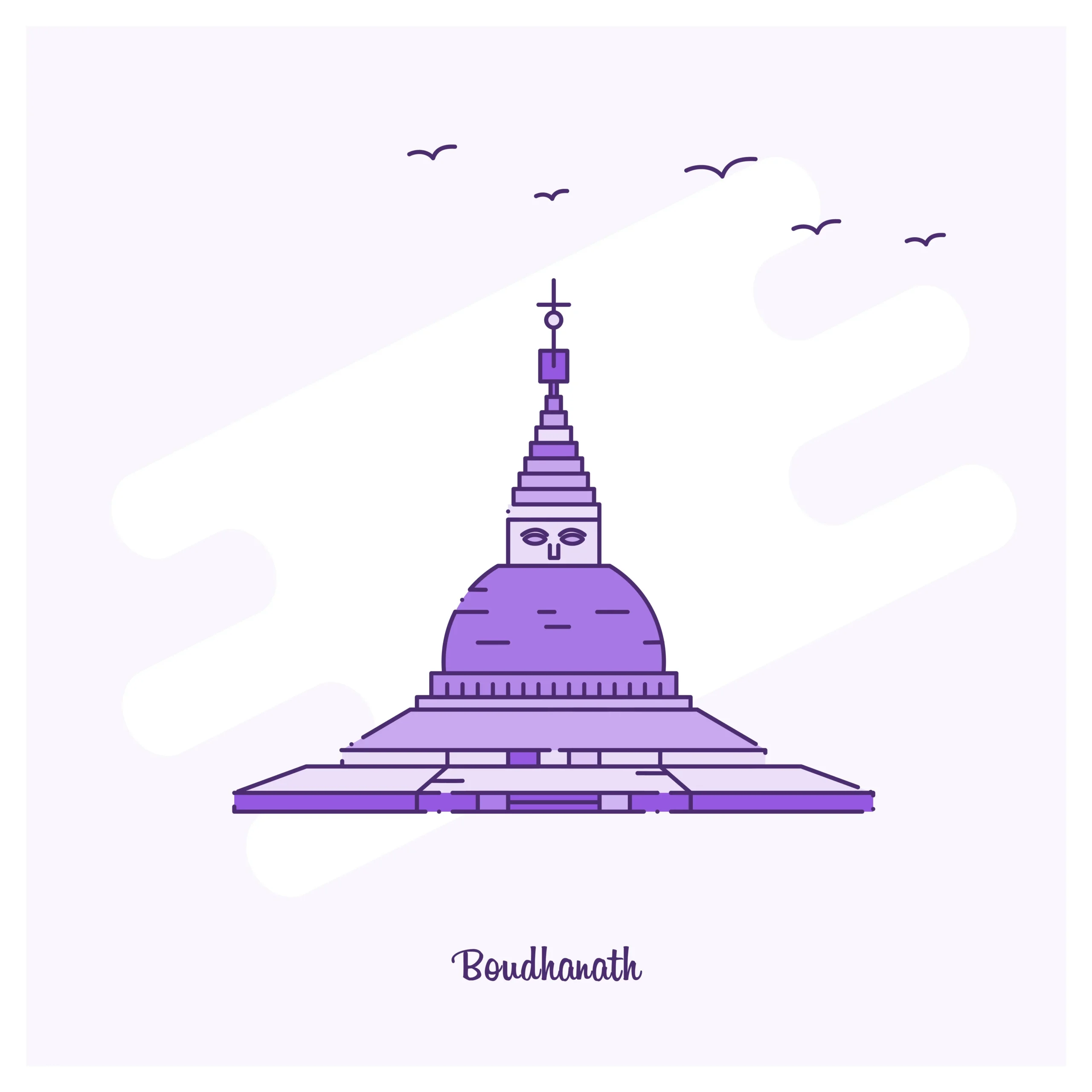
Short taxi ride from Pashupatinath temple and you’re at Boudhanath. The stupa rises above its own little neighborhood of shops and cafes, prayer flags strung between rooftops in every direction you look. Thousands of Tibetan refugees settled here after 1959 and the area has felt like a center of Buddhist life in exile ever since.
You notice it the moment you turn onto the main road. Something about the pace of things just slows down. More than fifty monasteries surround the stupa now, plus the cafes, thangka workshops, a shop or two pushing singing bowls on tourists who don’t know any better (some bowls are the real thing, plenty aren’t).
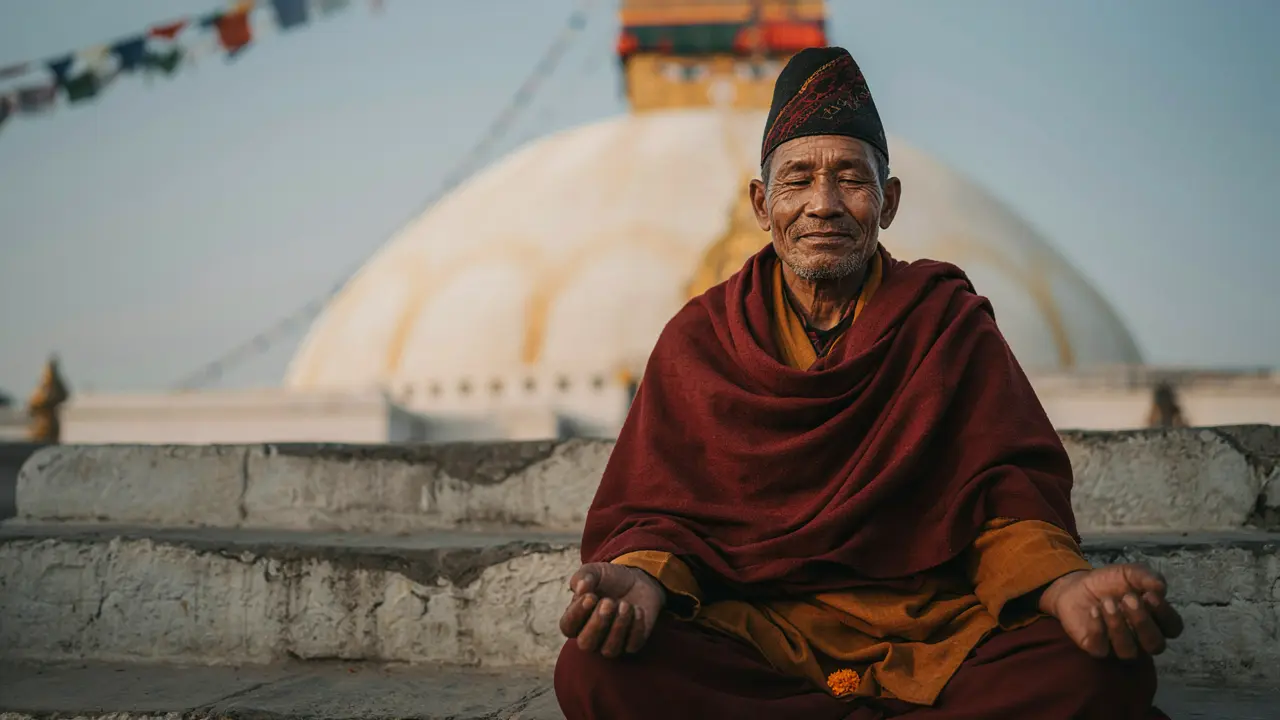
The painted eyes on the tower look out in all four directions at once. Ask a local and most will tell you it’s the Buddha keeping watch over everyone, everywhere, at the same time, which is a nice thought whether or not you buy into it literally.
Both sites, plus five others, make up the Kathmandu Valley’s UNESCO World Heritage listing. Worth knowing, mostly because it says something about how much sacred ground got packed into one small valley. The official listing has the full rundown if you want it straight from the source.
Visiting Etiquette: What to Know Before You Go?
A little prep goes further than most people assume.
Here are some things to know before going to Pashupatinath temple and Boudhanath stupa:
- Try to cover shoulders and knees.
- Shoes off before entering any shrine or monastery, that one is not negotiable.
- Don’t photograph cremation ceremonies at Pashupatinath temple, it just isn’t the moment for that.
- Walk clockwise around the Boudhanath stupa the way everyone else doing kora does.
- Try to keep your voice down near active prayer areas as sound carries further than people expect.
Foreign visitors need entry tickets at both spots. The Pashupati Area Development Trust sets the current rules for the temple grounds, worth a quick check since things shift now and then without much notice.
Mornings run calmer at Pashupatinath temple before the tour buses roll in. Late afternoon at Boudhanath, once the light turns gold and the butter lamps start getting lit, beats every other hour there, at least in my opinion.
How These Sites Fit Into a Yoga Retreat Schedule?
Most guests treat both sites as one relaxed half-day, not something squeezed between other stops on a bigger city tour. Nepal Yoga Home sits about five kilometers out, in the quiet slopes of Nagarjuna Hill, close enough that the Pashupatinath temple and Boudhanath stupa make for an easy morning trip.
We build the excursion into the schedule between practice sessions. That way people come back to a forested campus instead of a hotel stuck in downtown traffic.
A lot of guests on our one month yoga retreat or monastery yoga retreat tell us afterward it ended up being the part they remember most. After fifteen years of hearing that, it stopped surprising us a while ago.
Every once in a while, someone on our one month meditation retreat heads back to Pashupatinath temple a second time near the end of their stay. It hits completely differently once you’ve settled into a few weeks of daily practice, in a way that’s hard to explain until it happens to you personally.
Meditating at Boudhanath: A Living Practice
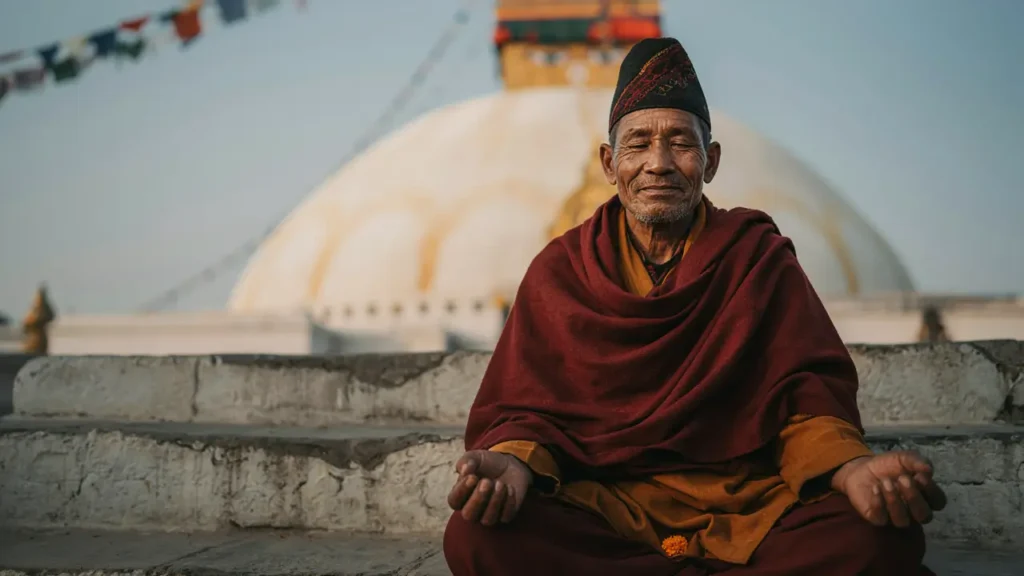
The kora, that circling walk around the Boudhanath stupa, is basically meditation while walking. Thousands of people do it daily without thinking twice about it, prayer wheels spinning, mala beads clicking through fingers, mantras murmured under people’s breath, sometimes for an hour, sometimes much longer than that.
Find a seat at one of the rooftop cafes overlooking the dome afterward. Just sit there a while with what you saw. Quite a few of our students describe it as an extension of the meditation training they’re already doing back at the school, just with a much better view attached.
If you’ve already got a breathing practice, bringing it here adds something a studio session simply can’t reach on its own. This is lived, ongoing devotion. Not something staged for a photo, whatever it might look like scrolling through someone’s feed later that night.
Plan a Retreat That Includes Sacred Site Visits
If reading this has you wanting to see the Pashupatinath temple and Boudhanath stupa yourself, a retreat takes most of the guesswork off your hands.
We’ve arranged trips like this for guests from more than eighty countries over the past fifteen-plus years, on top of daily yoga, home-cooked vegetarian meals, and a place that genuinely starts to feel like family the longer you stick around.
Take a look at our yoga retreats in Nepal or the 500-hour advanced yoga teacher training if sightseeing alone isn’t quite enough. Our gallery has real guest photos and the booking page is right there whenever you’re ready.
Still weighing it? Our FAQ page covers most of what people ask about schedules, food, and daily life on retreat. Anything it misses, just message us directly.
Frequently Asked Questions
Is the Pashupatinath temple open to non-Hindu visitors?
Only the main shrine is closed off. Everything else including the surrounding grounds, the riverside ghats, the forested hill, is open to anyone holding a valid ticket.
What should I wear?
Shoulders and knees covered at both the Pashupatinath temple and the Boudhanath stupa is preferred more by native peopl. We suggest you to wear shoes you can slip off easily since you’ll be doing it a lot on uneven stone.
Are temple visits included in Nepal Yoga Home’s retreats?
Depends on the package. Message our team directly and we’ll work a sacred sites excursion into your dates.
How much time should I set aside for both sites?
A half day, comfortably. Pashupatinath and Boudhanath sit close enough together within the Kathmandu Valley that you won’t lose half your trip getting between them.
by Nepal Yoga Home | Aug 31, 2026 | Mantra, Meditation, Yoga
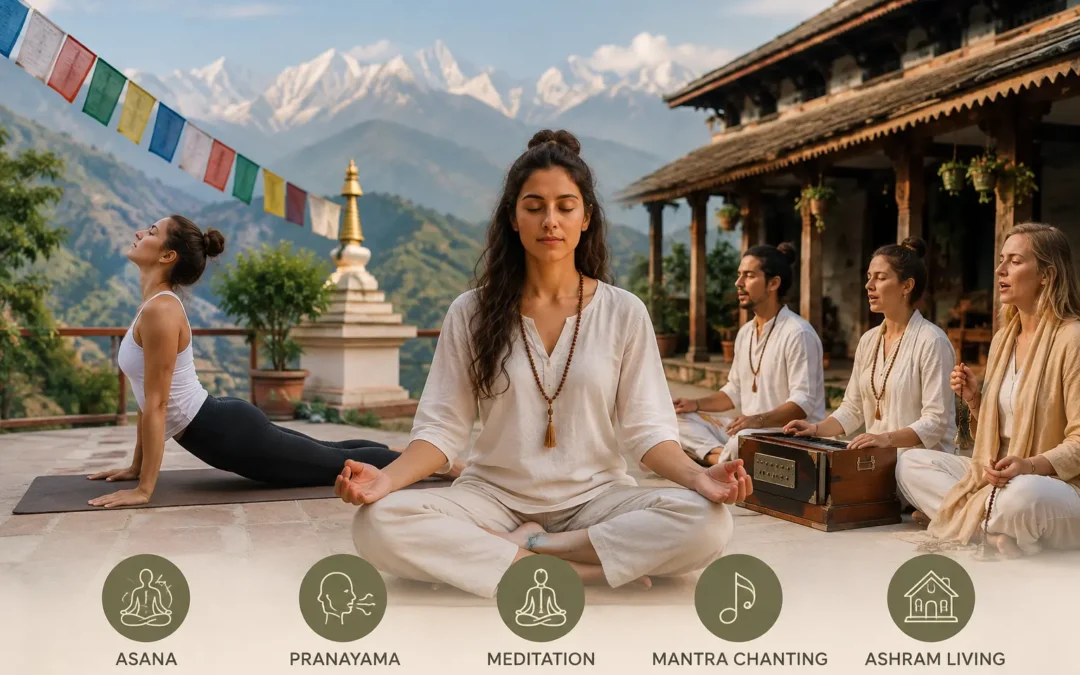
Say “yoga” to most people and a picture pops up straight away: a mat, an hour, some stretching, maybe a bit of sweat by the end. A yoga ashram in Nepal barely resembles that picture.
It takes up the whole day. Breath, posture, sitting still and chanting out loud, none of it gets treated as a separate class here. It’s all one thing, stitched together from sunrise onward.
The setting does a lot of the work too. That’s why Nepal Hoga Home is located on the hillside of the Nagarjun forest above the Kathmandu Valley, a forest that’s said to take its name from an enlightened monk who once meditated there.
This comprehensive blog is written for someone who’s never sat through a real meditation session, never chanted anything out loud, and feels a little unsure about the whole idea.
Why It Feels So Different From a Studio Class?
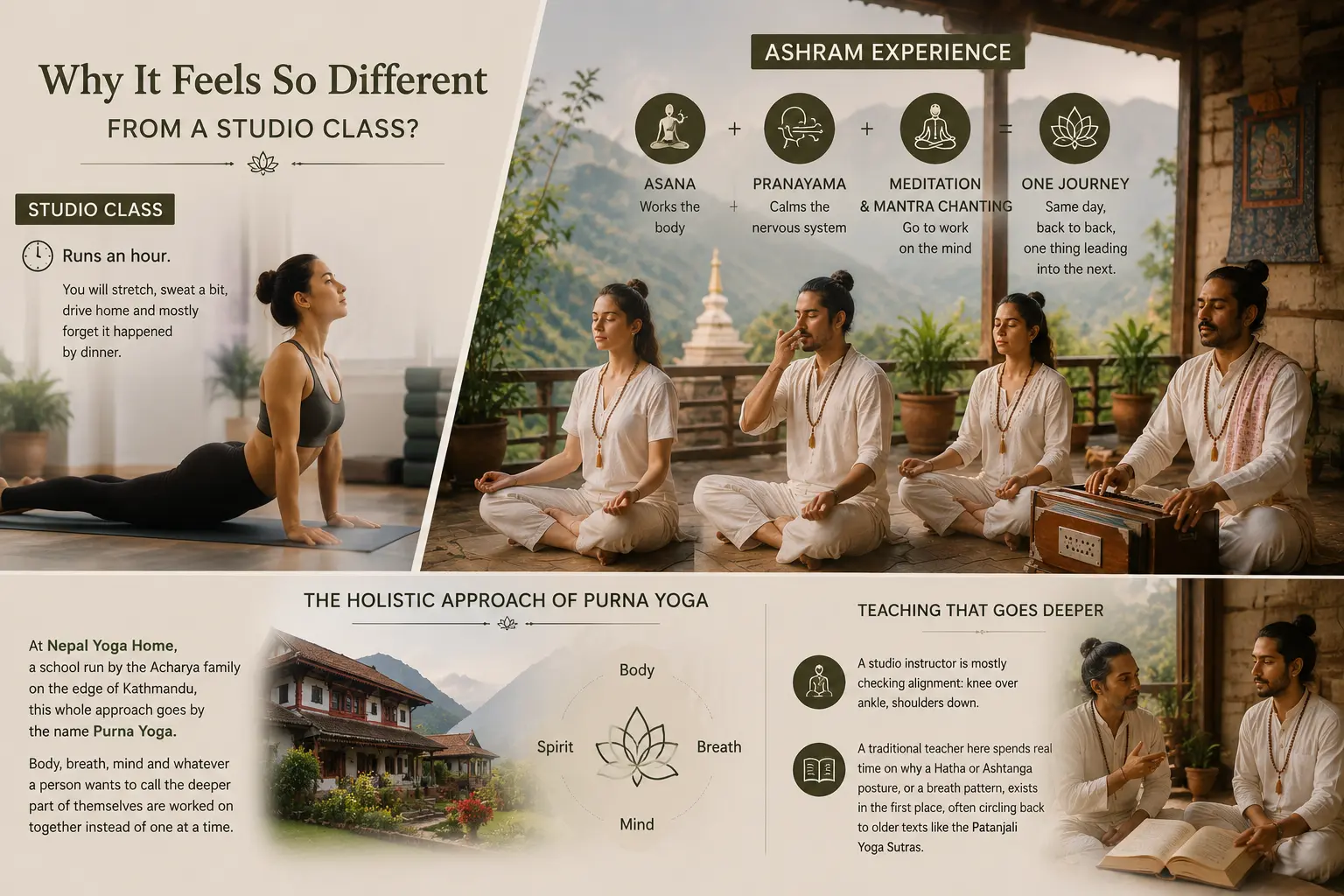
A studio class runs an hour. You will stretch, sweat a bit, drive home and mostly forget it happened by dinner.
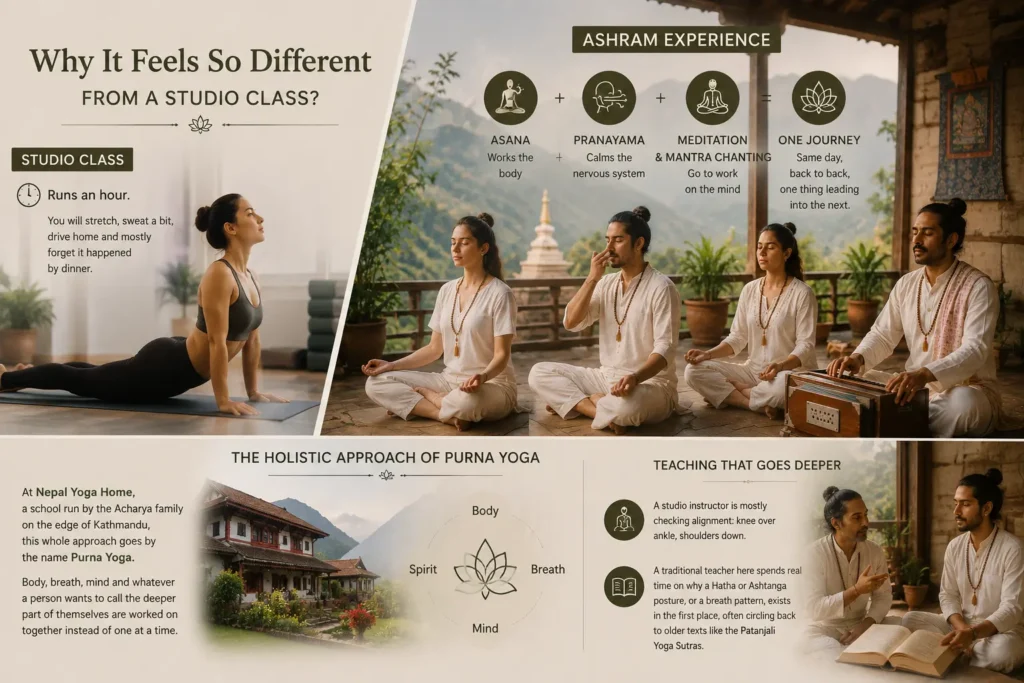
An ashram doesn’t run that way. Asana works the body, pranayama calms the nervous system down, meditation and mantra chanting go to work on the mind, and none of it is spread across separate sessions over separate weeks. Same day, back to back, one thing leading into the next.
At Nepal Yoga Home, a school run by the Acharya family on the edge of Kathmandu, this whole approach goes by the name Purna Yoga. Body, breath, mind and whatever a person wants to call the deeper part of themselves are worked on together instead of one at a time.
Even the teaching feels different. A studio instructor is mostly checking alignment: knee over ankle, shoulders down. A traditional teacher here spends real time on why a Hatha or Ashtanga posture, or a breath pattern, exists in the first place, often circling back to older texts like the Patanjali Yoga Sutras.
What Does Your Daily Rhythm Look Like?
Every ashram runs it a little differently, but the shape repeats itself almost everywhere.
| Time |
What’s Happening |
| Early morning |
Pranayama, then gentle asana as the sun comes up |
| Mid-morning |
Shared vegetarian breakfast, then philosophy or study |
| Afternoon |
Guided or silent meditation, often in the open garden set aside for individual practice |
| Evening |
Mantra chanting and a closing prayer, sometimes with singing on the rooftop afterward |
Sundays are usually off, free for a wander into Kathmandu or just sitting on the terrace with the valley spread out below.
What Happens During Meditation at a Yoga Ashram in Nepal?
A session usually opens with a few minutes of settling the breath, then moves into either guided focus or plain silence, depending on the day.
New arrivals sit for 20 to 40 minutes, and nobody’s expected to have a flawless, quiet mind on the first try. Most don’t, and that’s fine.
Longer stays, a 21-day yoga and meditation retreat for instance, build the sitting time up slowly across the days instead of dropping newcomers straight into an hour of silence.
The Sound Part: Mantra Chanting
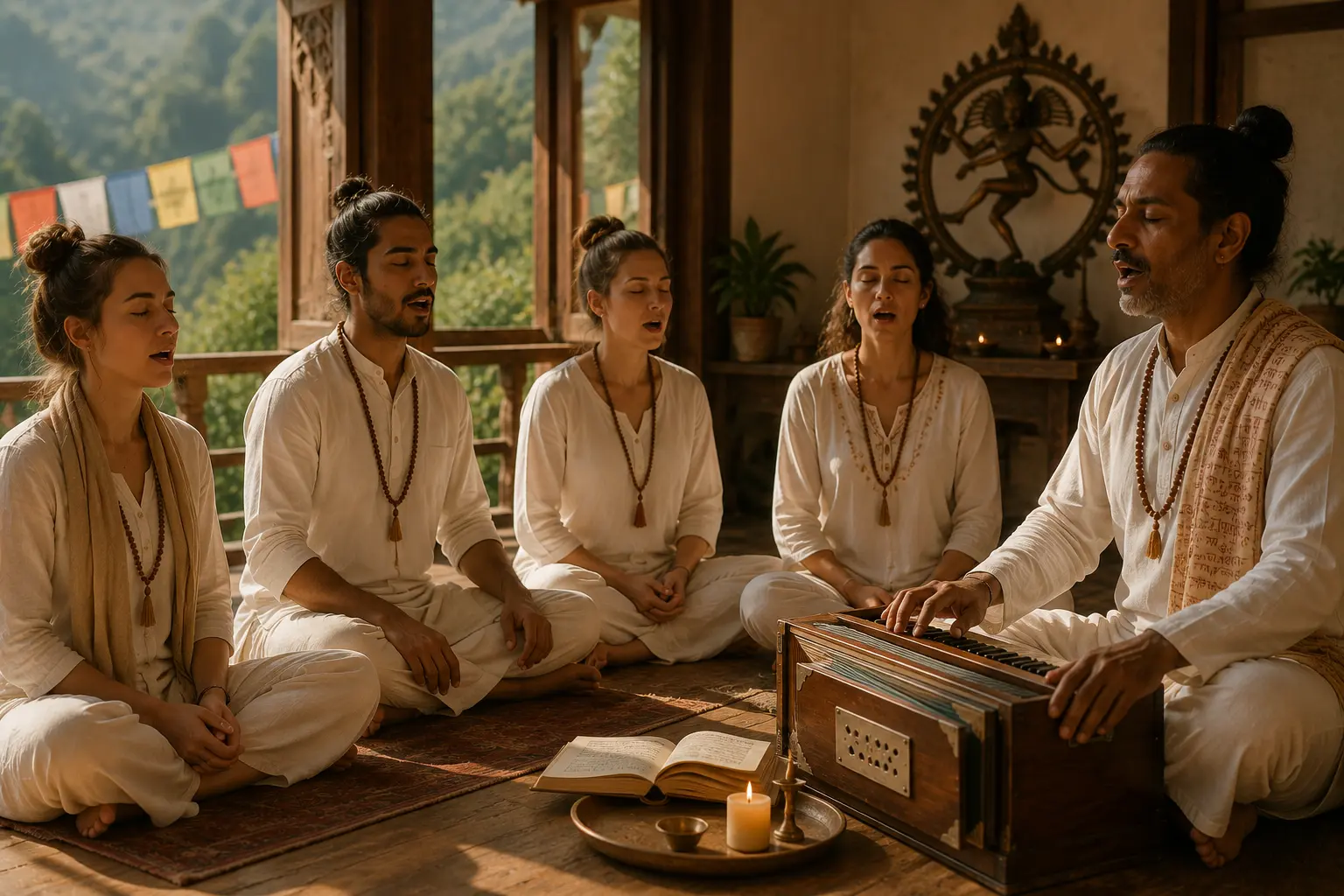
This tends to be the part that makes first-timers nervous before they even land. It looks strange right up until someone actually opens their mouth and tries it, and then, it just stops feeling that way.
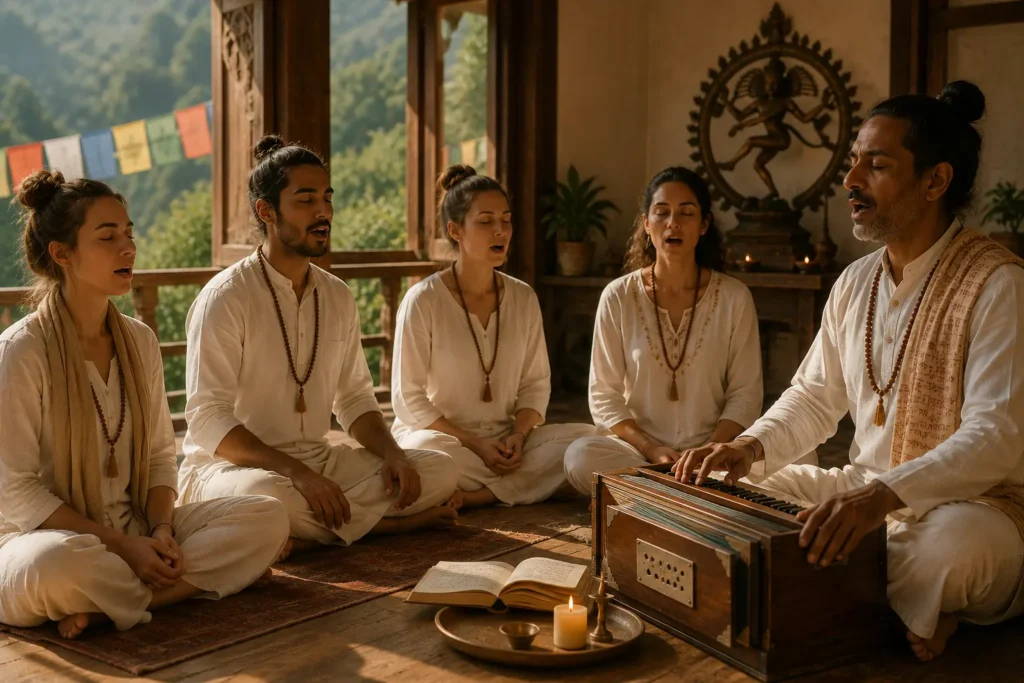
A mantra is a sound or phrase repeated with attention, nothing more complicated than that at its core. The word comes from Sanskrit, “man” for mind and “tra” for freeing, so a mantra is basically a tool for pulling the mind out of the loop it usually runs on all day.
A few that come up most often at a yoga ashram in Nepal:
- Om, the most basic sound there is
- Gayatri Mantra, chanted for clarity and wisdom
- Shanti Mantra, usually recited to close a session, asking for peace
There’s more behind this than tradition alone, as it turns out. A pilot fMRI study on PubMed/NCBI found that chanting Om out loud produced measurable deactivation in brain regions tied to stress and anxiety, an effect the researchers compared to vagus nerve stimulation therapy.
Who This Kind of Retreat Actually Suits?
People hear the word “ashram” and assume it’s only for lifelong yogis or the extremely spiritual. It really isn’t, not even close.
A few types it tends to suit well:
- Complete beginners with zero background in yoga or meditation
- Anyone genuinely burnt out and wanting real distance from a phone
- Travellers who’d rather have some structure than another loose sightseeing itinerary
- People more curious about the philosophy behind yoga than the postures themselves
- Anyone coming off a rough patch who wants a slower pace for a week or two
Anyone with a recent surgery, a serious heart condition, or an early pregnancy should mention it before booking, so the schedule can be adjusted.
There’s also an Ayurvedic doctor and massage on request, which some guests lean on to ease into the physical side of things if postures feel unfamiliar at first.
Nepal Yoga Home’s teacher training programmes and its founder, Dr. Prakash Acharya, can help work out what actually fits before anyone locks in dates.
Considering a Traditional Yoga Ashram in Nepal Retreat?
Reading about asana, meditation and mantra chanting only gets someone so far, honestly. The real shift happens the first morning it actually starts, sitting in a hall at sunrise, chanting next to a dozen strangers.
Nepal Yoga Home has been running programmes like this on the edge of the Nagarjun forest for years and holds Yoga Alliance registration for its teacher training standards.
Have a look at the retreat options, or head straight to booking if the dates are already decided.
Frequently Asked Questions
Is a Yoga Ashram Retreat Safe for Beginners?
Yes. Teachers adjust postures, breathing and meditation length based on where each person is actually starting from, so nobody’s stuck trying to keep pace with an advanced practitioner across the room. Built around meeting people where they are, not the other way round.
Anyone with a recent surgery, a serious heart condition or an early pregnancy should mention it before booking so the plan can be adjusted.
How Long Should a First Stay Be?
One to two weeks usually works best for a first visit, enough time to actually settle in rather than just get used to it and then leave. A shorter three or four day stay works as a taste test, while a 21-day retreat or a full month suits someone after a deeper reset, or planning to roll straight into teacher training afterward.
Is the Food Strictly Vegetarian?
Meals at most Nepal ashrams are simple and vegetarian. Dal, rice, seasonal vegetables and tea on tap through the day, all meant to keep energy steady through a full day of practice. Less about restriction, more about what actually works for the routine.
Can This Be Combined With Yoga Teacher Training?
Yes, plenty of people use a short ashram stay as a warm-up before a longer 200-hour teacher training course. Getting used to the rhythm, the meditation, and the chanting beforehand tends to soften the shock once the more intensive training actually begins.

by Tirtha Acharya | Jan 17, 2024 | Meditation
Samata Meditation: Underpinning for Awareness
For a wholesome and pure mind
The word samata means calm or balanced. Samata meditation is a meditation practice by which one fosters samadhi (the ultimate goal of yoga). Samata meditation is based on concentration. Thus it is also treated as the beginning state of vipassana meditation. It is a rock-solid condition of insight meditation.
Samata meditation is an effectual and soothing method of exercising the mind to cultivate internal potency, and freedom from restiveness, heading on to lucidity and comprehending.
Techniques and Objects applied in Samata Meditation:
Several forms of meditation objectives have been used for developing concentration in Samata Meditation. Basically, breath has been taken as the object of concentration. However visual object or statue or image of Buddha, etc. are also some optional object to fix the concentration. Any method which is helpful to strengthen the attention can be used.
The mind is not just clear and pure enough to witness this process when it is not focused. You lay the groundwork for genuine and liberating insight to emerge via the practice of samata method.
Sometimes it may not be possible to quiten your mind just by breath observation. So you require some other some other technique as well to attain best focus. Samata meditation gives you the aptitude to sustain the mind flatteringly concentrated on a point or object of your selection whenever you need, without the occurrence of a single thinking or other psychological interruption.
The mind cannot be absolute and strong enough without concentration. Pratice of samata meditation helps you grow the underpinning upon which genuine liberating awareness can exhibit itself.
Samatha Meditation and its path:
Every single peak has a gradual progression. The ultimate mindfulness or insight begins from Samata. It is the Base for Mindfulness.
In the beginning, while practicing samatha, it may appear as if the mind is just turn out to be more restless. The reason is you observe your psychological progressions with an intensifying magnifying glass and will understand your restlessness with enlarging refinement.
Every time you touch a new step of calm you become conscious that even this level is basically yet restless.
Dilgo Khyentse Rinpoche, a Tibetan Buddhist teacher states about this process by describing five stages of concentration:
- Concentration- like a cascade cascading from a perciple. Because you are now conscious of the movement of your mind, the thought seem to occurring more frequently than before, and they flow another incessantly.
- Concentration: similar to a river gushing through a valley in the mountain. There are times when the mind is tranquil and times when it is turbulent.
- Concentration: like a broad, effortlessly flowing river. When circumstances upset it, the mind moves, but otherwise it is at peace.
- Concentration: similar to a lake that has a few surface ripples. The surface of the mind is slightly disturbed, yet the depths of it are calm and present.
- Concentration- resembling a calm ocean. An unwavering, effortless focus where compensatory thoughts for discursive thinking are superfluous.
With regular samatha (concentration) practice lead you to the highest possible concentration. That is the background for wisdom.
Deliberately but Definitely-
The pathway of Samatha meditation is not quick. It is a steady path. It is the gradual path to liberation as taught by the Buddha.
Samatha meditation demands trust, persistence, vigor, patience, and loving-kindness. These qualities can be developed as your practice progresses.
Avoid meditation with the aim to be more focused or insightful, as any aim is just going to cause more obstacle. Whatever happens subsequently, making the time to meditate is sufficient. All you have to do is keep going and give it multiple attempts. Steadily but slowly. It’s crucial to meditate every day, even if it’s just for ten or twenty minutes.
Samata involves focusing the mind on a single object. The 40 such meditation items are taught by Buddha. He never claimed that items that one tool is superior to another. It may differ from person to person about the utility of the items. For some individuals, a type of item may be suitable while for others other types of items will be suitable.
One of the objects of Samata Meditation:
Meditation on Buddha: by concentrating to the resonance one creates by recurring the word Buddha out voluble again and again.
This is a procedure of buddhanusati meditation that the Buddha recommends. Buddhanusat means remembering the attributes of Buddha (i.e. enlightened person). During Buddhanusati meditation, for example, one traditionally actively reflects on these attributes to provide inspiration and energy. The sound produced when one repeats “Buddha” or Buddho” aloud symbolizes and embodies the attributes of the Buddha. There should be just one goal and one thing on your mind while you meditate- the Buddha. Here Buddha is not an individual but a level, a state which is enlightened state, a liberated state. Essentially, the technique consists of doing nothing but listening to the sound. The remainder occurs naturally.
In finality, the progressive Buddhist path of sila, Samadhi and panna (morality, concentration and wisdom) is encompassed by this meditation approach.
Intrinsic Quitetude via Sound Meditation for Samata
Focusing on sound as an object is one of the great ways to use our Western minds (in many cases), however for some Eastern minds also sometimes this method is also sometimes to be applied. When you practice samata meditation, you attempt to quiet your mind, initially your mind resists any sort of serenity. The inner quiet is resisted by it. Everything that can divert your attention is an additional barrier and opportunity for your mind to wander if you are still struggling with concentration. Concentration is particularly challenging when objects are seen or heard.
For more blogs visit on our Nepal Yoga Home blog section.

by Tirtha Acharya | Aug 15, 2022 | Meditation
13 levels of Insight in Vipassana Meditation
The practice of meditation consists of intently concentrating one’s attention. It can encourage relaxation, awareness, and an increased feeling of inner calm. There are a lot of Different Levels and Stages of life in which everyone have to meditate themselves in order to aware themselves from all the right and wrong things. Vipassana meditation, also known as insight meditation, is one method that may be used.
Self-observation is achieved via this approach by concentrating on one’s inner self in a manner free from judgment. Like other types of meditation, Insight in Vipassana has been shown to have positive effects on both the mind and the body.
What is Vipassana meditation?
Vipassana is a Buddhist meditation technique that has been around the longest and is used to develop awareness. The Satipatthana Sutta, also known as “Foundations of Mindfulness,” is a lecture from the Buddha himself. It is the source of the technique. “Seeing things as they are” is what the term “Vipassana” means when translated from Pali, an ancient Buddhist language.
Seeing your thoughts and feelings exactly as they are, without passing judgment or lingering on them, is an essential part of this practice. The phrase “special vision” comes from the exact translation. The words “mindfulness meditation” and “Insight in Vipassana” are sometimes used interchangeably; however, “Vipassana meditation” refers to a more particular practice.
Other meditation methods, such as pranayama (breathing exercises), and visualization are not the same. In these different methods, the focal center of attention is either a specific activity or an image. When you actively participate in a workout, you train your mind and body to do that action.
Benefits of Vipassana Meditation
Vipassana is a historical mindfulness meditation practice. Seeing your thoughts and feelings exactly as they are, without passing judgement or lingering on them, is an important part of this practice. Although further study is required, the research that has been done to yet has revealed that practicing Vipassana may lower stress and anxiety, which may have positive effects on drug use. It’s also possible that it encourages brain plasticity.
According to information provided by the National Center for Complementary and Integrative Health, a Trusted Source, Insight in Vippasana Meditation, in general, may give several advantages, including the following:
- Reducing the severity of specific anxiety symptoms
- Lowering blood pressure and, in some instances assisting with menopausal symptoms, all of which contribute to an improvement in the overall quality of life and mental health of cancer patients.
- Insight in Vipassana meditation, in particular, has been the subject of research, and the results have shown some possible positive effects on health. On the other hand, most of the study is somewhat limited in scope and only includes a limited number of individuals.
- For all of the probable advantages of Insight in Vipassana meditation to be confirmed, there has to be further research done on a larger scale.
- It is equally beneficial in reducing stress and anxiety.
Brain plasticity is the capacity of a person’s brain to reorganize itself in response to changes in the environment that it perceives as necessary. To put it another way, your brain has the ability to generate new pathways during your lifetime, which may boost mental performance and overall well-being. There is some evidence that regular meditation, particularly Insight in Vipassana meditation, may assist enhance your brain’s flexibility.
How to do it
If you would like to give Insight in Vipassana meditation a try in the comfort of your own home, please follow these steps:
- Make sure you give yourself ten to fifteen minutes to practice. It would be best if you began your Insight in Vipassana practice as soon as you opened your eyes in the morning.
- Pick a location that is serene and offers few or no potential distractions. A vacant room or a remote outdoor area are also excellent alternatives.
- Take a seat on the floor. Put your feet together in a position that is comfortable for you. Your abdominal muscles should be engaged, your back should be erect, and your body should be relaxed.
- Put your eyes out of your mind and continue to breathe normally. Pay attention to the way you naturally live and what you are feeling.
- Always have a conscious awareness of each inhale and exhale. Observe your thoughts, emotions, and sensations without reacting or passing judgment on whatever you discover.
- If you get distracted, you should notice the distraction before bringing your attention back to your breath.
- When you initially start, try giving this activity at least five to ten minutes of your time. Insight in Vipassana meditation should be practiced for at least 15 minutes once you have become used to the practice.
Thirteen Insight (Vipassana) Knowledge Stages
Insight (Vipassana) Knowledge Stages are as follows:
- Insight understanding of separating substance from thought
- Expertise in causal relationships or conditionality
- Perceptive understanding of comprehension
- Insight: Knowing that things come and go
- Insight on how things dissolve
- Insight into the nature of fear
- Understanding how bad things are
- Insight knowledge of disgust
- Insight knowledge of the desire to be saved
- Knowledge of re-observation based on insight
- Insight and Equanimity knowledge
- Understanding how to adapt
- Insight knowledge of growing up
Insight understanding of separating substance from thought
Such knowledge is the discriminating awareness between mental processes (such as noticing or understanding the belly) and physical methods (such as rising and falling of the abdomen), such as the rising and falling of the stomach. These two systems are entirely distinct phenomena that manifest themselves as being self.
Expertise in causal relationships or conditionality
At the second level of insight, one realizes that the law of cause and effect governs how the mind and matter interact or communicate with one another. For example, the movement toward rising is the cause, while consciousness of rising is the outcome. When seen on a broader scale, this concept refers to the realization that mind and matter are the driving forces behind the generation of spirit and body in the past, present, and future.
Perceptive understanding of comprehension
Take a look behind the scenes at the workings of anicca (permanence), dukkha (unsatisfactoriness), and anatta (selflessness) (non-self). It is the realization that mind and matter always have these three features in common, which is a fundamental aspect of both. At this juncture, the suffering and hopelessness are most readily apparent.
Insight: Knowing that things come and go
All of the tangible and intangible items in the observer’s area of focus are observed in a brisk, sequential, accurate, and unmistakable manner from beginning to finish, requiring minimal effort on the observer’s part. At this point, euphoria, rupture, serenity, excitement, and joy should all be present. The belief in the Buddha, the Dhamma, and the Sangha grows to be exceedingly strong.
Insight on how things dissolve
Eventually, the yogi will only be able to observe the manifestation of the termination of all sense objects since the originating of things will have become more obscured by this point. As this stage of Insight in Vipassana develops, there is nothing left to see except the conclusion of the breakdown of matter and mind and the sense that knows.
Insight into the nature of fear
As a result of seeing the quick, continuous, and ongoing destruction of matter and mind, the emotion of being frightened of having an issue and sense emerges.
Understanding how bad things are
After recognizing the futility of fear, one starts to perceive all of the flaws and deficiencies in the processes of the mind and the material world. This comprehension of the unstable and unsatisfying character of both matter and thought is an understanding of the sorrow that exists in the world.
Insight knowledge of disgust
next Insight in Vipassana is knowledge of disgust. When one considers how unpleasant and uninteresting the nature of matter and mind is, it causes one to feel exceedingly exhausted and uninterested (lost passion) in all things that are conditioned. This kind of understanding is known as insight knowledge into distaste.
Insight and knowledge of the desire to be saved
Knowledge of the yearning for deliverance is the pursuit of freedom from the sorrow and suffering brought on by matter and intellect. It is the aspiration to be free of both value and thought utterly. One no longer has the desire to take notes or observe, yet at the same time, it seems like taking notice is already happening on its own.
Knowledge of re-observation based on insight
In this Insight in Vipassana, One starts to feel as if they are repeatedly beginning the noticing and analyzing process. This comprehension essentially implies starting mindfulness practice all over again or returning to it. It is the process of re-observing and reflecting on the three qualities that matter and mind shares. Understanding of anicca, dukkha, and anatta will emerge, with particular emphasis placed on the severity of the suffering caused by dukkha, both in terms of its bodily and mental manifestations.
Insight and Equanimity knowledge
When this happens, conscious awareness of any things is as natural as breathing. One is not only completely aware of all points of touch, without missing any of them, but also able to observe them on a surface level, without actively seeking pleasurable or unpleasant sensations. It will be beneficial for Insight in Vipassana.
It is the capacity to watch everything with the same level of calm and composure. It is accurate while yet retaining a very delicate and supple tone. It is possible to do this for several hours without exerting any mental or physical effort.
Understanding how to adapt
The specific knowledge that the physical and mental phenomena that occur at the six sense doors are ephemeral, unsatisfying, and have no center is what it means to have attained enlightenment. This understanding emerges simultaneously and in harmony in this Insight in Vipassana with all the discoveries that came before it. It prepares the mind to adjust to the conditions at the edge of Nibbana and makes it capable of doing so.
Insight and knowledge of growing up
This understanding frees one from all sorts of pain caused by the interaction of physical and mental phenomena. It moves from the ordinary realm to the ultra-mundane world and seizes Nibbana as an object same like Insight in Vippsana. This information breaks the global ling lineage, also known as the putthujnas, and connects the noble family (ariya).

by Tirtha Acharya | Aug 5, 2022 | Meditation
How To Do The Crown Chakra Meditation- Purifying the Sahasrara chakra
How To Do The Crown Chakra Meditation- Purifying the Sahasrara chakra? It is the way to connect with the cosmic energy, the supreme power. This is the path to connect with your original source. If you’re interested in unlocking the mysteries of the crown chakra meditation, aren’t you? Divine energy will flow from your Ajna chakra to your crown chakra if you’ve worked through all blocks or imbalances in your root, sacral, solar plexus, heart, throat, and third eye chakras.
For your crown chakra meditation to be enlightened with divine light, your idea and Pingala conduits of divine energy must be balanced with the free flow of kundalini energy travelling up and down the centre column of the spine.
To begin with, what is the function of the Crown Chakra?
Sahasrara, the Sanskrit name for the crown chakra meditation, refers to the lotus flower with its thousand white petals. Sahasrara links us to the spiritual energy of enlightenment, much as the root chakra, crown chakra meditation, ties us to our foundation and Mother Earth. Awakening to a higher power and realizing that we are expressions of universal awareness is facilitated by this energy point.
To attain enlightenment, it is necessary to recognize that you are nothing but pure awareness. If you’re willing and ready to open your body, heart, and mind to the Divine, the seventh chakra has something in store for you.
In these higher states of awareness, cynicism, negativity, or self-doubt have no place. That, as well as your ego and the idea that your spiritual path is just for you, is left behind. In the future, you won’t have to say, Excuse me, please don’t touch my yoga mat. In addition, I apologize for not being able to assist anyone in need right now, as I am en route to my meditation session.
crown chakra meditation with Different Techniques
The process of opening the crown chakra meditation differs from that of other energy centres in that You may accomplish it in a much shorter amount of time. To open the remaining major chakras, yoga poses, healing gemstones and crystals, chanting, and meditation are used.
Following your chakra and spiritual awakening, it is time to return to the foundations of your spiritual healing practice. You may awaken your crown chakra using meditation, resignation, and stillness.
Meditation
You should have a concept of how chakra meditation will feel for each of your primary chakras. All that is needed to practice Sahasrara chakra meditation is sincerity and dedication. Every day, take a few minutes to sit in silence and concentrate your attention inside. Having a profound spiritual experience with each meditation is not necessary. Allow yourself to exist.
Remember that you can’t go to a higher state of awareness by scratching and clawing. But! If you’re on and are drawn to crystals and gemstones, you may want to try chakra meditation with amethyst, clear quartz, selenite, or moonstone.
Surrender
An open crown chakra requires commitment or a willingness to let go to make room for the unknown. To understand the crown chakra meaning, you must be open to the thought that there may be things that you do not know or have not experienced.Be open to the possibility of miracles. Permit yourself to love without conditions. Relinquish your fear. These activities are essential to your spiritual path toward opening your head chakra.
Silence
The third and last part of the trifecta for balancing the crown chakra is the element that is inherent in all things. To experience spiritual awakening, make it a point to sit in solitude for at least a few minutes each day. You can’t use your phone, you can’t go through your to-do list in your head, and you can’t let yourself get distracted. Silence can heal you if you allow yourself to feel it.
Incorporate these tools and practices into your daily routine to cultivate little moments of spiritual happiness. You’re left with nothing but pure, unadulterated awareness when you put all of these petals together.
Stabilize the head chakra with a series of yoga poses.
Postures, or asanas, in yoga, assist in uniting the physical and spiritual aspects. Holding asanas while focusing on your breath will help you relax and open the head chakra.
Take a Breath of Fresh Air
As you inhale and exhale, keep your attention on your breath. Observe and let go of ideas as they occur. As we develop a relationship with our divine selves, we begin to feel a feeling of spirituality.
Using a Crown Chakra Meditation Method
Take a seat where you won’t be bothered and where you’ll have peace. Begin by closing your eyes and focusing only on your breathing. Start focusing on the top and back of your head while your breathing slows and becomes rhythmic. Visualize a violet beam of light coming into your body and exhaling AH from the top of your head.
Every atom of your body is energized as you inhale the violet light and exhale the tension, and your body gets lighter and lighter as you exhale and say, “AHH.” When you take a deep breath in and then exhale while chanting AH, the violet light from the cosmos enters your body and begins to heal every part of it.

by Tirtha Acharya | Jul 30, 2022 | Meditation
How To Do The Third Eye Chakra Meditation- Purifying the Ajna Chakra
How To Do The Third Eye Chakra Meditation– Purifying the Ajna Chakra? The pineal gland resides in the middle of the forehead, where the third eye, also known as the inner eye, is believed to be placed. People say it has the power to see and feel things and energy when it is engaged. Activating the Third eye chakra meditation (Ajna chakra), or energy point, by the practice of reflection on the third eye, known as trataka, is one of the most effective methods to expand your capacity for emotion and understanding.
Pick a place to stay
You’ll want to choose an area where you won’t be interrupted or distracted. Having a regular place to meditate helps your body and mind grow acclimated to the location and posture, making opening up your third eye easier.
Be deliberate in the time you allocate to each task.
As with choosing a certain location, many people find that meditating at the same time each day helps their practice progress. Don’t do it just before or after a meal, either. While many individuals like to meditate in the morning, it is possible to contemplate at any time of day as long as you are persistent.
Make sure to warm up first
You’ll be able to meditate more comfortably if you first work on loosening up your body. Doing this each time you sit down to meditate will help you get into the right state of mind. You should try each of them for approximately 30 seconds before moving on.
- The act of stopping and attempting to reach your toes
- Extending your arms in front of you
- With your legs at a ninety-degree angle to the rest of your body, lay on your back with your feet elevated.
- Stance your hips wide in the figure-four or pigeon pose before sitting in the full lotus position for meditation.
Relax
Allow yourself some time to relax. Inhale and exhale. Be aware of your physical state and how it affects you. Work on relieving any aches and pains in your body before you begin. Sit comfortably and pay attention to the various parts of your body. Begin shifting your attention away from your anxieties and toward the here and now. Breathe in and out slowly and deliberately.
Breathe
Breathing is the foundation of all meditation. Breathe in and out with awareness. Do this three times, and then continue.
Take a deep breath in your head
It would be best to begin to concentrate on your third eye, which is located in the middle of your forehead. You may access the Third eye chakra meditation by moving your eyeballs under your eyelids. Throughout the meditation, keep your attention there. Get into the habit of starting at 100 and counting backwards. Don’t panic if you can’t come in contact with the Third eye chakra meditation right away. It might take some time to become habituated to meditation and much longer activate the third eye.
Take a look at things from a new perspective.
You should be able to access the Third eye chakra meditation by the time you’ve counted backwards from one hundred. Everything is black except for the Third eye chakra meditation when focused. Third eye chakra meditation activation will allow your brain to rest while operating at a new level. You’ll be able to feel the energy surrounding you since your brain is working in tandem on both sides.
You’ve reached the third eye when you sense a new level of energy flowing through and around your body. Also, if you can concentrate intently on one thing or picture and your mind is entirely occupied by that object or image, you have activated your third eye.
You may experience the third eye
Third-eye activation elicits a wide range of emotions in individuals. Images of nature, people, trains, and other sights that you may have seen flash through the head of some individuals. As if your thoughts were on a chalkboard, some people describe it as being able to see them in real-time.
Spend 10 to 15 minutes on your third eye
In the beginning, you may have a headache while trying to open your third eye. Don’t worry; the headaches will go gone as you keep practising. If you want to improve your understanding of the third eye, consider concentrating on a single picture. Try to focus on whatever image you’ve selected, whether it’s a number or an item.
Slowly get out of the trance you’ve been in
Remove your focus from the area around your third eye. Remain calm, but pay attention to your breathing. Be aware of how your breath comes and departs. When you’re coming out of meditation, counting your breaths might help you concentrate more on it. Open your eyes gradually.
Take up Hatha Yoga as an alternative
The practice of Hatha Yoga, which includes meditation and energy work, includes reflection on the Third eye chakra meditation as part of the greater practice. There are seven chakras or energy centres in the body; the Third eye chakra meditation, or Ajna chakra, is located at the top of the body. Activating the others would need a physical practice, not merely a kind of meditation.