by Nepal Yoga Home | Oct 26, 2026 | Yoga, Yoga School
Picture a quiet morning at the edge of a forest, with the Himalayas somewhere behind the haze. You unroll your mat, breathe slowly and begin the day that will turn you into a teacher.
That is daily life during yoga teacher training in Kathmandu. It asks for effort, but it gives back strength, clarity and a calmer mind.
We run this training at Nepal Yoga Home, about 5 km from the city centre. Here is what you will learn, how the 21 days work and how to choose the right school.
Why Kathmandu Is a Good Place to Train?
Kathmandu sits in the heart of the Himalayas, and Nepal is the birthplace of Lord Buddha. Meditation and yoga are part of everyday culture here. Our school stands by the Nagarjuna forest, so you get quiet, clean air and still stay close to the city.
Many students choose yoga teacher training in Kathmandu because it feels like a real break from home. You can learn more about who we are on our about us page.
7 Ways Yoga Teacher Training in Kathmandu Transforms You
1. A Calmer Mind
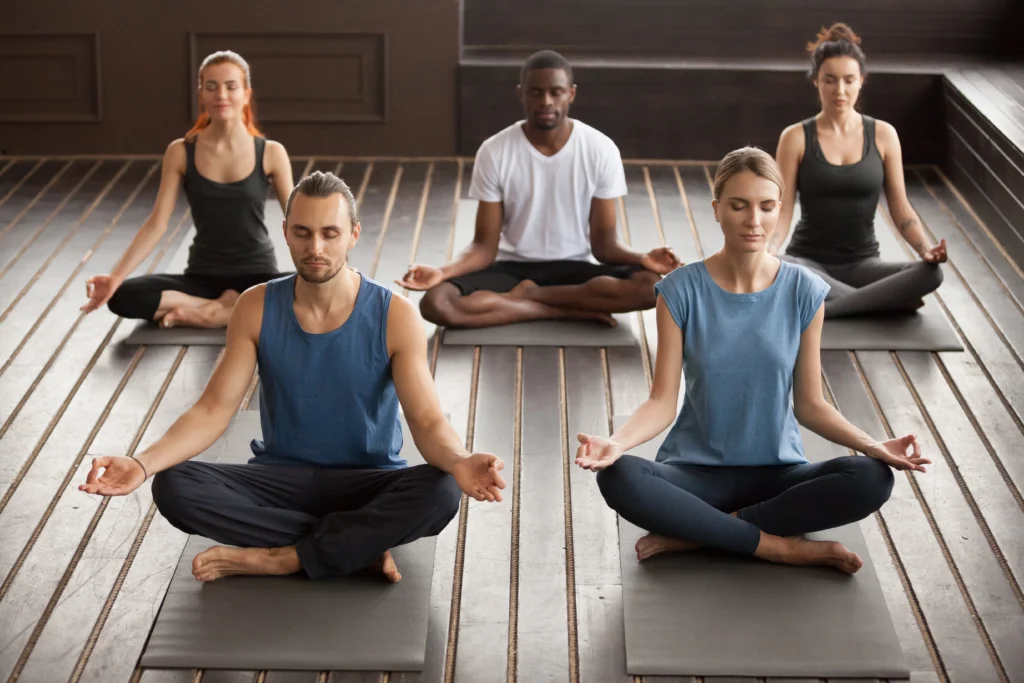
Meditation is part of every day. You try mindfulness, Vipassana, So-Ham, walking and Kundalini meditation. Over 21 days, you build a habit you can keep at home. Our meditation page explains the basics.
2. A Stronger Body
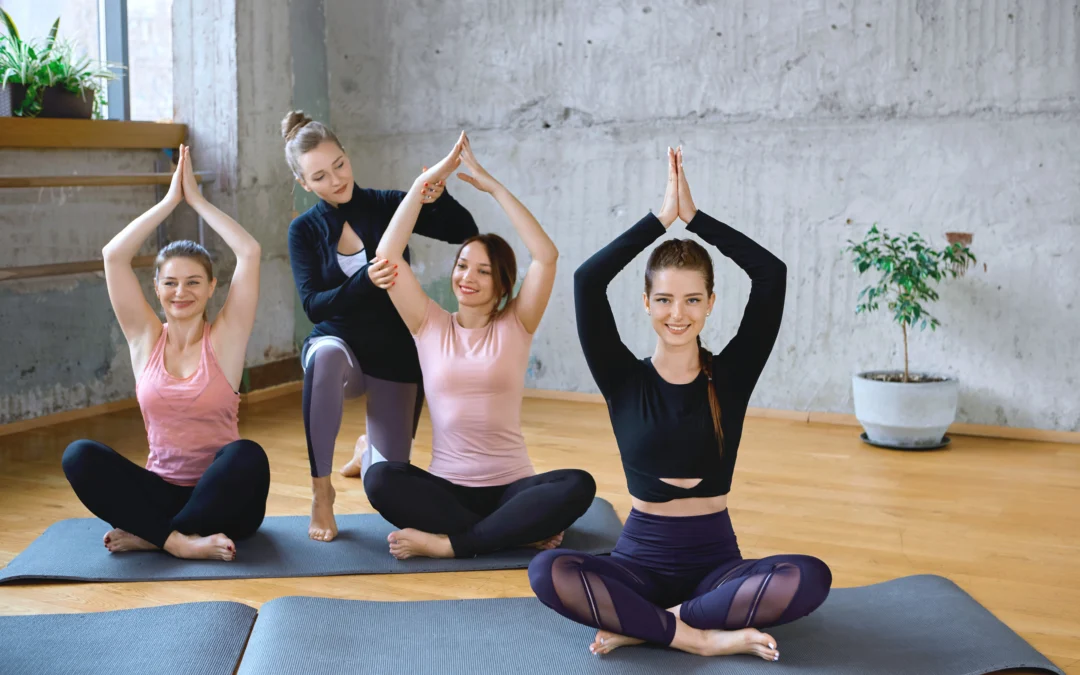
In yoga teacher training in Kathmandu, you practise about 7 hours a day with our teachers. Classes cover Hatha yoga and Ashtanga Vinyasa, with plenty of time for alignment. Beginners are welcome, and your teachers adjust poses to your body.
3. A Deeper Spirit
You study the Yoga Sutras of Patanjali, the eight limbs and the chakras. You also learn mantra chanting, including the Gayatri Mantra, and finish the day with deep relaxation through yoga nidra.
4. Real Teaching Skills
Every trainee completes at least 10 hours of supervised teaching practice. You learn to plan a class, give clear cues and handle feedback. Our post on the teaching practicum in yoga training goes deeper once it goes live.
Our founder, Dr. Prakash Acharya, holds a master’s degree in yoga and a PhD in meditation, and you can meet the full team on our teachers page.
5. A Cleaner Lifestyle
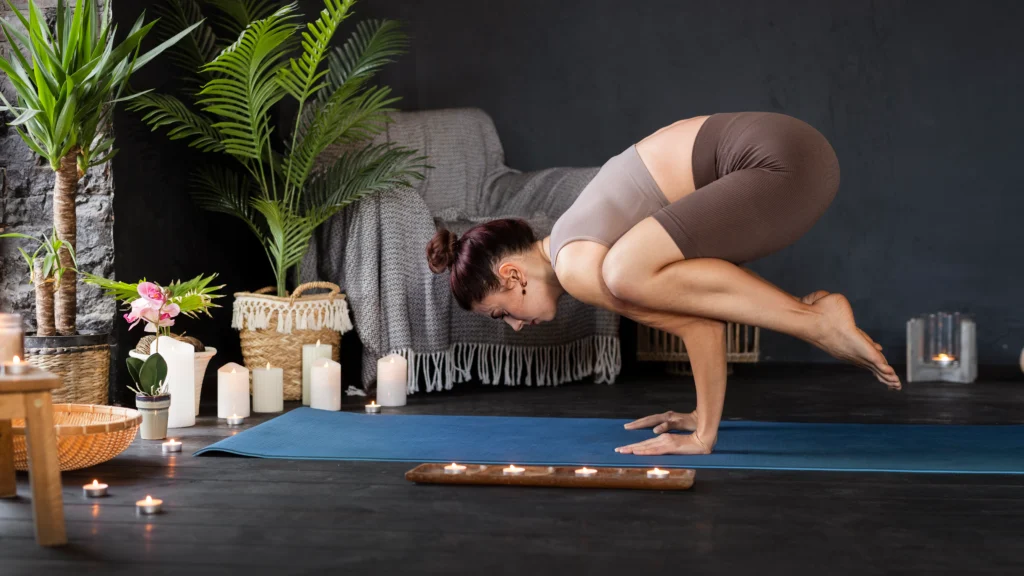
You learn the six yogic cleansing practices, called shat kriyas, and how to do them safely. You eat three vegetarian meals a day and drink herbal tea. Want to go further later? Try our yoga detox retreat or the 2-week Ayurveda and yoga detox.
6. A Global Community
Students from about 80 countries have trained with us through yoga teacher training in Kathmandu. Each week brings outings such as hiking, karma yoga, a town visit and Nepali language coaching. You can meet past trainees on our YTTC students page and read their words on our testimonials page.
7. A Certificate That Travels
Our 200-hour course is Yoga Alliance certified, and we are registered with the Yoga Alliance International Registry. Studios and retreat centres around the world recognise this kind of certificate.
Your Day During the 21-Day Training
This is a sample timetable from our 200-hour course. It may change with the subject and the season.
| Time |
Session |
| 7:00 am |
Hatha yoga flow |
| 8:15 am |
Hatha textbook, detox and teaching practice |
| 11:00 am |
Relaxation, chanting or anatomy |
| 12:15 pm |
Ashtanga Vinyasa flow |
| 3:30 pm |
Meditation and breathing |
| 4:30 pm |
Alignment and yoga flow |
| 6:00 pm |
Meditation and philosophy |
| 9:00 pm |
Silence |
Breakfast, lunch and dinner fit between these sessions.
What You Will Study?
Our syllabus has nine parts:
- Yoga asanas
- Meditation
- Pranayama, bandha and mudra
- Mantra chanting and yogic relaxation
- Yoga philosophy
- Anatomy, physiology and lifestyle
- Yogic detoxification
- Teaching practice
- Extra activities and outings
Course Snapshot
| Detail |
What to know |
| Course |
200-hour yoga teacher training |
| Length |
21 days |
| Start dates |
The 1st of every month, ending on the 21st |
| Styles |
Hatha, Ashtanga and more |
| Included |
Classes, accommodation, three vegetarian meals, books and a shared mat |
| Price |
From 1,400 USD in a standard shared room |
Flights, visa fees, laundry, airport pickup and sightseeing are not included.
Which Training Level Fits You?
Different goals need different programmes. Here are the main options for yoga teacher training in Kathmandu at our school:
We also offer 200-hour Kundalini training, seniors yoga training, children yoga training and prenatal yoga training. Prefer to learn from home? Look at our 200-hour online yoga training.
5 Tips for Choosing a School
- Research the lead teacher: Ask about their personal practice and teaching background.
- Do not treat registration as proof of quality: Yoga Alliance registration shows a school meets a minimum standard and lets you read its curriculum.
- Ask about class size: Smaller groups mean more personal attention.
- Ask about assessment and practice teaching: A good school gives you supervised practice and honest feedback.
- Talk to the school directly: Avoid third-party agents, and ask for alumni to speak with.
We are happy to answer all five. See our services and facilities page for rooms and meals.
Best Time to Join
Spring (March to May) and autumn (September to November) bring clear skies and mild days.
Our training runs every month, so you can also join in winter or in the monsoon, when classes continue indoors or under cover. Choose the month that fits your work and travel plans.
What to Bring
Pack comfortable clothes for practice, a warm layer for cool mornings, a journal and any personal medicine. We provide a shared mat. If you want to take a mat home, bring your own.
Start Your Yoga Teacher Training in Kathmandu With Us
Ready to take the next step? Read our FAQ, contact us with any question, and book your training when you feel ready. If you want a short taste first, try a one-week yoga retreat class or our one-month yoga retreat.
Frequently Asked Questions
Can I register with Yoga Alliance after the course?
Yes, after a Yoga Alliance certified course you can apply to register as a teacher. Yoga Alliance sets its own fees and steps, so check its website for the latest rules.
What if my plans change before the training starts?
Your booking is fully refundable or reschedulable before the course begins. After it starts, payments are non-refundable, but we stay flexible in an emergency.
Do I need a visa for Nepal?
Most visitors need a tourist visa, and the fee is not part of the course price. Please check the current rules with Nepal’s immigration office before you travel.
Is airport pickup included?
Pickup and drop service is not included in the fee. Ask our team about your arrival details and we will guide you.
Can I join if I have never practised yoga?
Yes, beginners can join and many students start with no experience. Our teachers give extra attention to new students in asana and alignment.
by Nepal Yoga Home | Oct 9, 2026 | Yoga, Yoga School, yoga training and yoga courses
Most of the yoga centres hear this question often: “How often should you practise yoga as a beginner?” Three days a week works well for most people, and it is a good place to start.
New students often worry about doing too little or too much. This guide answers how often you should practise yoga as a beginner with five simple rules.
You will also find a weekly plan, warning signs to watch for and tips to build a habit. If you want expert guidance from day one, our 100-hour beginner course is a good fit.
Short Answer on Frequency of Practice as a Beginner
The short answer to how often you should practise yoga as a beginner looks like this:
- Start with: Three days a week
- Session length: 20 to 30 minutes
- Rest: At least one easy day between harder sessions
- Build up: Add one day or five minutes every three to four weeks
Why Frequency Matters More Than Length?
Your body learns through repetition. When you ask how often you should practise yoga as a beginner, the honest answer is often enough to build skill, but not so often that you feel sore or bored. Muscles, joints and your mind all need time to adjust.
Our teachers see this every month with new students.
How Often Should You Practise Yoga as a Beginner? A Weekly Guide
The right answer to how often you should practise yoga as a beginner depends on your goal. Use this table as a starting point.
| Goal |
Sessions per week |
Length |
| Gentle start, low energy |
2 |
15 to 20 minutes |
| Flexibility and general fitness |
3 |
20 to 30 minutes |
| Stress relief and better sleep |
4 to 5 |
15 to 30 minutes |
| Building strength |
3 to 4 |
30 to 45 minutes |
| A daily habit |
5 to 7 (mostly gentle) |
10 to 15 minutes |
These ranges are general. Adjust them to how your body feels.
5 Simple Rules to Follow
These five rules give you a clear answer to how often you should practise yoga as a beginner.
1. Start with three days a week
Three sessions give your body time to learn the poses and recover in between. Try Monday, Wednesday and Saturday. If three feels like a lot, begin with two and add the third next week.
2. Keep each session short
Twenty to thirty minutes is plenty at the start. A short class you finish beats a long one you skip. Our beginner classes stay simple for this reason.
3. Take rest days
Muscles get stronger while you rest, not while you stretch. Leave at least one day between harder sessions. On rest days, take a walk or sit for a few minutes of meditation.
4. Add time slowly
Increase by five minutes or one extra day every three to four weeks, never both at once. This slow pace protects your wrists, knees and lower back.
5. Match the style to your day
Feeling tired? Choose gentle stretching. Full of energy? Try something stronger, such as our power yoga workshop.
A 4-Week Starter Plan
Here is a simple plan that puts the answer to how often should you practise yoga as a beginner into action.
| Week |
Days |
Minutes per session |
| 1 |
2 |
20 |
| 2 |
3 |
20 |
| 3 |
3 |
25 |
| 4 |
3 to 4 |
30 |
After week four, keep three or four days and slowly make your sessions longer.
Signs You Are Doing Too Much or Too Little
Watch for these signs to check whether your answer to how often should you practise yoga as a beginner is working.
Too much:
- Sore joints that last more than two days
- Constant tiredness
- Dreading your next session
- Sharp pain during any pose
Too little:
- You forget the poses between sessions
- You see no change after a month
- Stiffness comes back within a day or two
Best Time of Day
Morning practice wakes you up and helps you build a routine. Evening practice melts away stress and can help you sleep.
Pick the slot you can keep, because consistency matters more than the clock. If your schedule changes often, our online yoga classes let you practise at any hour.
5 Tips to Build the Habit
Here are five simple habits that you can adopt as a beginner for yoga practise:
- Pick fixed days and write them in your calendar.
- Leave your mat unrolled where you can see it.
- Follow a class instead of guessing. Try our 5-hour basic online yoga class to get started.
- Tick off each session on a paper calendar.
- Book a yoga at home session if you want a teacher to guide you in your own space.
Who Should Be Careful
See your doctor first if you have an injury, high blood pressure, a chronic condition or you are pregnant. Tell your teacher about it before class starts. Gentler options exist, such as our therapeutic yoga retreat and chair yoga for seniors.
Want to Learn Faster?
A short stay can speed up your progress, because you practise daily with a teacher beside you. Try a one night, two days retreat, a one-week yoga class in Nepal or a 10-day rejuvenating yoga retreat. You can also check our services and facilities before you plan your visit.
Final Thoughts
So, how often should you practise yoga as a beginner? Start with three short sessions a week, rest well and grow slowly. Remember that the answer to how often should you practise yoga as a beginner changes as your body gets stronger.
Read what our students say, then contact us with questions or book your class today.
Frequently Asked Questions
How often should you practise yoga as a beginner to see results?
Three sessions a week usually bring small changes in flexibility and mood within a month. Results vary, so stay patient and keep your practise steady.
Is it okay to practise yoga every day?
Yes, as long as most days stay gentle and short. Keep one lighter day each week and listen to your body.
How long should a beginner yoga session last?
Twenty to thirty minutes works well for most beginners. On busy days, even ten minutes still counts.
Can I practise yoga on back-to-back days?
Yes, if you vary the intensity. Follow a strong class with a gentle one so your muscles can recover.
Do I need a teacher at the start?
A teacher is not required, but one helps you avoid common mistakes. Our beginner course gives you that support, and you can read more answers on our FAQ page.
by Nepal Yoga Home | Aug 26, 2026 | Yoga School
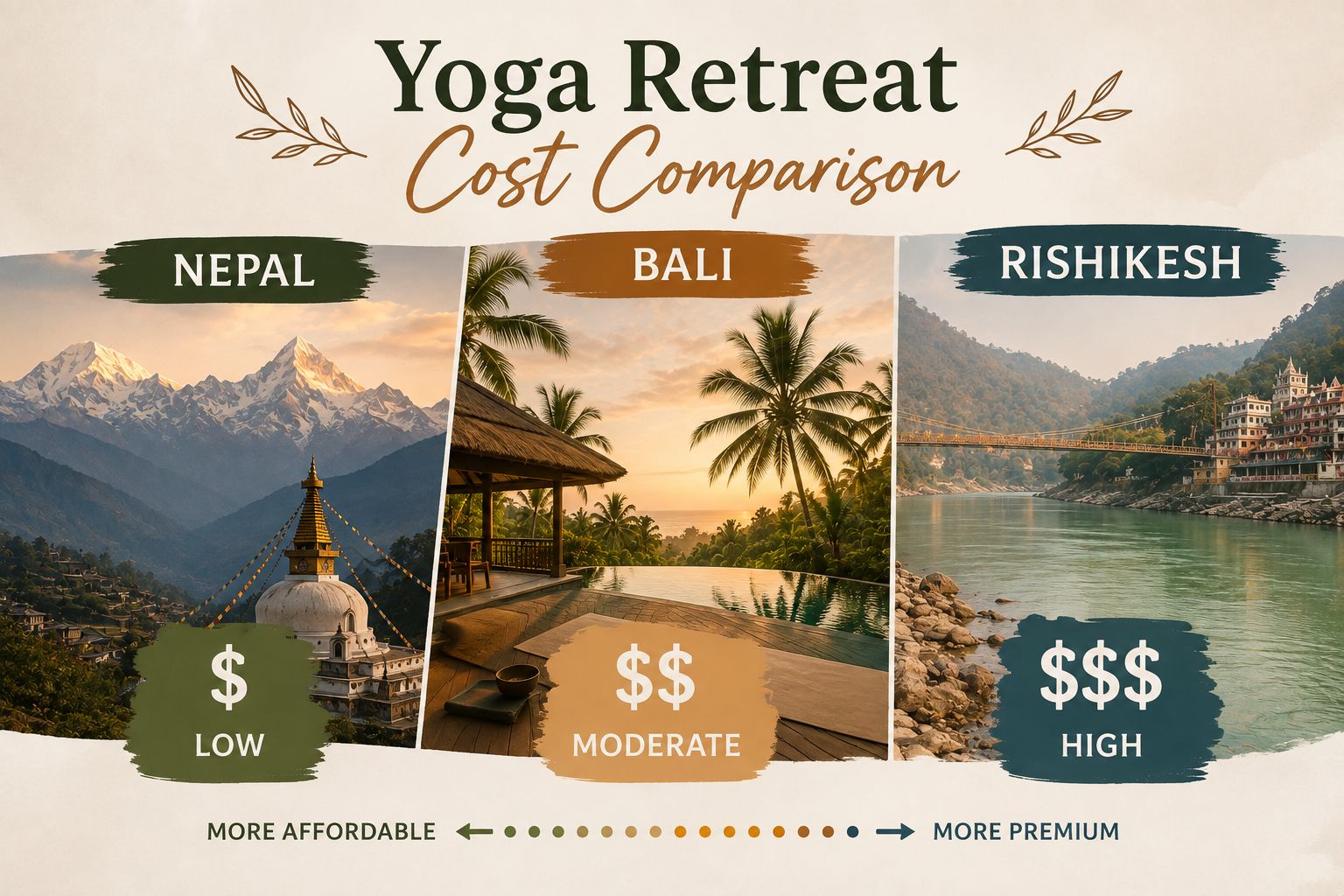
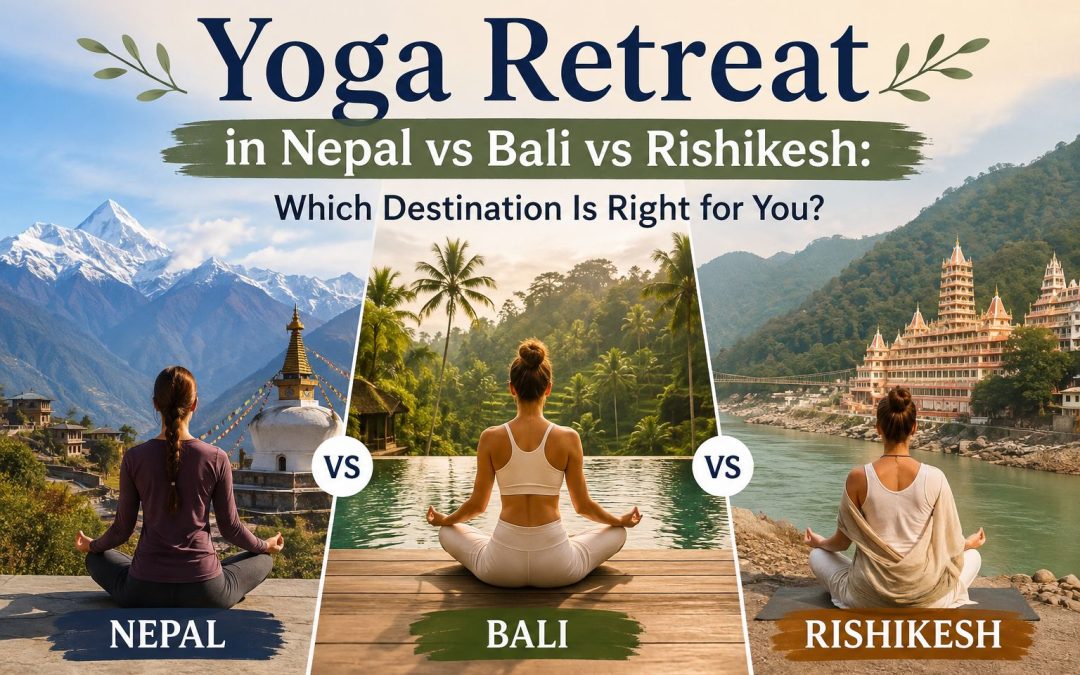
If you’ve spent an evening comparing a yoga retreat in Nepal vs Bali vs Rishikesh, you know how quickly it turns into a mess.
One review tells you Bali is overrated. The next says Rishikesh changed someone’s life. A third swears by a tiny school in Kathmandu you’ve never heard of.
All three destinations are amazing, and thousands of certified teachers have come out of each one, but they are not interchangeable once you look past the photos.
This guide provides detailed information about what each place actually costs, what your mornings will look like and which type of traveler tends to leave each one happiest.
Nepal vs Bali vs Rishikesh at a Glance
Costs and class sizes don’t mean much in isolation. Understand the ground each destination stands on first, then the numbers make a lot more sense.
1. Nepal: Himalayan, Understated and Community-Focused
Yoga schools in Nepal cluster mostly around the Kathmandu Valley or the lakeside town of Pokhara. Practice often happens at altitude, sometimes with a Himalayan peak framed right behind your mat.
The centres running these programmes tend to feel more like someone’s home than a business, and that difference is usually obvious within a day or two of arriving.
2. Bali: Polished, Social and Built for Comfort
Head to Bali and you’ll probably end up in Ubud, the town where Bali’s yoga reputation was really built. Art galleries, juice bars, and studios line up one after another, and the scene has only grown since Eat, Pray, Love put Ubud on the map.
Rice paddy views and five-star shalas are easy to find here. If Ubud feels too crowded, Canggu offers a surfier, trendier version of the same scene.
3. Rishikesh: Raw, Spiritual and Intense
Rishikesh has carried the nickname “Yoga Capital of the World” since the Beatles studied meditation there in 1968. It’s beside the Ganges, and the evening Ganga Aarti ceremony after a day of practice is something most travelers don’t forget.
Quick Comparison Table: Yoga Retreat in Nepal vs Bali vs Rishikesh
Here’s a detailed table that helps you understand yoga retreat in Nepal vs Bali vs Rishikesh:
| What’s being compared |
Nepal |
Bali |
Rishikesh |
| 7-day retreat cost |
A week in Nepal usually costs $300 to $700, with meals and lodging fully included. |
A comparable week in Bali often runs $500 to $1,500, and meals aren’t always bundled in. |
Rishikesh stays cheapest overall, with a full week sometimes available for around $200. |
| 200-hour YTT cost |
A complete 200-hour teacher training in Nepal typically costs $800 to $1,500 with everything covered. |
The same certification in Bali often runs $2,000 to $4,000, frequently excluding food and lodging. |
Some Rishikesh ashrams offer full 200-hour training for close to $1,000, the lowest of the three. |
| Visa process |
A visa on arrival costs $30 to $50, and no paperwork is needed beforehand. |
Bali grants a free 30-day visa on arrival, though longer stays require extra paperwork later. |
India requires an e-visa arranged in advance, usually taking three to five working days. |
| Typical class size |
Nepali schools generally keep groups between eight and fifteen students, allowing for closer instructor attention. |
Larger Bali studios can run fifteen to thirty students per class during busy season. |
Popular Rishikesh ashrams sometimes place twenty to forty students in a single batch. |
| Everyday comfort |
Electricity stays reliable across most of the Kathmandu Valley, and hot water is standard at nearly every school. |
Bali offers dependable power and widespread air conditioning, plus easy access to Western comforts. |
Power cuts happen often in Rishikesh, and air conditioning remains rare across most of the town. |
| Food and lifestyle |
Local meals cost $2 to $5 a plate, with both vegetarian and meat options easy to find nearby. |
Meal options range from cheap warungs to pricier Western cafes, and alcohol is sold almost everywhere. |
The entire town stays alcohol and meat free, keeping the focus squarely on yogic lifestyle. |
| Best suited for |
Budget-conscious beginners who also want to trek in the Himalayas usually pick Nepal. |
Travelers who want resort-level comfort and a strong digital nomad scene usually pick Bali. |
Long-stay purists who value tradition over comfort usually pick Rishikesh. |
What the Numbers Actually Mean?
Nepal ranks in the middle on price, but the value goes further than the number alone suggests. $800 to $1,500 buys a private room and daily meals there, not a shared dorm bed.
Rishikesh looks cheapest on paper but that price comes bundled with unreliable power and a dry town.
Bali costs the most by a wide margin, and scooter rental plus Western cafe prices only stretch that gap wider once you’re actually on the ground.
What a Yoga Retreat Actually Costs You in Each Country?
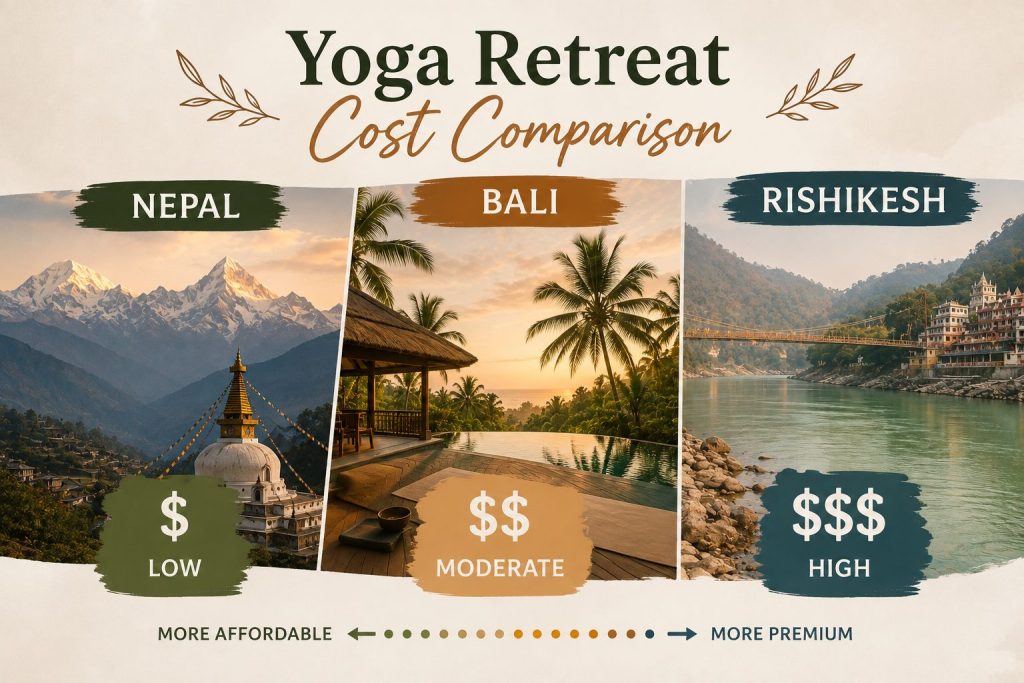
Here’s what a yoga retreat actually costs you per day:
1. Nepal: Where Your Money Is Most Valuable
A week in Nepal costs $300 to $700, and a full 200-hour teacher training lands between $800 and $1,500. Nepal Yoga Home’s 200 Hours Yoga Teacher Training offers accommodation, meals and daily classes already built into the price.
A few things tend to catch first-time visitors off guard when they start budgeting:
- A 30-day visa costs around $50, paid in cash at the airport, with no paperwork required beforehand.
- Food outside the programme runs $2 to $5 a plate, so even a day barely exceeds the budget.
- A full month of local transport, if it’s even needed, rarely climbs above $40.
2. Bali: Comfort Carries a Real Price Tag
A week in Bali costs $500 to $1,500, and a full YTT often runs $2,000 to $4,000, frequently without meals or accommodation included. Ubud studios really are beautiful and that polish is exactly what pushes the price up.
The visa stays free for the first 30 days, which softens things slightly. Scooter rental, Western cafe prices and Ubud’s general cost of living catch up with most budgets fast.
3. Rishikesh: The Cheapest Option
A week in Rishikesh can cost as little as $200 and some ashrams run full 200-hour trainings for around $1,000. Thali meals cost a couple of dollars each, so daily spending stays low throughout the stay.
The catch shows up before the trip even starts. An Indian e-visa has to be arranged in advance and can take several days to process, so last-minute bookings rarely work here.
Scenery and Setting: What You’ll Wake Up To
Mood shifts more here than almost anywhere else on this list.
1. Waking Up in Nepal
Forested hills, prayer flags moving in the wind and on a clear morning in Pokhara, Machhapuchhre reflected across Phewa Lake. Quiet settles in fast, without much effort required to slow down.
Travelers drawn to mountains and forest trails will find that Nepal Yoga Home’s Yoga Retreat programmes lean fully into that Himalayan setting.
2. Waking Up in Bali
Humidity, birdsong and rice terraces stepping down toward the valley floor greet most mornings in Ubud. Shalas here are often open-air, so practice happens with a breeze moving through bamboo walls.
3. Waking Up in Rishikesh
The Ganges announces itself before it’s even visible. Temple bells ring through town well before sunrise, and the Aarti ceremony along the riverbank each evening tends to stay with people long after the trip ends.
Authenticity and Lineage: Who Is Actually Teaching You?
Not all yoga instruction carries equal weight. It’s worth asking who trained your teacher before you book anything.
Nepal and Rishikesh both has genuinely old yogic traditions, where Hatha, Ashtanga and Kundalini styles pass down through instructors trained under their own teachers.
Bali’s scene grew mostly out of the global wellness boom of the last twenty years, which makes it younger and shaped more by market demand than lineage.
How Nepal Yoga Home Approaches Tradition?
Training at Nepal Yoga Home runs under the direct guidance of Yoga Guru Dr. Prakash Acharya, the school’s founder, covering Hatha, Ashtanga, Iyengar, and Kundalini inside one multi-style curriculum. That matters if depth counts for more to you than decor.
Crowds and Commercialization: How Much Space Is There?
-
Rishikesh: Crowded and Still Growing
Laxman Jhula and Tapovan have turned into one long strip of yoga shops, smoothie bars, and competing ashrams over the past decade. Elbow room isn’t really on offer here anymore.
-
Bali: Trendy but Increasingly Busy
Ubud started as a quiet artist town. These days it’s packed with co-working cafes and studios competing for attention online, and Canggu has absorbed a good chunk of the overflow crowd chasing something newer.
Kathmandu’s schools have mostly stayed out of that race. Family-run centres with eight to fifteen students per class remain the norm rather than the exception.
This is one of the clearer reasons Nepal keeps coming up favorably in the yoga retreat in Nepal vs Bali vs Rishikesh conversation.
Visa and Travel Logistics to Plan Around
A few practical points worth sorting before booking flights:
- Nepal offers a visa on arrival at Tribhuvan International Airport, no advance paperwork, costing $30 for 15 days or $50 for 30 days.
- Bali grants a free visa on arrival for the first 30 days, with extensions available but increasingly bureaucratic.
- Rishikesh, India requires an e-visa before departure, usually taking three to five working days to process.
Anyone booking a trip on short notice will find Nepal and Bali far more forgiving than India.
Which Destination Actually Fits You: Yoga Retreat in Nepal vs Bali vs Rishikesh?
If Price Is Your Deciding Factor
Rishikesh wins here, as long as power cuts and a completely dry town aren’t dealbreakers for you.
If Comfort Is Your Priority
Bali delivers that experience well, and the price reflects it.
If Balance Matters Most
Nepal is usually the answer if you want mountains, small groups, real tradition and a price that leaves room for the rest of your trip. Most first-time visitors land here once they’ve weighed everything else.
Why Consider Nepal Yoga Home Specifically?

If Nepal is starting to look like the right call, here’s why you should choose us:
1. A School With Fifteen Years Behind It
Nepal Yoga Home has run teacher training and retreat programmes out of Kathmandu for more than fifteen years, with over ten thousand students from roughly eighty countries passing through its doors.
Our school is near Nagarjun Hill, away from city noise, and classes stay deliberately small so nobody gets lost in a crowd of thirty strangers.
2. Certified Courses Across Every Level
Every course runs under Yoga Alliance USA certification. That includes the 200 Hours Yoga Teacher Training for those just starting out and the 500 Hours Advanced Yoga Teacher Training for those going further, both taught across Hatha, Ashtanga, Iyengar, and Kundalini styles.
3. Retreats, Extensions and Himalayan Treks
For anyone wanting more than a single course, the 1 Month Yoga Retreat in Kathmandu blends asana, pranayama, meditation, and yogic philosophy into a longer stay.
Pairing practice with mountain trekking, something neither Bali nor Rishikesh really offers, is also possible through the Everest Base Camp Yoga Trek or the Annapurna Yoga Trek.
4. Food and Community
Meals are home-cooked, vegetarian, and made fresh daily as part of the school’s ashram-style routine.
Past students bring up the food and the family atmosphere again and again in their reviews, which are worth reading in full on the testimonials page. It’s usually the detail people remember longest after the trip ends.
Conclusion
There’s no single right answer to the yoga retreat in Nepal vs Bali vs Rishikesh question, since each place genuinely rewards a different kind of traveler. A cheap ashram bed in Rishikesh and a private villa in Ubud are solving completely different problems, and neither is wrong.
If a decision still feels hard after all this, ask what you’d regret skipping more: the mountain views, the comfort, or the lowest possible price tag. That question tends to answer itself faster than any comparison chart, and for a lot of travelers, the honest answer ends up being Nepal.
Frequently Asked Questions
Is Nepal cheaper than Bali for yoga teacher training?
Yes. A 200-hour YTT in Nepal typically costs $800 to $1,500, while the same course in Bali often runs $2,000 to $4,000 and sometimes leaves out meals and lodging entirely.
Is Rishikesh or Nepal better for beginners?
Both work fine for beginners, though the day-to-day experience feels quite different. Nepal tends toward smaller classes and a gentler pace, while Rishikesh has deeper infrastructure built over decades, along with bigger crowds and fewer comforts.
How many days should a yoga retreat in Nepal be?
That comes down to schedule and goals more than anything else. Nepal Yoga Home runs everything from a single overnight package up to a full one-month retreat, covering both short breaks and longer immersions.
Can trekking be combined with a yoga retreat in Nepal?
Yes, and it’s one of Nepal’s clearer advantages over the other two destinations. The Everest Base Camp Yoga Trek and Annapurna Yoga Trek both weave daily practice into multi-day mountain hikes.
Is Nepal Yoga Home Yoga Alliance certified?
Yes, the school is registered under Yoga Alliance USA for both its 200-hour and 500-hour courses. Full certification details are on the FAQ page or through the About Us section.

by Tirtha Acharya | Mar 26, 2021 | Yoga School
Best Yoga School in Kathmandu
Nepal Yoga Home is considered to be the best yoga school in Kathmandu, Nepal. It is a perfect yoga center for yoga teacher training, yoga retreat, and Ayurvedic courses. Many people from all over the world have got benefits of yoga here. It has a Wonderful history of the field. It is solely dedicated to spreading the holy yoga throughout the world and enhance the health situation and spiritual awakening of the people. It is the most successful and best yoga school in Kathmandu to share the yogic knowledge to the people of the world. As the school has been providing spiritual knowledge and yogic practice for a long time

The main reasons why Nepal Yoga Home is the best yoga school in Kathmandu
- Nepal Yoga Home is only one “500-hour certified” yoga school in Nepal to be registered in US yoga alliance.
- It has an amazing team of highly experienced teachers. Each teacher is an expert in his field.
- Though it is in the capital city, you will find peace, greenery, and natural beauty since it is located next to the forest (Sivapuri-Nagarjuna Park), at the lap of the mountain.
- Since Nepal Yoga Home and International Airport both situated in Kathmandu, easy and near to reach here from the airport.
- This is only one school that graduates the highest number of students in Kathmandu and in Nepal. People from more than 100 countries come here to get yoga training, retreat, Ayurveda classes, etc.
- It follows the true principle of yoga also maintains the international standard. Many yoga schools in Nepal are good for the people at the local level, but Nepal Yoga Home offers the course for national and international students.

- Being far from your country, and a densely populated place, Kathmandu you will feel here warm hospitality as in family. You will get the members of this yoga school as your family members and close friends.
- Nepal Yoga Home has its own building. All the rooms have air-conditioning. It has a big rooftop with an amazing view of the Himalayas, Jungle, Kathmandu city, and village. It has a beautiful garden, open grassy space where you can pleasantly enjoy your free time, that is another reason why it is the best yoga school in Kathmandu.
- Comparing to the quality, of course, accommodation, food and hospitality, the cost is very reasonable. Maybe this is the most affordable school in Nepal along with the best possible facilities for an international student.
- Nepal Yoga Home runs the classes throughout the year. Yoga teacher training course is conducted on 1stof every month.
- Nepal Yoga Home is the one and only one school which includes yoga in its holistic approach including yoga posture, meditation, breathing, philosophy, chanting, detox, Anatomy, and all the branches of yoga. There are different teachers to teach the varieties of yoga so it is consider as the best yoga school in kathmandu.
- This yoga school provides not only a specific or limited range of yoga but it has effective courses on verities sectors such as
You will get a long experienced teacher for each of the courses.
Spiritual guidelines and practices you get here will be proved to be most valuable in your life. The knowledge you learn from here guides you in every step of your life. Physical health, mental peace, and spiritual awakening are the basic aspect of the classes. It is really a great opportunity to get such courses with learned teachers, in a naturally beautiful environment with a deeper practice to achieve the true essence of spirituality and yoga.
So, if you are searching for the best yoga school in Kathmandu, keep Nepal Yoga Home in your mind without any doubt and sign up here for YTT, retreat, and Ayurveda courses.

by Tirtha Acharya | Jan 2, 2021 | Yoga School
Why to choose Yoga Alliance RYS (Register Yoga School) for yoga coaching?
How much are you into looking for a yoga teacher training program which provides you the best coaching so that you could become a quality teacher in future? Are you searching for the best teacher training program that helps you to teach yoga all over the globe? You do not have to look further, Nepal Yoga Home, a register yoga school provides the best module for yoga coaching program. The yoga program is the best and suits you with your schedule which likewise, helps you to get the chance for education , empowerment and self-development in a similar pattern.
In addition to In-school yoga teaching training, adopting to the technology online yoga training is the core practice of the Nepal Yoga Home. The classes are easily accessible through the ZOOM at the morning as well as in the evening time. Likewise, the training provides an opportunity to meet with your favourite yoga teacher in the one to one mentoring sessions.
Perquisites of choosing Yoga Alliance RYS for yoga coaching
- You will be a qualified coach to run classes all over the world.
- Certificates are provided as perquisite of learning yoga.
- You will be part of the bigger alliance by enrolling to the Yoga Alliance RYS ( Register Yoga School) for yoga coaching.
- You will be healthy and hearty by joining the yoga class.
- You will be able to deepen the asana and meditation poses.
- You will be able to cleanse your chakras and levitate to the higher energy state.
- You will be the part of the bigger group that means you will have larger family members.
- You will be able to synchronize your energy to the positive direction and lead a blissful life ahead.
- RYS is a global standard yoga teaching course which allows you to be the world-wide standard yoga teacher to teach the course.
- The credentialed and trust of your teaching increases as the course is globally recognized (all over the world).
- The person coming out of the register yoga school ( RYS) course are more experts, furthermore, they are part of globally certified alliance.
- Likewise, you are able to join the universal teacher community by making your profile stronger.
- You will be able to share the art of living with others.
- Though you will learn in a group, nevertheless, you will have a chance to learn at your own pace without competing with any person.
Nepal Yoga Home a sweet abode for Yoga Alliance Register Training (RYT) course
The yoga coaching program offered by the Nepal Yoga Home allows you to engage with various individuals in a comprehensive way. The modules are adoptive and are highly flexible to commit to your training pathway, which ultimately fits with your needs. The combination of the online class with the one to one mentor session provides a unique opportunity to help to grow at your own pace and achieve your dreams.
Nepal Yoga Home (Register Yoga School) provides 3 types of classes which is registered with yoga alliance. Nepal yoga home is registered yoga school (RYS). The Yoga school provides ranges of courses including:
The Yoga coaching are a chance to participate in an extensive arrangement of restorative yoga intended to illuminate, prepare and rouse our understudies while offering a groundbreaking encounter which surpasses the business standard and least necessities set by Yoga Alliance. The program features the proof based examination supporting Yoga and explains the significant job this incredible treatment plays in living admirably, medical services today and the continuum of care (CAM).
The yoga treatment segments of this preparation depend on our forte preparing in the helpful use of yoga, the utilization of yoga as a complimentary medication, contextual investigation assistance, and patient consideration isn’t gotten from our status as a RYS with Yoga Alliance Registry. To ask about the virtual module preparing program design, contact underneath.
For more detail visit our website www.nepalyogahome.com

by Tirtha Acharya | Oct 26, 2018 | Yoga School
Nepal Yoga Home: An Academy for Yoga Teacher’s Training | Yoga Academy in Nepal
Nepal Yoga Home is one of the best academics for Yoga Teacher’s Training in Nepal. It is internationally recognized and many people come here from different countries to learn yoga. The academic system of Nepal Yoga Home is in the international standard which has become comfortable for all the students throughout the world to learn yoga. Many students from various countries have been taking part in Yoga Teacher’s Training at Nepal Yoga Home. Normally 200 hours yoga teachers training and 500 hours yoga teachers training are being continued from some years.
The courses complete in 21 days and 30 days respectively. The classes run from the early morning to late evening. Lodging and food facilities are provided in the center. Nepal Yoga Home offers natural and organic food, free from harmful chemicals. It serves vegetarian and vegan food. If anyone desires non-veg food, then it tries to fulfill their demands from other sources. Nepal Yoga Home is franchised with American Yoga Alliance. So students are internationally certified after the completion of the course. People are being benefitted in many ways form Yoga Teacher’s Training.
They learn how to keep self-healthy and alert. It has been observed that yoga learners at Nepal Yoga Home have improved themselves in their personal life as well. Some of the students of Nepal Yoga Home make Yoga Teaching as a profession as they become expert in the course. The Academy for yoga at Nepal Yoga Home is properly and carefully managed in the hygienic environment. The greenery of the forest has increased the beauty of this place. Thus, the mentality of the learner remains always fresh and conscious to learn in the depth. Anyone who learns at Nepal Yoga Home with faith and devotion becomes expert in yoga.