

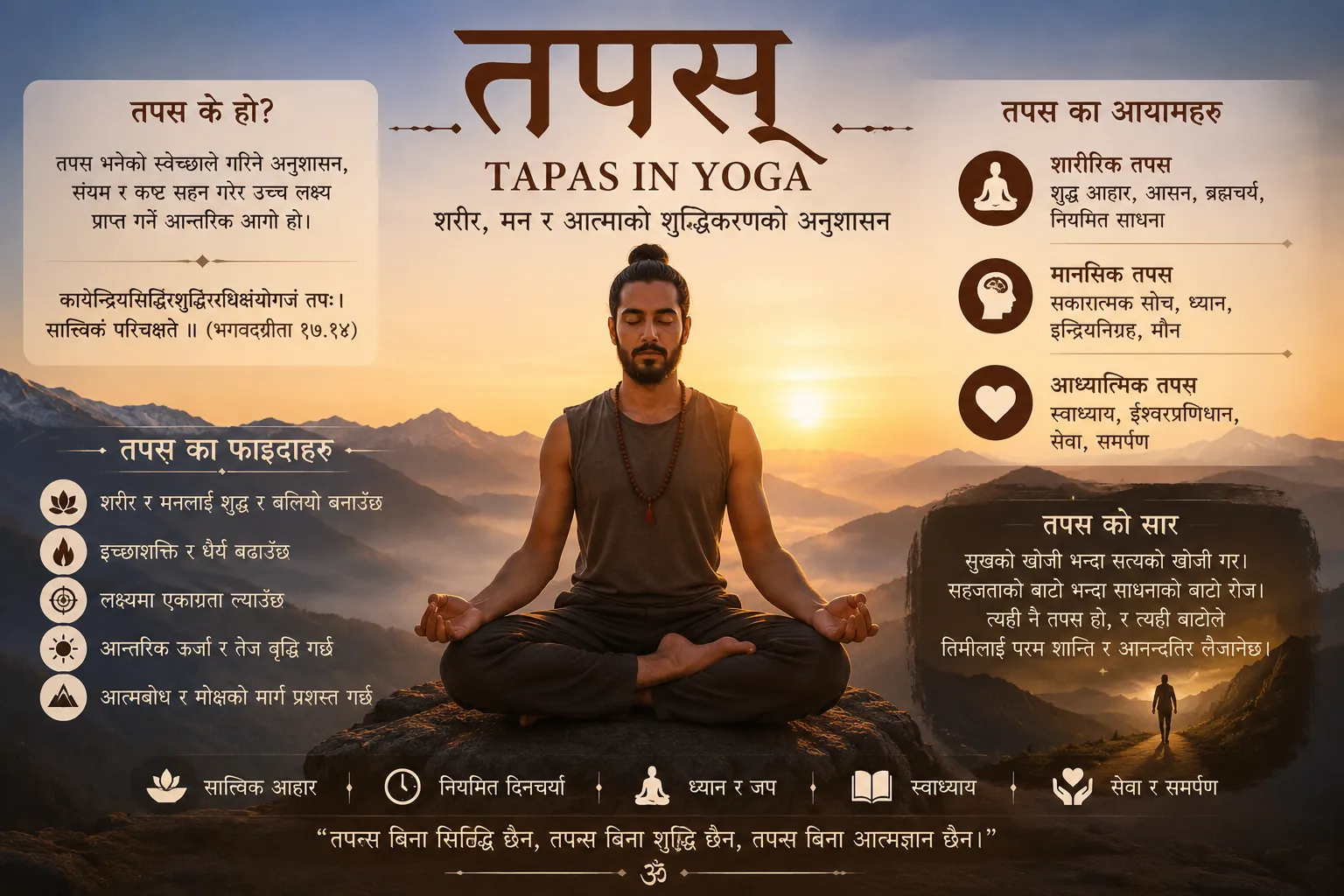
Tapas: Igniting the Inner Fire
“Transformation doesn’t happen in a single moment. It happens through small, consistent actions repeated every day.” This simple truth beautifully describes the yogic principle of Tapas.
In today’s world, life has become easier than ever. Food can be delivered in minutes, entertainment is available 24 hours a day, and technology helps us avoid many physical challenges. Comfort is always within reach, yet many people still feel stressed, distracted, anxious, and disconnected from themselves.
In yoga philosophy, tapas is traditionally translated as austere discipline, spiritual fervor, or fiery commitment. It is the internal fire you ignite when you willingly choose a difficult but necessary path over an easy, comfortable one.
Yoga offers a different perspective. It teaches that lasting happiness comes not from constant comfort but from developing inner strength, self-awareness, and balance. One of the most practical teachings in Yoga Philosophy is Tapas, the inner fire of disciplined effort.
Whether you practice Hatha Yoga, Meditation, Pranayama, Yoga Nidra, Ashtanga Yoga, or simply wish to live a healthier and more meaningful life, understanding Tapas can help you create positive and lasting change.
The beautiful part is that Tapas is not only for monks, yogis, or spiritual seekers. It is a practice for everyone—students, parents, professionals, retirees, and anyone who wants to become a better version of themselves.
What Does Tapas Mean?
The Sanskrit word Tapas (तपस्) comes from the root tap, meaning:
- To Heat
- To Burn
- To Shine
This does not refer to physical heat alone. It symbolizes the inner fire that burns away laziness, negative habits, fear, distractions, and ignorance.
Just as gold becomes pure when refined by fire, our character becomes stronger through conscious discipline.
Tapas means choosing what is beneficial instead of what is merely comfortable.
It is waking up for your morning yoga practice even when your bed feels warm.
It is practicing meditation when your mind wants constant distraction.
It is speaking kindly when anger feels easier.
These simple choices gradually transform our lives.
Tapas in Patanjali’s Yoga Sutras
The great sage Patanjali, who organized the classical system of yoga, considered Tapas an essential part of spiritual growth.
In Yoga Sutra 2.32, he writes:
शौचसन्तोषतपःस्वाध्यायेश्वरप्रणिधानानि नियमाः॥
Śauca, Santosha, Tapas, Svādhyāya, and Īśvara Praṇidhāna are the five Niyamas.
The Niyamas are personal observances that help us cultivate a peaceful and balanced life.
They are:
- Saucha (Purity)
- Santosha (Contentment)
- Tapas (Disciplined Effort)
- Svadhyaya (Self-Study)
- Ishvara Pranidhana (Surrender to the Divine)
Patanjali again emphasizes Tapas in Yoga Sutra 2.1:
तपःस्वाध्यायेश्वरप्रणिधानानि क्रियायोगः॥
Tapas, self-study, and surrender to the Divine constitute Kriya Yoga.
This reminds us that yoga is much more than physical postures. It is a way of living with awareness and purpose.
Later, Patanjali beautifully describes the fruit of Tapas:
कायेन्द्रियसिद्धिरशुद्धिक्षयात्तपसः॥ (Yoga Sutra 2.43)
Through Tapas, impurities are reduced and the body and senses become refined.
This “purification” is not only physical. It includes the purification of our thoughts, emotions, habits, and intentions.
A Simple Story About Tapas
There was once a young man who wanted to become a skilled gardener. He planted a seed and expected flowers within a week. When nothing happened, he became disappointed. An elderly gardener smiled and said, “The seed is growing even when you cannot see it. Your job is simply to water it every day.” The young man continued watering the plant with patience. Weeks passed. Then tiny leaves appeared. Months later, beautiful flowers bloomed. The old gardener said, “It was not one day that created the garden. It was your daily care.”
Tapas is exactly like caring for a garden.
Every meditation.
Every yoga class.
Every mindful breath.
Every healthy meal.
Every act of kindness.
These small actions may seem insignificant, but together they create a beautiful life.
Tapas in the Bhagavad Gita
The Bhagavad Gita explains that Tapas is much more than physical discipline.
In Chapter 17, Lord Krishna describes three forms of Tapas.
Physical Tapas
देवद्विजगुरुप्राज्ञपूजनं शौचमार्जवम् ।
ब्रह्मचर्यमहिंसा च शारीरं तप उच्यते ॥ (17.14)
deva-dwija-guru-prājña- pūjanaṁ śhaucham ārjavam
brahmacharyam ahinsā cha śhārīraṁ tapa uchyate
Respecting and caring for the body through cleanliness, moderation, self-control, and non-violence. Tapas is the daily practice of becoming a better human being. It is reflected in how we care for our body, treat others with respect, control our impulses, live honestly, and choose kindness over harm. Rather than extreme austerity, the Bhagavad Gita teaches that real tapas is a disciplined lifestyle that purifies the body and prepares the mind for higher spiritual growth.
Verbal Tapas
अनुद्वेगकरं वाक्यं सत्यं प्रियहितं च यत् ।
स्वाध्यायाभ्यसनं चैव वाङ्मयं तप उच्यते ॥ 17.15॥
anudvega-karaṁ vākyaṁ satyaṁ priya-hitaṁ cha yat
svādhyāyābhyasanaṁ chaiva vāṅ-mayaṁ tapa uchyate
Verbal tapas mean thinking before speaking. It is the discipline of using words that are truthful, gentle, and helpful. Speaking honestly without being hurtful, avoiding gossip and unnecessary criticism, and regularly learning from inspiring wisdom are all forms of tapas. When our speech reflects compassion, sincerity, and self-awareness, it becomes a powerful practice that brings peace to ourselves and those around us.
Speaking words that are truthful, kind, helpful, and peaceful.
Before speaking, we can ask:
- Is it true?
- Is it kind?
- Is it necessary?
Practicing this every day is a powerful form of Tapas.
Mental Tapas
मन: प्रसाद: सौम्यत्वं मौनमात्मविनिग्रह: ।
भावसंशुद्धिरित्येतत्तपो मानसमुच्यते ॥ 17.16॥
manaḥ-prasādaḥ saumyatvaṁ maunam ātma-vinigrahaḥ
bhāva-sanśhuddhir ity etat tapo mānasam uchyate
This verse teaches that the highest form of tapas begins in the mind. It is not about forcing the mind to be silent or suppressing emotions, but about training it to become calm, clear, and pure. It is the daily practice of training the mind to remain peaceful, kind, and disciplined. It means choosing calm over anger, positive thoughts over negativity, mindful silence over constant mental noise, and pure intentions over selfish motives. By practicing mental tapas, we develop emotional resilience, clarity, and inner peace, allowing us to respond to life’s challenges with wisdom rather than reaction.
Krishna teaches that a peaceful and disciplined mind is developed through:
- Calmness
- Compassion
- Positive thinking
- Self-control
- Purity of intention
These qualities create inner peace.
Tapas in Autobiography of a Yogi
In Autobiography of a Yogi, Paramahansa Yogananda illustrates Tapas through the lives of enlightened saints and spiritual masters, whose unwavering discipline and dedication exemplify the transformative power of sincere spiritual practice.
Throughout his own journey, Yogananda demonstrates that Tapas is not a practice of self-denial or harsh austerity, but a joyful commitment to inner growth through perseverance, self-control, humility, and devotion. Under the loving yet disciplined guidance of his guru, Sri Yukteswar, he learned that lasting spiritual transformation is achieved through consistent daily practice rather than occasional enthusiasm.
The book teaches that true Tapas is the willingness to remain steadfast in one’s spiritual path despite challenges, distractions, and personal limitations. When discipline is inspired by love for truth, God, and self-realization, it becomes a source of inner strength, peace, and freedom rather than a burden.
In this way, Yogananda presents Tapas as a lifelong practice that purifies the mind, strengthens the will, and awakens the highest potential within every individual.
Tapas in Hatha Yoga Pradipika
अशेषतापतप्तानां समाश्रयमठो हठः।
अशेषयोगयुक्तानामाधारकमठो हठः॥ 1.10॥
aśeṣa-tāpa-taptānāṁ samāśraya-maṭho haṭhaḥ ।
aśeṣa-yoga-yuktānām ādhāra-kamaṭho haṭhaḥ ॥10॥
The Hatha Yoga Pradipika presents tapas not as harsh austerity but as steadfast, disciplined practice. It teaches that sincere effort, patience, moderation, and unwavering determination purify the body and mind, making Hatha Yoga a refuge from suffering and a firm foundation for higher spiritual realization and self-transformation. (Muktibodhananda, 1985)
Tapas Is Not About Punishment
Many beginners misunderstand Tapas.
They imagine that yoga requires suffering, strict fasting, or pushing the body beyond its limits.
This is not what authentic yoga teaches.
Healthy discipline is balanced and becomes easy over the period of time.
Sometimes Tapas means waking early for meditation.
Sometimes it means taking rest because your body needs recovery.
Real yoga encourages awareness rather than extremes.
Practicing Tapas in Everyday Life
You do not need to change your whole life overnight.
Tapas begins with small decisions.
For example:
- Waking up fifteen minutes earlier.
- Practice daily discipline by making your bed immediately after waking up.
- Practicing five minutes of meditation.
- Attending regular yoga classes.
- Eating fresh and nourishing food.
- Walking instead of always driving.
- Reducing unnecessary screen time.
- Sleeping on time.
- Reading a few pages of an inspiring book.
- Keeping promises you make to yourself.
Each small action strengthens self-confidence.
Eventually discipline becomes natural rather than difficult.
Tapas on the Yoga Mat
Many people think Tapas means attempting advanced yoga poses.
Actually, Tapas is much simpler.
It means:
- Arriving for practice consistently
- Breathing mindfully
- Listening to your body
- Practicing with patience
- Accepting gradual progress
Some days your practice feels easy.
Some days it feels challenging.
Showing up with sincerity on both kinds of days is Tapas.
Practicing Tapas at Nepal Yoga Home
For many students, developing discipline is easier when they learn in a peaceful and supportive environment. At Nepal Yoga Home, participants naturally experience Tapas through the rhythm of daily yogic living.
Whether someone joins a Yoga Teacher Training, a Meditation Retreat, a Singing Bowl Healing Course, a Pranayama Retreat, or a Yoga Retreat in Nepal, the daily schedule encourages consistency without harshness.
Participants usually begin the day early with gentle meditation and breathing practices. Morning Yoga sessions help awaken the body with awareness, while healthy vegetarian meals support physical and mental well-being. Throughout the day, students are encouraged to practice mindfulness, study yoga philosophy, spend time in nature, and observe their thoughts with compassion.
These simple daily routines are practical expressions of Tapas. They are not about perfection. They are about showing up each day with sincerity.
Many participants discover that the peaceful surroundings of Nepal, the Himalayan atmosphere, and the supportive guidance of experienced yoga teachers make it easier to develop healthy habits that can continue long after they return home.
The real purpose is not simply to complete a retreat or a teacher training. It is to cultivate habits that bring more balance, clarity, and kindness into everyday life.
Why Tapas Matters Today
Modern life constantly competes for our attention.
Social media.
Television.
Emails.
Notifications.
Endless distractions.
Tapas helps us regain control of our attention.
Instead of reacting automatically, we begin making conscious choices.
Instead of seeking instant pleasure, we choose long-term well-being.
Instead of living by habit, we begin living with awareness.
This is one of yoga’s greatest gifts.
Small Steps Create Great Change
Many people fail because they try to change everything at once.
Yoga recommends another path.
Start with one small commitment.
Perhaps:
- Ten minutes of yoga each morning
- Five minutes of mindful breathing
- One healthy meal every day
- Gratitude before sleeping
- Reading few pages of a yoga philosophy book
Small daily actions become lifelong habits.
As Patanjali reminds us, transformation happens through steady practice rather than occasional effort.
The Inner Fire That Leads to Freedom
Tapas is much more than discipline. It is the quiet inner strength that helps us live according to our highest values rather than our passing moods.
Patanjali teaches that Tapas purifies the body and mind. The Bhagavad Gita shows that it refines our actions, speech, and thoughts. Autobiography of a Yogi reminds us that sincere spiritual growth blossoms through loving, consistent practice.
You do not need to become a perfect yogi to practice Tapas. You simply need to take one sincere step today.
Every conscious breath.
Every yoga practice.
Every act of patience.
Every healthy choice.
Every moment of mindfulness.
These become the sparks that keep your inner fire alive.
Whether you are beginning your yoga journey or deepening your understanding through a retreat or Yoga Teacher Training at Nepal Yoga Home, remember that Tapas is not about forcing yourself. It is about nurturing the steady flame of awareness, discipline, and compassion.
Over time, that small flame grows brighter. It illuminates your path, strengthens your character, and reveals the peace that yoga has always promised—a peace that comes not from changing the world around you, but from transforming the world within.
When you cultivate your inner fire, you stop being afraid of discomfort. You know that you can handle a tough conversation, a difficult project, a physical challenge, or a period of scarcity. You stop running from the fire and learn to stand in it, knowing it will only make you stronger.
The next time you face a hard choice, a boring task, or a moment of exhaustion, don’t run away. Take a deep breath, smile, and remember: this is the heat. This is tapas. This is where the transformation happens. Turn up the thermostat and let yourself shine.
References
Burgin, T. (2025, 07 19). Yoga Basics. Retrieved from https://www.yogabasics.com/: https://www.yogabasics.com/learn/tapas-yogic-will-power/
Health, K. C. (2025, 01 01). Kripalu. Retrieved from https://kripalu.org/: https://kripalu.org/living-kripalu/playing-fire-power-tapas-help-us-fulfill-our-intentions
MacGregor, K. (2025, 01 20). Yoga Journal. Retrieved from https://www.yogajournal.com/: https://www.yogajournal.com/
Muktibodhananda, S. (1985). Hatha Yoga Pradipika. Bihar: Bihar School of Yoga.
Mukundananda, S. (2024). Bhagavad Gita: The Song of God. New Delhi: Rupa Publication India P.Ltd.
Vivekananda, S. (2024). Patanjali’s Yoga Sutras. New Delhi: Finger Prints.
Yogananda, P. (2023). Autobiography of a Yogi. Kolkata: Yogoda Satsang Society of India